
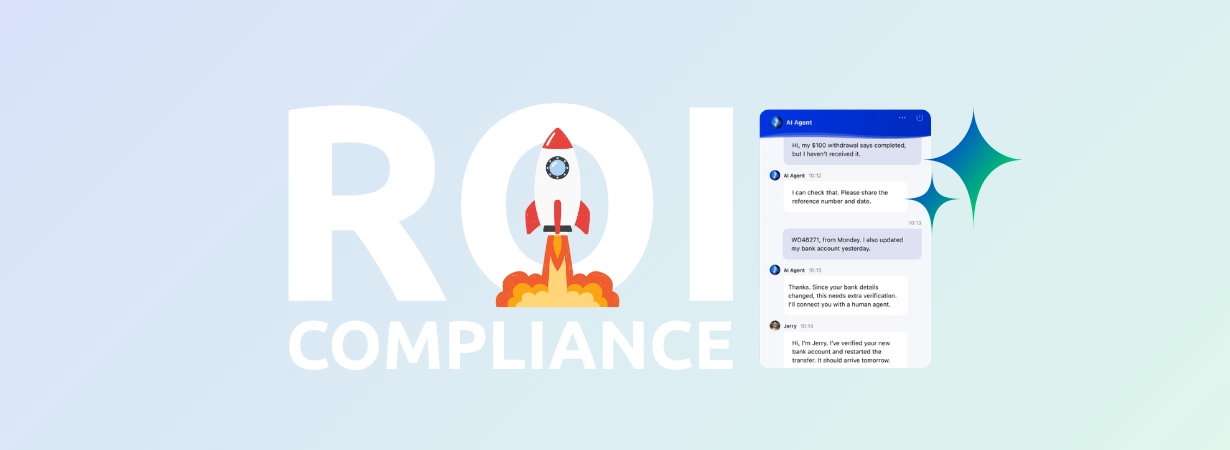
A major football fixture on a Saturday afternoon is a stress test for any operator’s support team. Deposit volumes spike, withdrawal questions flood + Read More about ai-powered support for igaming: maximize roi and compliance
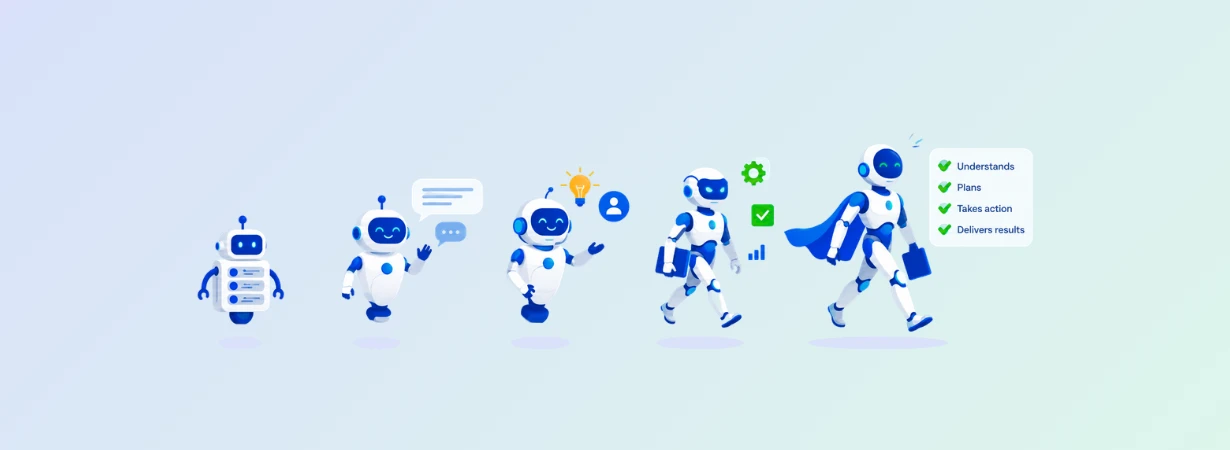
From Chatbots to Agents: What “Agentic” Actually Means in Support
In the customer support realm, “agentic” describes a system that can take action in your business systems to resolve a request, rather than only generating a reply about it.
A chatbot’s job ends when it has produced a response; an agent’s job ends when the request is resolved, which usually means the software has to read a live record, complete a task, or change something in a system of record. The distinction is about what the system can reach and what it is permitted to do when it gets there, not about how well it writes.
Here is why the distinction matters to anyone running a queue. Answer-shaped automation and task-shaped automation deflect completely different work. Answer-shaped automation removes questions.
Task-shaped automation removes whole categories. A team drowning in repetitive queries like “what are your withdrawal limits” or “when is the application deadline” needs the first and will get real relief from it.
A team that’s bogged down with queries like “where is my money” or “why can’t I register” needs the second, and no amount of better writing will help, because those people are not asking for information. They are asking for their payout and their timetable.
Most of the disappointment with customer service automation over the past five years traces back to that mismatch. Teams bought answer-shaped automation for task-shaped queues, measured containment, watched it plateau around a third of volume, and concluded the technology did not work. The technology worked. It was pointed at the wrong half of the queue.
What Does Agentic AI Mean in Customer Service?
Agentic AI in customer service describes a system that can take actions in your business systems to resolve a request, rather than only generating a reply about it. It interprets what the person wants, retrieves the specific information their answer depends on, carries out the steps required to settle the request, and hands over to a human with full context when it cannot.
The word “agentic” points at that capacity to act. A conventional chatbot operates entirely inside the conversation. It receives a message and returns text. An agentic system reaches outside the conversation, into the payment platform, the order or records system, the customer relationship management record, or the calendar, and reads or changes something there before it replies.
Three properties separate agentic systems from AI chatbots in practice:
- It knows which specific account or record the conversation is about. General answers are not enough.
- It can complete at least one task end to end. No person touches it.
- It escalates with the identity, the history, and its own conclusion attached. The human picks up a case rather than starting one.
None of that is a claim about how well the system writes. Language quality is now table stakes across every serious product on the market, which is precisely why demos that test conversation quality have stopped telling buyers anything useful.
The question worth asking is narrower: what can this system reach, and what is it permitted to do when it gets there. If you are surveying the field, our roundup of the best enterprise AI chatbots and the breakdown of 22 types of AI agents used in customer support both sort products on that basis.
How Is an Agentic AI Agent Different from a Conventional Chatbot?
The difference shows up fastest in what each one does with a real query. The table below runs the same five requests past both, using the kinds of contacts that fill support queues across industries as examples.
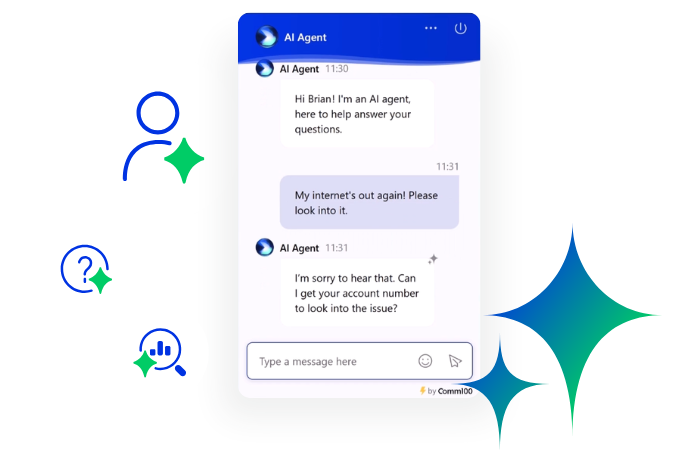
| The Request | A Conventional Chatbot | An Agentic AI Agent |
|---|---|---|
| “My withdrawal hasn’t arrived” | States the published processing times, and the reply is identical for every customer who asks | Identifies the specific withdrawal, reads its live state, and names what is holding it up |
| “Why hasn’t my refund come through?” | Restates the refund policy the customer has already read and disputes | Reads the actual transaction, identifies what is holding the refund, and reports the amount and timing |
| “Have you received my documents?” | Explains the general timeline for processing documents | Reads that person’s record and reports what has arrived, what is outstanding, and what happens next |
| “Why is my account blocked?” | Explains the general policy and how the process normally works | Finds the hold, identifies what placed it there, and either clears it or routes to the right team with the cause stated |
| “I need to move my appointment” | Links out to the booking page | Checks availability, releases the old slot, books the new one, and confirms it |
Generally, the right-hand column is a description of reach rather than intelligence. Every row depends on the system being able to see one specific record and, in three of the five, change something.

The AI Agent Buyer’s Guide
Move beyond conversational demos and compare what AI Agents can actually do. Use a practical framework to evaluate readiness, capabilities, pricing, resolution claims, and the questions to ask each vendor.
Download the ebook noweBook
The Technology That Powers Agentic AI
Understanding what sits behind the conversation makes vendor claims much easier to test, because each layer below fails in a different and recognizable way.
How Does an Agentic AI Agent Understand a Request?
A large language model interprets the intent behind the message rather than matching keywords against a list.
Where the request is ambiguous, a well-built agent asks a clarifying question instead of guessing. The Comm100 AI Agent works this way, recalling session history and asking for clarification where a request is not yet specific enough to act on.
The failure mode at this layer is confident misreading. The system decides which of your topics the message belongs to and commits. A threshold set too loosely sends people down the wrong path fluently, which is one of the oldest entries in any list of chatbot dos and don’ts.
Where Do the Answers Come From?
Grounding is what separates a useful answer from an invented one. Rather than generating from what the underlying model absorbed during training, the Comm100 AI Agent learns from sources you supply, including your website content, knowledge base articles, uploaded documents, and connected cloud directories, then answers from that material.
Two published behaviors matter here:
- Responses are generated only from verified knowledge sources. That is how hallucination is contained.
- Responses are never cached. The agent reads current material rather than replaying an answer that was accurate last quarter.
For regulated businesses and institutions, the practical consequence is that answer accuracy becomes a knowledge management problem you can audit rather than a model behaviour you can only hope about. Tooling like AI Knowledge exists to find the gaps that produce bad answers, and our guide to choosing AI knowledge base software covers what to look for.
How Does It Actually Complete a Task?
Completing a task means calling something outside the conversation, and the Comm100 AI Agent does that in three ways:
- An Application Programming Interface (API) Function connects to external systems over standard web endpoints. It retrieves or sends real-time data, which covers reading a withdrawal state or a registration hold.
- An LLM Function reasons over messy input. It classifies or extracts from unstructured text without calling an external system at all.
- A Model Context Protocol (MCP) Server connects the agent to live business tools. It can retrieve real-time data or perform approved actions mid-conversation.
MCP is worth understanding by name, because it acts as a standardized adapter between AI agents and external systems. Earlier integration work was bespoke per system, which is what made previous automation projects expensive enough to stall. Comm100’s integrations library covers the pre-built end of the same problem.
Actions are then assembled into workflows, either in a visual builder or by describing the process in plain language and letting the system convert it. Custom actions along the lines of “Book Appointment,” “Cancel Order,” or “Check Account Balance” are configured once and invoked when the conversation calls for them.
8 Support Use Cases for Agentic AI in Customer Support
Layers only matter where they touch real volume. Eight situations follow, drawn from across industries, chosen because they fill a queue rather than because they demo well.
Each covers what an answer-shaped bot does with it and what finishing the task actually requires. For a wider survey across other sectors, see our 12 AI-automated customer service examples.
1. Checking withdrawal and payout status
“Where is my money” is the highest-volume task-shaped query in almost any industry that moves money — banking, fintech, insurance, marketplaces, iGaming — and it is the one a standard chatbot handles worst. Asked about a delayed payout, it recites the processing times from the terms page: 24 hours for e-wallets, three to five days for bank transfer. The customer already knows the processing times. They read them before they opened the chat. What they want to know is what happened to their withdrawal.
Finishing this takes three things:
- Identify which withdrawal is being discussed.
- Read its live state from the system that holds it.
- Translate that state into something the customer can act on.
A pending payout, an outstanding verification step, and a provider-side delay are three different answers, and only one asks anything further of the customer. In iGaming specifically, payout friction sits near the top of the support challenges specific to iGaming operators for exactly that reason.
2. Verifying user identity
Know-your-customer (KYC) and identity checks sit in front of the highest-stakes moments in almost every queue that touches money or sensitive records: a first withdrawal, a change of payment method, a locked account, a request to release a file. Nothing moves until the business knows who is asking, and customers read the delay as stalling.
An answer bot describes the verification process. It explains which documents are needed and links to an upload page, at which point the customer is doing admin on behalf of the business that just failed to help them. An agent collects what it needs inside the conversation, checks the current verification state, and either confirms the account is clear or names the item still missing.
Being wrong here costs more than anywhere else on this list, which argues for scoping carefully rather than avoiding the category. Confirming that verification is complete carries a different risk from changing where money is sent. Plenty of teams automate the first and route the second to a person with the checks already run, which is a design decision rather than a failure to automate. Where the data is sensitive enough to constrain the architecture itself, Comm100’s security and compliance posture and on-premises deployment option become part of the same conversation.
3. Resolving credit, refund, and eligibility disputes
Disputes over credits, refunds, and promotional balances look like policy questions and behave like account questions. “Why can’t I withdraw this” usually means a condition attached to the account is still outstanding, and the answer depends on how much of it this particular customer has cleared.
An answer bot restates the terms, which the customer has already read and disputes. That exchange goes nowhere and lands in the queue with the customer angrier than they started.
An agent reads the actual condition attached to the account, works out what remains, and says so in a number. Disputes end faster when the response is specific, and the ones that still need a human arrive with the position established rather than as an argument to untangle. This is also where an answer bot does the most damage, because a confidently generic reply to a specific grievance reads as evasion, and grievances handled badly are precisely how support erodes player lifetime value.
4. Supporting customers on messaging channels
Telegram and WhatsApp are where much of the customer base already lives, and they impose a constraint worth naming: there is no persistent interface. No sidebar, no account panel, no page to link out to without losing the thread. Everything happens inside the conversation, which makes messaging the strictest test of whether an assistant can finish anything.
Red Chip Media, an iGaming consultancy that launched the Telegram Casino, reports that the AI “handles 60% of common player inquiries with human-like responses” and escalates to a live agent when needed, with live agents receiving real-time, brand- and channel-specific suggestions from AI Copilot.
The channel-choice argument holds well beyond gaming. Global Affairs Canada reports that the chatbot (now AI Agent) handles 78% of incoming chats, with the stated goal of letting every individual pick their preferred channel and still get a quick, accurate answer. Running that across ticketing and messaging channels from one configuration is what keeps the answers consistent wherever the customer starts.
5. Answering application and order status questions
Application and status queues — admissions, loan and claim filings, shipments, service requests — carry two query shapes that look identical in a transcript. “What are the requirements” is answer-shaped, and a good bot removes most of it. “Have you received my document” is task-shaped, and no amount of policy content touches it.
An answer bot handles the second by explaining the general timeline for document processing, the least useful piece of information they could be given. They are asking about one file, theirs, and they are asking because a deadline is close.
Finishing means reading that person’s record and reporting its actual state: what has arrived, what is outstanding, and what happens next. People who get that answer stop contacting you weekly, which is the real volume story in any status-driven queue. One unresolved status question generates repeat contacts until somebody answers it properly, and repeat contacts are the quiet cost that first contact resolution work is designed to expose.
6. Clearing holds and blocked accounts
Holds are the compound problem in most queues, and they reach them disguised as something else. Someone contacts support because an action will not go through: a registration, a transaction, a renewal. The cause is one of several things, and the person has no idea which:
- An unpaid balance.
- An incomplete document or verification file.
- A compliance or eligibility flag nobody explained.
An answer bot answers the question as asked and explains how the process works, which is accurate and useless. An agent checks the record, finds the hold, identifies what placed it there, and either resolves it or routes the case to the team that can, with the reason already stated.
Multi-step problems are where most of the value sits, because these are the cases that used to need an experienced staff member to unpick. Even when the AI cannot lift the hold, arriving with the diagnosis written changes handling time substantially. Staff pick up a case that says what is wrong, not one that says a customer is stuck.
7. Booking and rescheduling appointments
Service visits, branch appointments, advising slots, and campus tours share a pattern: someone wants a time, and the times sit in a calendar the assistant can either see or not see.
An answer bot links out to a booking page, which converts poorly, because the customer is already mid-conversation and has just been asked to start again somewhere else. An agent checks availability, holds the slot, and confirms it, which is what pairing an AI agent with Booking and Queue Management is for.
The closest published figure to this pattern comes from a major United States college, which automated 49% of potential advising meetings. Read that as an automation result rather than as proof of any particular booking mechanism, since the case study reports the outcome and not the configuration. What makes the number worth sitting with is the denominator. These were meetings that would have been booked either way, and roughly half stopped needing a person to book them.
8. Routing across departments with different rules
In any large organization, answer quality is rarely the hard part. Billing, claims, technical support, compliance, and the front line each have their own hours, policies, and knowledge, and one shared assistant has to respect all of them without turning into a switchboard that makes the customer pick a department first.
San Jose State University has run Comm100 since 2014 and now spans 33 departments, with 55% of all chats managed by bots, an average live chat customer satisfaction (CSAT) rating of 4.3 across departments between October 2022 and October 2023, and over 4,000 live chats a month. The published detail that matters most is administrative rather than technical: chats route instantly between departments, and each department is set up with its own settings and rules.
At the University of British Columbia (UBC) Okanagan, Terina Mailer, Manager of Academic and Career Advising, describes the same triage from the other end. “We automate the simple queries off the top with a chatbot,” she says, then pass more complicated questions to live chat. UBC Okanagan reports a 30% reduction in student wait time. Both institutions sit inside the wider set of higher education trends worth watching this year.
Four further published figures give a sense of the range across sectors:
- McMaster Health Sciences improved resolution times by 75%.
- Canadian Blood Services routes more than 70% of live chat queries to the chatbot (now AI Agent), and 68% of those routed queries are resolved without human interaction.
- At Rackspace Technology, Andrea Trevino, Manager of human resources (HR) Services, reports that the chatbot (now AI Agent) significantly reduced ticket support volume and that employees get answers in seconds rather than hours.
- Lake Michigan Credit Union extended support hours to 24/7.
The vendor figure most often quoted is up to 80% of inbound queries automated, and its stated scope is worth reading closely, because the testing sectors are gaming and higher education. The same source notes that a healthcare provider handling sensitive patient triage might sit closer to 50% or 60%. The spread between those numbers is the useful part.
How Do Handoffs Work with Agentic AI?
When the AI cannot finish, what it passes to the human decides whether the automation helped or made things worse. An escalation arriving as a bare transfer costs more than no automation at all, because the person has now explained the problem twice: once to software, then again to an agent who is visibly reading it for the first time.
A handoff worth having carries:
- Who the customer is, already identified. The agent does not restart verification.
- What has already been tried. Nothing gets repeated.
- What the AI concluded, including the point where it got stuck.
The third is what most implementations skip and what saves the most time. “Identity verified, withdrawal pending since August 14, provider returned no status” is a case an agent can pick up and close. “Customer needs help with a withdrawal” is a case an agent has to restart.
Set the escalation triggers deliberately too. An assistant that never escalates is worse than one that escalates early, because the failure mode of the first is a customer arguing with software while their problem gets older, and in consumer-facing queues that argument often happens in public, on a channel their friends are reading. Teams who have worked through where AI should stop and people should start tend to draw that line earlier than the software would.
Limits of Agentic AI Systems
- Actions inherit the data quality of the system behind them. An agent reading a stale record produces confident but incorrect answers faster than a person would. The confidence is the expensive part.
- A workflow needing six pieces of information becomes an interrogation. Every input the agent cannot infer turns into a question. People abandon long question sequences.
- Automation rates track query mix, not model quality. Someone at that other organization decided which queries their assistant would see. That decision set the ceiling long before the software did.
- Containment is not resolution. A contained conversation might have ended with a customer giving up and phoning instead. Track both numbers, or the first will flatter you. Reporting through AI Insights is where that distinction either shows up or hides.
- Every automated category still needs an owner. Terms change, catalogs and calendars roll over, policies get rewritten. An assistant that was accurate in March is confidently wrong by September.
Calculate Your AI Agent ROI
Use your own support volume and expected resolution rate to estimate conversations resolved, human support hours freed, additional team capacity, annual ROI, and payback period.
Calculate ROIROI Calculator
What’s Powering the Shift Towards Agentic AI in Customer Support?
Four things changed at roughly the same time, and none of them is that the models started writing better sentences.
- Tool use became reliable enough to put in front of customers. Calling an external system, reading what comes back, and deciding what to do with it is the capability the previous generation lacked. It is the whole difference between answering and finishing.
- The connection layer standardized. MCP gives AI agents a common adapter for external systems. Integration cost, rather than conversational ability, was the binding constraint for most of the last decade.
- The queue moved to messaging. Customers arrive on Telegram and WhatsApp and expect the same immediacy wherever they already are. There is no self-service portal to redirect them to.
- Containment stopped counting as a result. Teams began asking what happened inside the contained conversations. The ceiling turned out to be query mix, which is why more knowledge base content was never going to move the numbers.
The practical effect is a change in what teams measure and what they ask vendors to prove. Our analysis of how much AI actually reduces agent workload covers where the savings land, and the 2026 AI Live Chat Benchmark Report gives sector-level figures to compare your own against.
Agentic AI is the Future of Customer Service
Pull last quarter’s contact reasons and sort them into two piles: the ones satisfied by information, and the ones only satisfied by something happening in a system. The first pile is what your current bot is for, and it is probably handling more of it than you get credit for. The second pile is the entire argument for anything agentic, and its size is the number that should drive the decision, not the containment rate you are reporting today.
In some queues the second pile is seasonal and enormous, concentrated around renewal or enrollment periods. In others it is constant, and disproportionately made of money questions, which are the ones that cost you a customer when they go badly. If you want a rough figure before you talk to anyone, the AI Agent ROI calculator will size it.
See what finishing looks like on your own queue. Request a demo of the Comm100 AI Agent and bring one task-shaped query from that second pile, whether that is a stuck withdrawal, a blocked account, or a missing document. Ask to watch it completed end to end, on the channel your customers actually use.

See Agentic AI in Action
Bring one task-shaped support query and see how Comm100 AI Agent retrieves live data, completes an approved action, and hands off to a human with full context when needed.
Request a demo todayRequest Demo