

Your shortlist looked strong in the demo. Then security asked which certifications actually cover the product you’re buying, compliance asked where conversation data + Read More about selecting a financial services chatbot: security, compliance, and integration checklist
The Regulated-Industry RFP Checklist: Vendor Questions on Security, Compliance, and Data Residency
Your support team spends six weeks building a shortlist. Then the security team reviews the vendor responses, finds no current audit report and no defined breach notification window, and the front-runner is gone.
This happens because buying customer service software for a regulated organization is a different job than buying it anywhere else, and most customer support platform RFPs don’t reflect that. They’re built around features and pricing, with a security section lifted from a template written for some other purchase. The gap sits there until legal or infosec reads the responses, and at most organizations that review is the last gate, not the first.
Comm100 has built AI-powered omnichannel customer service software for regulated sectors, including finance, insurance, healthcare, and government, since 2009, so the questions below reflect what its own buyers tend to raise. They cover the four areas a generic template usually skimps on: security evidence, certification scope, data residency, and whatever your specific regulator demands on top.
Security Questions That Separate Real Controls From Marketing Claims
Vendor security answers become verifiable when the question asks for an artifact instead of an assurance. A yes-or-no question produces a yes, while a question that asks for the current report, the testing cadence, or the contractual window produces something your security team can assess. Treat the questions below as the basis of your vendor security assessment, whether you ask them inside the RFP or in a separate vendor security questionnaire.
- Can you provide your most recent SOC 2 Type II report under NDA today? A strong answer names the audit period and the auditing firm, and the report arrives before contract signature.
- How is data encrypted in transit and at rest, and who holds the keys? Look for named standards and a clear statement on key management.
- How often do you commission third-party penetration testing, and will you share the summary? Annual testing is a reasonable floor. A vendor who has never commissioned an external test is telling you something useful.
- What is your contractual breach notification window, in hours? A number belongs in the contract. “Promptly” is unenforceable.
- How granular are agent permissions, and can you restrict which fields an agent sees? This matters most where support staff handles account balances, claims detail, or health records.
- Which subprocessors touch our data, and where is that list published? If a vendor can’t name its subprocessors, you can’t assess its supply chain.
- What happens to conversation transcripts, and how long are they retained? Retention is your compliance decision, so it needs to be configurable by you rather than fixed by the vendor.
Comm100’s certifications include SOC 2 Type II, ISO 27001, PCI DSS, HIPAA, and WCAG, and it publishes its security documentation in the Comm100 Trust Center. Whatever platform you choose, that is a fair benchmark for what a vendor should make available before you sign, not after. Set that expectation in your RFP, and you’ll lose fewer weeks to chasing artifacts later.
Compliance and Certification Questions to Put in Writing
A certification logo on a vendor website tells you very little on its own. Certifications carry scope: a specific legal entity, a defined set of systems, a region, sometimes a single deployment model. The certification covering a vendor’s shared cloud product may not cover the on-premises build you’re interested in. Every certification claim needs its scope attached before it can be verified.
- Which legal entity was audited, and which systems were in scope? Ask for the scope section of the report itself.
- When does the certification expire, and when is the next audit scheduled? A lapsed certification and a current one look identical on a marketing page.
- Will you sign a Business Associate Agreement or Data Processing Agreement covering every product in this RFP? Under the HIPAA Rules, a covered entity has to obtain written assurances from any business associate that handles protected health information on its behalf. A vendor willing to sign for one product but not another is a scope problem you want surfaced now.
- What is your current WCAG conformance level, and can you supply a recent conformance report? The WCAG guidelines are versioned and tiered, so “accessible” without a version and level attached isn’t an answer.
- Who monitors regulatory change on your side, and how are customers notified? Frameworks move. You want to know whether you’ll hear about it from your vendor or from your auditor.
- Does any AI capability process our data differently from the rest of the platform? Automation is often built on a different stack than the core product, and it needs to sit inside the same controls.
Many buyers send a separate vendor security questionnaire once a shortlist exists. Pulling these questions forward into the RFP can save a full evaluation cycle. Keep in mind that a vendor supports your compliance obligations; it can’t make you compliant. Comm100 supports regulated organizations with enterprise-grade security and data-residency options, and the Comm100 AI Agent resolves up to 80% of inquiries automatically while operating inside the same controls as every other channel on the platform.
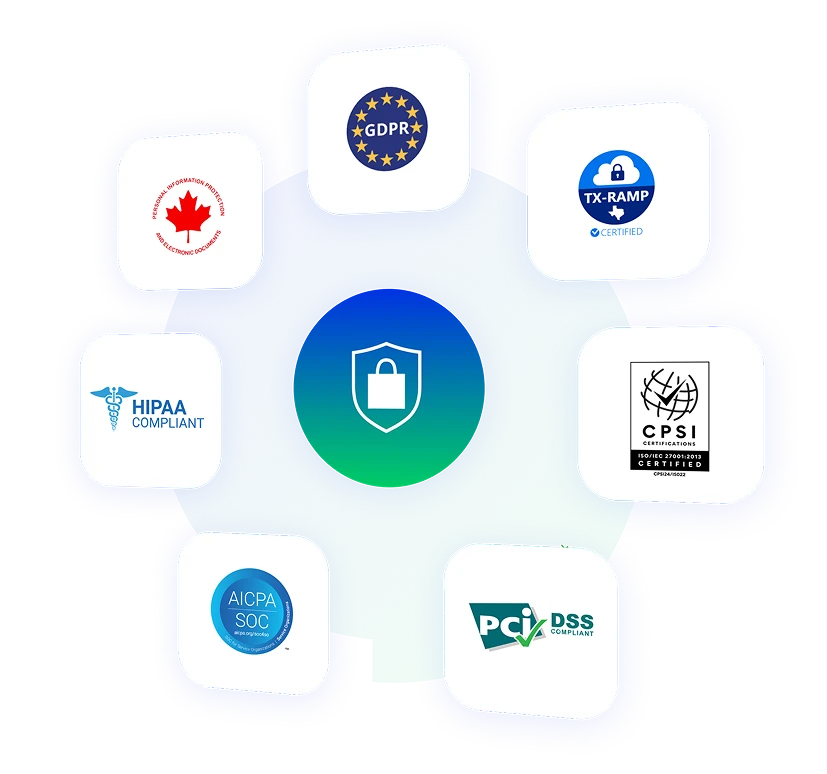
Explore the Comm100 Trust Center
Review Comm100’s security controls and compliance information as you prepare your vendor assessment.
Visit Trust CenterTrust Center
Data Residency and Sovereignty Questions Most RFPs Miss
Three terms get used interchangeably and mean different things. Data residency is where data physically sits. Data sovereignty is which country’s laws govern it, which is not always the same place. Data localization is a legal requirement that specifies data never leaves a jurisdiction. Your data residency requirements may touch all three, and a vendor who answers only the first hasn’t answered the question. A customer support platform RFP that asks where data is stored and stops there will not surface the problem.
- In which region is our primary data stored, and can we choose it?
- Where do backups and disaster recovery copies live? These frequently sit in a different region from primary storage, and buyers often forget to ask.
- Where are logs, chat transcripts, and analytics data held? Transcripts are the records regulators care about, and they’re often stored separately from the primary database.
- Where do your support and engineering staff sit when they access our data? Storing records in-country means little if a support engineer on another continent can open them.
- Which subprocessors operate outside our required region?
- On termination, how is our data exported and deleted, in what format and on what timeline?
| Requirement | Regional cloud | On-premises |
|---|---|---|
| Primary data storage | Vendor’s regional data center | Your own infrastructure |
| Backup and DR location | Confirm separately from primary storage | Under your control |
| Vendor staff access | Support and engineering may sit outside the region | Governed by your own access policy |
| Data export at termination | Contractual, so confirm format and timeline | Already in your environment |
Comm100 operates data centers in the US, Canada, Europe, and APAC, and offers on-premises deployment for organizations that can’t place records in shared cloud infrastructure. A vendor security assessment that stops at the primary storage location misses most of the surface area. Canadian organizations handling personal information under PIPEDA need to know where that information is processed as well as where it’s stored.
Vertical-Specific Questions for Finance, Insurance, Healthcare, and Government
The security and certification questions above apply across the board, but each sector’s regulator adds its own requirements, and your RFP should ask about them directly.
| Vertical | Framework to cite | Questions to add |
|---|---|---|
| Finance | PCI DSS, SOC 2 Type II | Is cardholder data ever visible in a chat transcript or agent console? How is payment data masked or excluded from stored conversations? Can audit logs be exported for examiner review? |
| Insurance | Record retention obligations, GDPR | How long are claims-related conversations retained, and is the period configurable? Can a policyholder’s full interaction history be produced on request? |
| Healthcare | HIPAA, Business Associate Agreement | Will you sign a BAA covering every product in scope? How is protected health information handled inside transcripts, analytics, and automation? |
| Government | WCAG, data sovereignty | What is your current accessibility conformance level, and is a report available? Where does citizen data reside, and is in-country hosting offered? |
Public sector buyers can also work through the government live chat security and WCAG checklist, which covers accessibility procurement in more depth than a single table allows. Financial institutions evaluating Comm100 for financial services will find the PCI DSS and audit-log questions above are usually the ones that separate a shortlist.
Vocabulary matters here too. If you’re writing for a government audience, the records in question belong to citizens. In insurance, they belong to policyholders, and in healthcare to patients. Vendors who use your sector’s language in their responses have usually sold into it before.
How to Score the Answers You Get Back
Scoring an RFP only works if the criteria are fixed before the responses arrive rather than after. Split the scoring in two. Non-negotiable requirements become pass-or-fail gates, and everything else gets weighted. Score the vendor security assessment answers on their own scale rather than folding them into the feature comparison.
Separate them because a weighted score lets a strong feature set paper over a missing certification. If your regulator won’t accept that trade, your scoring model shouldn’t either. Anything that would fail an audit belongs in a gate.
Four answers are worth treating as automatic disqualifiers:
- A certification cited without its scope. The logo doesn’t tell you what was audited.
- A report available only after contract signature. You’re being asked to buy before you can verify.
- No named breach notification window. If it isn’t a number in the contract, it isn’t a commitment.
- A refusal to name subprocessors. You can’t assess a supply chain you can’t see.
For the weighted half of the evaluation, the criteria that usually matter most in regulated buying are integration with your existing systems, deployment flexibility, total cost of ownership over three to five years, and whether the vendor assigns a named customer success contact. Our guide to evaluating enterprise customer service platforms works through those criteria in detail.
Regulated-Industry RFP Questions: FAQ
What’s the difference between an RFP and a vendor security questionnaire?
A customer support platform RFP evaluates and compares vendors across capability, pricing, and fit before selection. A vendor security questionnaire assesses one vendor’s security posture and is often sent after a shortlist is set or to an existing supplier. In regulated buying, you want the security questions inside the RFP so a vendor can be eliminated early rather than after commercial negotiation.
Is SOC 2 Type II enough on its own?
No. SOC 2 Type II confirms that a set of controls operated effectively over a defined period, which is meaningful but bounded. It doesn’t confirm which systems were in scope, whether the certification covers the product you’re buying, or whether sector-specific obligations such as HIPAA or PCI DSS are met. Treat it as a floor.
What does data residency mean for a customer support platform?
It means where every category of conversation data physically sits: live chat records, ticket history, transcripts, logs, analytics, and backups. Customer service software generates more record types than buyers expect, and they aren’t always stored in the same region. A single answer about “our data center location” rarely covers all of them.
How long does a regulated-industry RFP usually take?
It depends far more on the number of review gates than on the length of the document, so an RFP timeline should be built backwards from those gates. A process requiring information security review, privacy review, legal review, and procurement sign-off will run substantially longer than one with a single technical evaluator. Map your gates before you set a timeline, and ask vendors how quickly they can turn around security artifacts.
Is on-premises deployment still worth requesting?
Yes, if your data residency requirements or internal policy rule out shared cloud infrastructure. Fewer vendors offer it than five years ago, so including it as a requirement narrows the field quickly. Ask specifically whether the on-premises build carries the same certifications and the same feature set as the cloud product, because it often doesn’t.
Build a Shortlist Your Security Review Will Approve
A regulated-industry RFP works when the security, certification, and residency questions carry the same weight as the feature comparison. Ask for artifacts rather than assurances, attach scope to every certification claim, and put your non-negotiables in pass-or-fail gates. The vendors who answer all of that on the first pass are the ones that survive legal review.
Comm100 has supported organizations across government, finance, healthcare, and higher education since 2009, with cloud and on-premises deployment and data centers in the US, Canada, Europe, and APAC.

Evaluate Comm100 Against Your RFP
See how organizations in regulated industries are using Comm100 to deliver secure, compliant customer service.
Request your personalized demoRequest Demo