
SBC Summit 2026 was the most ambitious edition of the event yet, and the Comm100 team spent three busy days right in the + Read More about sbc lisbon 2026 recap: ushering in a new era

10 Unique Customer Support Challenges for iGaming Operators (And How to Solve Them)
iGaming support sits in an unusual spot. Players expect a reply in seconds, at any hour, in their own language, often while money is moving in or out of their account. Regulators expect every one of those conversations to be logged, age-checked, and defensible months later. Most support tools were built for one of those pressures, not all at once.
The volume is real. According to the European Gaming and Betting Association’s 2025 sustainability report, customer service teams across EGBA member operators handled close to 16 million interactions in 2024, most commonly about bonuses and offers. The same report counted 38.6 million active customer accounts, up 19% year on year. More players, more money in motion, and a thinner margin for a bad support experience.
But customer support in the iGaming market isn’t free of challenges. Having closely partnered with iGaming companies for more than a decade, here are the 10 unique customer support challenges that iGaming operators face, and how to fix them.
1. Round-the-Clock Demand Turns into a Morning Backlog You Can’t Staff Away
Players don’t gamble on a nine-to-five schedule. A sportsbook bettor in one time zone is placing an in-play wager while your day shift is asleep, and a casino player on a weekend session expects help at 3 a.m. the same way they’d expect it at 3 p.m. When overnight coverage is thin, the requests don’t disappear. They queue up and land on the morning shift as a backlog, which pushes up wait times and resolution times for everyone, including the players who waited all night.
The off-hours requests are rarely complicated. They tend to be the same handful of questions, asked over and over:
- A player wants to know why a withdrawal is still pending.
- Someone is locked out and needs a password reset.
- A bettor is asking why a wager settled the way it did.
The cost of leaving those unanswered is higher in iGaming than in most industries. A frustrated player can move to a competitor in the time it takes to load a new tab, and the deposit goes with them.
How to Solve It
Put an AI chatbot on the front line for the hours your human team isn’t online, and let it resolve the high-frequency, low-complexity questions on its own. Anything it can’t answer cleanly should book a callback or open a ticket, ideally one that captures the full chat so the morning shift starts with a sorted, context-rich queue instead of a wall of unread conversations.
The goal isn’t to remove people from overnight support. It’s to make sure the simple cases are already closed by the time a human logs in, so agents spend their hours on the issues that actually need judgment.
2. VIP Players Churn Fast When Support Feels Generic
High-value players carry a disproportionate share of revenue, and they have almost no tolerance for friction. A slow cashier page, a canned chatbot reply, or a support agent who clearly doesn’t know who they are can be enough to send a VIP looking elsewhere. Optimove’s analysis of more than 5.3 million players across global operators (October 2023 to October 2024) found that, on average, 55% of an operator’s customer base sits in a churned segment at any given time, and the longer a high-value player drifts, the less likely and less valuable their return becomes.
The instinct to automate VIP support is the wrong one. These players want a named human host who recognizes them and remembers their history. The real constraint is capacity: a host can only manage so many relationships before quality slips, and that ceiling drops as the player base grows.
How to Solve It
Use automation to protect host capacity rather than replace it. The moment a high-value player is identified, route their conversation to a dedicated team so they never sit in a general queue.
At the same time, let AI absorb the routine questions across the rest of your player base so your hosts aren’t pulled away from the relationships that drive spend. The framing that works is simple: AI keeps human VIP relationships sustainable as your player count grows. Plus, enabling AI agents to work in tandem with your AI Copilot could go a long way in helping you resolve issues faster.
For a closer look at the support figures that signal a VIP at risk, see the metrics iGaming support teams should track.
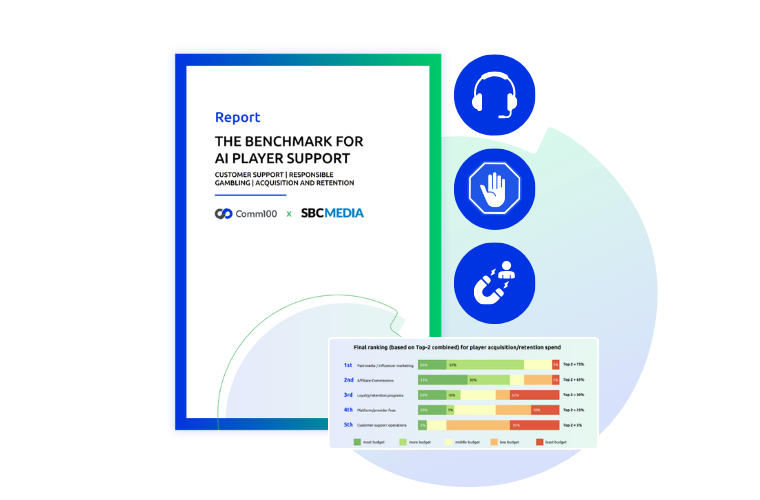
The Benchmark for AI Player Support
Discover how leading gaming operators use AI and human agents together to improve player support, increase resolution rates, and protect VIP relationships.
Get the reportReport
3. KYC Verification Costs You New Players Before They Deposit
Identity verification is mandatory in regulated markets, and it lands at the worst possible moment for conversion: right after a new player has signed up and is ready to play. If the verification step is confusing, slow, or asks for more than the player expects, a meaningful share abandon before their first deposit. The acquisition spend that brought them in is gone, and so is the player, often to a competitor whose onboarding felt lighter.
A lot of the friction is informational rather than technical. Players stall because they don’t understand why an address document is needed, whether their passport will be accepted, or how long the check will take. Silence at that moment reads as a dead end.
How to Solve It
Answer the verification questions inside the chat, before the player gives up. A bot connected to your knowledge base can explain exactly which documents are accepted and why they’re required, walk the player through the upload, and hand off to a human the second something needs review. A staged, risk-based approach helps too: low-risk profiles clear with minimal steps while higher-risk ones get the deeper checks, which keeps friction off the players least likely to be a problem.
Treat KYC as part of the support experience rather than a wall the player hits alone, and the verification step converts players instead of losing them.
4. Problem-Gambling Signals Surface in Support Before Anywhere Else
Responsible gambling obligations now sit at the center of most licensing regimes, and the markers of harm often appear first in support conversations. A player mentioning chasing losses, asking to raise limits right after a heavy loss, or showing distress in a chat is a signal that a trained specialist needs to step in. Miss those signals and you have both a duty-of-care failure and, increasingly, a regulatory one.
The scale of the effort is visible in the industry’s own data. EGBA members sent 100 million safer-gambling messages to customers in 2024, a 48% increase year on year, and 69% of their customers used at least one safety tool such as a deposit limit. That volume of intervention is difficult to run on manual monitoring alone, especially across millions of conversations.
How to Solve It
Configure your support system to recognize language patterns associated with problem-gambling behavior and route those conversations straight to trained responsible-gaming specialists, around the clock. The automation isn’t making the welfare decision. It’s catching the early signal and getting it in front of a qualified person faster than a human-only queue could manage. Pair that with self-exclusion and limit-setting prompts the bot can surface on request, so players who want a safety tool can reach it without waiting or asking twice.
This is one area where AI earns its place by widening the net, then handing the sensitive judgment to people who are trained to make it.
5. Every Support Chat Is an AML and Audit-Trail Risk
In iGaming, a chat transcript can become evidence. Anti-money-laundering and social-responsibility obligations mean operators have to demonstrate, after the fact, that they identified risk, intervened appropriately, and kept records. Regulators have been active about it. The UK Gambling Commission issued fines exceeding £40 million between January 2023 and April 2024, and enforcement has continued, with operators like Spreadex paying penalties above £2 million in 2025 for AML and social-responsibility failings. A support platform that doesn’t keep clean, retrievable records turns routine conversations into liabilities.
Multi-jurisdiction operators face a second layer: data residency. Some markets require player data to stay within specific geographic borders, which rules out support tools that can only store data in a single cloud region.
How to Solve It
Choose a platform built for regulated support rather than retrofitted for it. In practice that means a few non-negotiables:
- Transcripts are time-stamped and easy to retrieve.
- Card details are masked in every conversation.
- Access is restricted by role.
- Data can be kept inside a required region.
Recognized certifications matter alongside those controls, including SOC 2 Type II, PCI DSS, and ISO 27001, which is why security and compliance should be an early question in any evaluation rather than a late one. For operators with data-residency requirements, on-premise or region-specific deployment can be the deciding factor, since a cloud-only tool is a disqualifier in jurisdictions that mandate local storage. The practical test during a vendor demo: ask what happens when a regulator requests six months of interaction history for a named player. If the answer is slow or vague, that’s your risk sitting in plain sight.
6. Payment and Withdrawal Questions Drive the Most Complaints
Deposits and withdrawals are the most emotionally charged conversations in iGaming support. A player whose withdrawal is pending is anxious about their own money, and the patience window is short. These queries are also high-volume and repetitive, which means they consume agent time that could go to higher-value work, while still managing to frustrate players when answers are slow or inconsistent.
The risk compounds when payment conversations touch card details. Any tool handling that data without proper certification creates a compliance exposure on top of the support problem.
How to Solve It
Let an AI agent own the status-check layer. A player asking “where is my withdrawal” usually wants a real-time answer, and a bot connected to your payment and player systems can give it instantly without occupying an agent. Route anything involving a dispute, a failed transaction, or a card change to a human, and make sure the channel handling card data is PCI DSS certified.
Consistency matters here as much as speed. When the bot, the live agent, and the email follow-up all give the same answer, the player stops escalating. A short, accurate “your withdrawal is processing and will clear within X hours” resolves more anxiety than a fast but empty reply.
7. Major Sporting Events and Promotions Overwhelm the Queue
Sportsbook volume isn’t steady. A major match, a championship final, or a big promotional push can multiply support requests several times over within a few hours, and the spike arrives exactly when stakes and emotions are highest. Teams staffed for an average day get buried, queues stretch, and the players you most wanted to impress during a marquee event get your worst experience.
Hiring for the peak isn’t viable, because the peak is occasional and the rest of the year you’d be carrying idle headcount.
How to Solve It
Build elastic capacity with automation as the shock absorber. During a surge, the AI agent takes the volume of repeat questions (how do I cash out, why was my bet voided, what are the rules on this market) so human agents stay free for the conversations that actually need them. Smart routing and queue management hold the line by directing each conversation to the right team and setting clear expectations on wait time, which keeps players informed instead of guessing.
Plan a big event like an operations exercise. Pre-load the bot with answers to the questions that specific event will generate, brief agents on the likely edge cases before kickoff, and agree how escalations will be handled before volume peaks.
8. Bonus and Promotion Disputes Are a Constant, Charged Volume
Bonuses are the lifeblood of player acquisition and the single most common reason players contact support. EGBA’s 2025 report found bonuses and offers were the most frequent topic across the roughly 16 million support interactions its members handled. Wagering requirements, expiry dates, eligibility rules, and “why didn’t my bonus apply” questions repeat endlessly, and they’re often charged because the player feels they’re owed something.
Inconsistency makes it worse. When two agents explain the same wagering requirement differently, the player loses trust and a simple question becomes a dispute.
How to Solve It
Standardize the answers and put them where players ask the question. A bot trained on your current promotion terms can explain wagering requirements, check eligibility, and surface the exact terms of an active offer in seconds, with the same answer every time. Keep the underlying terms in a single knowledge base so that when a promotion changes, the bot, the agents, and the help center all update from one source. Then equip your live agents with an AI assistant that pulls the relevant promo terms into the conversation, so even a new agent gives the veteran’s answer.
Disputes drop when the rules are easy to find and explained the same way by every channel a player might use.
9. Multilingual Support Across Markets Strains Agent Coverage
Operators scaling across jurisdictions inherit a language problem fast. A player who can’t get support in their own language churns quietly, and hiring native-speaking agents for every market and every shift is expensive and slow. The gap usually shows at the edges: a market large enough to matter but not large enough to justify a dedicated multilingual team around the clock.
How to Solve It
Lead with automation that already speaks the languages you operate in. An AI agent that handles dozens of languages out of the box can cover first-line support across markets without a proportional increase in headcount, and real-time translation lets a single agent assist a player in a language they don’t speak. Reserve native-speaking human agents for the complex or sensitive cases in your highest-value markets, where nuance actually changes the outcome.
This keeps coverage wide while concentrating your scarce language talent on the conversations where it pays off: money, complaints, and player welfare.
10. Fragmented Channels Leave Agents Without Player Context
When live chat, email, social, and messaging live in separate tools, agents work blind. A player who raised an issue by email yesterday has to re-explain it on chat today, and the agent has no view of the deposit history, the prior complaint, or the VIP status that should change how the conversation goes. The result is slower resolutions, repeated questions, and a player who feels like a stranger to a brand they fund.
How to Solve It
Consolidate channels into one console so an agent sees the full player context in a single place: past conversations across every channel, account details, and history. With everything unified, ticketing and messaging keep complex cases moving across channels without losing the thread, and an agent picking up a chat already knows what happened on email last week. Routing rules then make sure each conversation reaches the team equipped to handle it, whether that’s VIP, payments, or responsible gaming.
Context is what separates support that feels personal from support that feels like a call-center lottery.
How Comm100 Helps iGaming Operators
We built Comm100 for support teams in regulated industries, and iGaming is one of the verticals we know best. Our platform brings live chat, ticketing, messaging, and AI into one console, so agents work from a single view of the player instead of stitching together separate tools.
A few things matter specifically for gaming operators:
- We hold the certifications regulators look for, including SOC 2 Type II, PCI DSS, ISO 27001, GDPR, and HIPAA.
- We offer on-premise deployment for jurisdictions with data-residency rules, which most major support vendors don’t.
- Our AI Agent resolves routine player questions and can be configured to flag responsible-gaming signals.
- Our AI Copilot helps live agents reply faster and more consistently.
- Our routing identifies VIP players and sends them straight to dedicated hosts.
Our own 2026 AI Live Chat Benchmark Report shows iGaming queries resolve through automation at a lower rate than sectors like education or banking, which reflects how many gaming conversations involve payments, identity, and disputes that need a person. That’s the design principle we work from: automate the volume, route the sensitive cases to people, and keep the whole thing audit-ready. You can see the certifications in our Trust Center, the gaming-specific setup on our iGaming solutions page, and the criteria that matter for gaming in our comparison of the best live chat software for iGaming.
Conclusion
The through-line across all ten challenges is the same: in iGaming, speed and compliance pull in opposite directions, and most support failures happen where they meet. Players want instant answers about their money; regulators want a defensible record of every interaction. The operators who handle this well don’t pick one or the other. They automate the high-volume, low-risk questions so human agents have the hours to handle VIP relationships, payment disputes, and welfare signals with the care those cases demand, all on a platform that keeps the audit trail clean. Get that balance right and support stops being a cost center you defend in regulator meetings and starts being a reason players stay.

Deliver Faster, Safer Player Support with Comm100
See how leading iGaming operators combine AI Agents, AI Copilot, omnichannel support, and enterprise-grade compliance to improve player experiences and reduce operational costs.
Request a demo todayRequest Demo
Frequently Asked Questions
What Is the Biggest Customer Support Challenge for iGaming Operators?
There isn’t a single one, but the recurring theme is that support and compliance overlap. Questions about payments, identity verification, bonuses, and responsible gambling all carry regulatory weight, so a slow or inconsistent answer can become both a churn problem and a compliance problem at the same time. That’s what makes iGaming support harder than general customer service.
Can AI Chatbots Handle iGaming Customer Support on Their Own?
For the high-volume, repetitive questions, yes: balance checks, withdrawal status, password resets, bonus terms, and basic verification guidance. For payment disputes, responsible-gambling signals, and VIP relationships, the better model is to use AI to catch and route those cases quickly to trained human agents rather than resolve them automatically. The aim is to protect human capacity, not remove humans.
How Does Customer Support Affect Player Retention in iGaming?
Heavily. High-value players in particular have very little tolerance for friction, and a poor support experience is a common reason they move to a competitor. Because acquiring a new player costs far more than keeping an existing one, fast and consistent support is one of the cheaper levers an operator has for protecting revenue.
What Compliance Features Should iGaming Support Software Have?
At a minimum: audit-ready, time-stamped transcripts; credit card masking; role-based access controls; and recognized certifications such as SOC 2 Type II, PCI DSS, and ISO 27001. Operators in markets with data-residency rules should also confirm whether on-premise or region-specific deployment is available, since cloud-only storage can fail local requirements.
How Can Support Teams Help With Responsible Gambling?
Support is often where harm markers appear first. Configuring the system to recognize problem-gambling language and route those conversations to trained responsible-gaming specialists, around the clock, gets the right person involved faster. Support tools can also surface self-exclusion and deposit-limit options on request, making safety tools easy for players to reach.
How Do iGaming Operators Handle Support During Major Sporting Events?
By using automation as elastic capacity. During a spike, an AI agent absorbs the surge of repeat questions while human agents stay free for complex cases, and queue management keeps players informed about wait times. Preparation helps as much as technology: load the bot with answers specific to that event and brief agents on likely edge cases before it starts.