
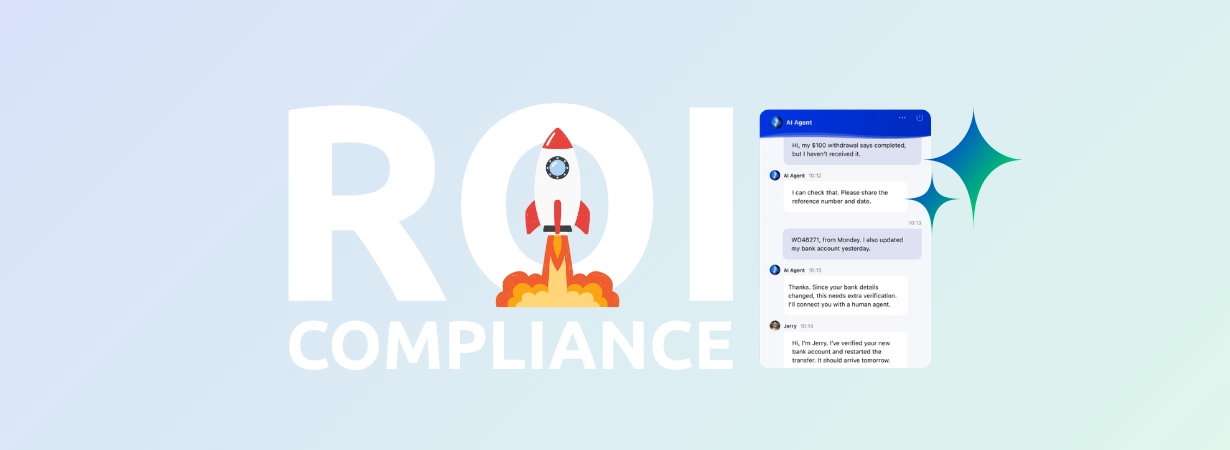
A major football fixture on a Saturday afternoon is a stress test for any operator’s support team. Deposit volumes spike, withdrawal questions flood + Read More about ai-powered support for igaming: maximize roi and compliance

Where AI Stops and People Start: Lessons from Our iGaming Support Panel
The phrase “AI-first” gets repeated so often in iGaming that it has started to sound like a destination. Get there, and the support operation runs itself. But the people running player support in regulated markets describe something more careful than that. AI-first, for them, is an operational choice about where to start a conversation.
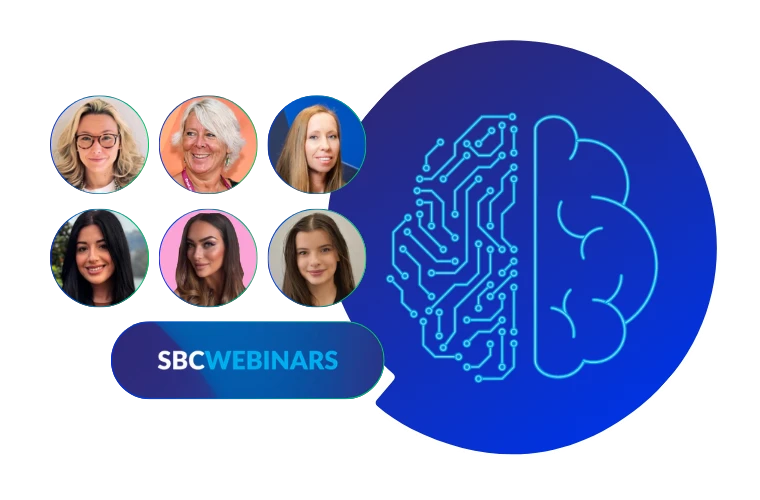
That distinction ran through the whole of our fourth webinar with SBC, “AI + Human Agents: How to Find the Right Balance in High-Stakes Player Interaction.” Moderated by Comm100’s Karen Woods, the all-female panel brought together five operators and specialists who deal with this balance daily:
- Iris den Boer, an AI gaming consultant with 15 years in responsible gaming and compliance
- Kylie Tanti, Head of Operations at Reactivaction
- Liesbeth Oost, Head of ESG at JVH Gaming & Entertainment Group
- Lisa Courtey, Head of Safer Gambling at BVGroup
- Maria Boelius, CEO of Wildz Group.
Why Doesn’t AI-First Mean AI-Only?
The simplest answer came from Iris, and it reframed the entire debate: AI catches the risk, and the humans behind it care. In her experience, AI is good at spotting certain risks and reading vulnerabilities in customer behavior and conversation. But it is the responsible gaming team that brings personal judgment to a flagged case, takes the time to understand it, and decides what feedback or outreach the player actually needs.
Maria described how this plays out at scale. Her chatbot is involved in roughly 90% of conversations, but it escalates to a human agent when its confidence in an answer drops below a set threshold. The team deliberately does not let the bot handle every chat, because an incorrect answer to a player is worse than a slower one. That confidence threshold is the hinge the whole system turns on.
Liesbeth drew the sharpest line of the session. For most industries, she argued, AI-only is an operational question; if something goes wrong in ecommerce, the harm is usually small. In iGaming, it becomes an ethical one. As player value and duty of care rise, the level of automation should not automatically rise with them. If anything, the stakes raise the importance of human decisions about who designs the prompts, who sets the escalation thresholds, and whether the handoff itself is smooth or full of friction.
Kylie, working the operations frontline, agreed without hedging. iGaming remains a relationship-driven industry, and VIP interactions, vulnerable players, and emotionally charged cases all need the human element. AI is a strong technology to support agents. It is not a replacement for them.
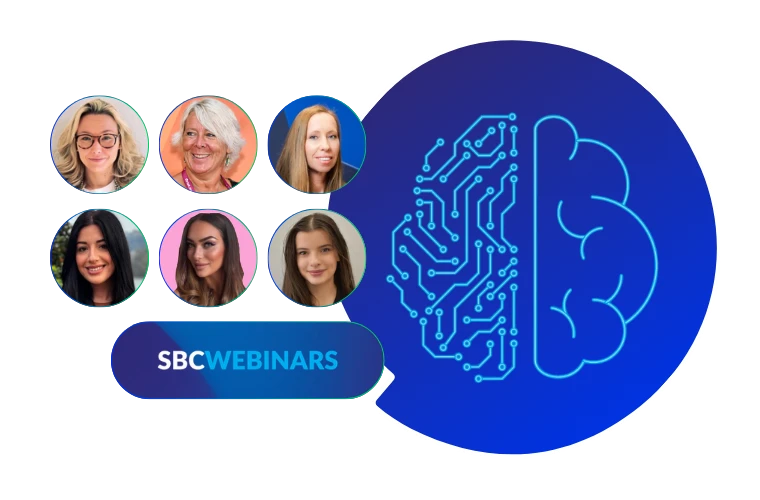
Watch Our AI + Human Agents Webinar
Learn how iGaming support teams balance AI and human intervention to protect players and manage high-stakes interactions efficiently.
Watch nowWebinar
How Should Operators Decide What to Automate and What to Keep Human?
Liesbeth offered a test worth borrowing. Before automating an interaction, ask not only “can we automate this?” but “what is the cost if it goes wrong, and how reversible is that?” By that measure, the panel sorted interactions into rough tiers:
- Safe to automate: low-emotion, reversible tasks such as password resets, deposit confirmations, information about games, and basic payment queries. Kylie’s version of the same rule covered repetitive, FAQ-style questions like KYC document requirements, which a bot can answer easily.
- The grey zone: anything where tone or ambiguity signals a more vulnerable conversation, where AI assists but does not decide.
- Human-only: affordability conversations, self-exclusion, complaints, and anything where a player mentions trouble with money, family, sleep, or emotions.
This is where the panel got genuinely interesting, because Lisa pushed against the idea that sensitive automatically means human-only. From the safer gambling side, she has seen AI help filter conversations before they reach her CS team, screening for specific words and concerns so her officers spend their time on the players who truly need them. A neutral system, she noted, can sometimes pick up signals that a busy agent might not.
But Lisa drew her own line just as firmly. She is comfortable with AI assisting a safer gambling conversation, transcribing it, flagging a missed cue, prompting an officer to follow up on something a customer said. She is not comfortable with AI looking after a player who may be experiencing gambling harm. Generic actions like applying a deposit limit or explaining a withdrawal timeline can be automated. An interaction with someone in distress needs a human, assisted by AI rather than replaced by it.
Maria confirmed this is a live struggle in her own operation, where the team works closely with compliance to find the line. They use AI as a copilot for responsible gaming rather than automating it outright, and they use it to build RG markers that detect hints of a gambling problem in conversations.
Iris closed the section with the compliance case for AI, and it cut against the instinct that automation is the riskier choice. Your best agent can still have a bad day and miss a cue. A well-built AI system applies the same scrutiny to every conversation. Used as a safety net that catches risk and hands a filtered, fully documented case to a human team, AI can build more safety for both the company and the player, not less.
Where Is AI Actually Improving Support Operations Right Now?
When the conversation moved from boundaries to benefits, the panel kept returning to a word: copilot. The gains they were most excited about were largely internal.
Kylie called the internal support layer underrated. AI cuts the time agents spend hunting for a player’s account history, and it summarizes the intent of a conversation before an agent even picks it up. The result is a team that handles more volume without adding headcount. Auto-translation came up repeatedly as a practical win, letting operators serve players in multiple languages without staffing a specialist agent for each one. Maria noted it works well for German and French, with one honest caveat: it still struggles with Finnish.
Maria also pointed to something less glamorous but clearly valuable. Her team has begun using AI to automate team-leader and shift-leader tasks like performance reporting and QA, which she described as a real time saver for her leaders.
Liesbeth widened the lens to pattern detection across the player journey, where AI can surface language shifts and session escalations that point to risk, tuned to a specific market or audience. She made a sequencing argument the rest of the panel seemed to share. Start by pairing AI with your human agents internally. Train your people to work alongside it, and the agents end up free to focus on empathy, tone, and emotion while the bot absorbs the repetitive work. Roll it out externally only after that foundation is in place.
Iris brought it back to the player. The long queue for live chat, once simply part of the experience, is disappearing. Intelligent systems now assist players instantly, reference earlier conversations through memory, and mimic a human tone well enough to lift both the customer experience and the operation’s capacity. She was careful to separate this from the older, menu-driven bots that sent players in circles. The difference between those two things is the difference between AI that helps and AI that frustrates.
Lisa, still early in bringing AI into her safer gambling department, named the win she is most looking forward to. After-call documentation, the notes and audit trail her officers must complete after every interaction, takes up most of their time. If AI can take that task off them, her limited team of officers can help more of the many players who need guidance. More help from the same number of people was the thread connecting every answer.
Is the AI-to-Human Handoff the Weakest Link?
The panel was honest that the handoff is where the experience can break, and that the failure is rarely technical. It is about context.
Iris framed the stakes plainly. A good transfer hands the human agent a complete case with a full summary, and the conversation continues smoothly. A bad one forces a player to open up a second time, repeating a sensitive disclosure they just made to a bot. Avoiding that second disclosure is the whole point, and for compliance it matters that the detected information is not only captured but stored and passed on in a way that holds up as an audit trail.
Drawing the threads together, the panel described what an agent should actually receive at the moment of handoff:
- A summary of the live conversation, so the player never has to repeat what they just told the bot.
- The issue’s context and the player’s tone, whether they are calm, frustrated, or vulnerable, which Kylie flagged as essential to picking up the conversation well.
- The player’s contact history, including answers already given, since Lisa noted players often return repeatedly about the same unresolved issue.
- Sentiment passed as a question, not a verdict, so the agent can confirm or correct the bot’s read on what the player meant.
Maria added a friction point that has no neat solution. Around 10% of her players refuse to engage with AI at all and demand a human immediately, sometimes on issues the bot could have resolved instantly. Part of this is human nature. Part of it, she explained during the closing Q&A, is lower-tier VIP players requesting an agent in the hope of talking their way into a bonus the bot will not grant. And part of it is memory of a bad first experience. A player burned once by a poor bot interaction will resist the next one, which makes first impressions, and steady improvement of the bot’s answers, the path to earning that trust back.
Liesbeth took the context argument to its most precise point with an example of dialect. The Netherlands alone has more than 20 regional dialects, and the same phrase can carry opposite meaning depending on where a player is from. A bot can misread intent until it has learned how people in a given region actually speak, which is exactly why she wants the human agent positioned to catch what the model gets wrong.
The Throughline
The takeaway the panel converged on is not that AI will eventually replace iGaming support. It is that the operators closest to the work do not want it to, and have thought carefully about why. AI earns its place by detecting risk, clearing repetitive volume, and handing people a complete, well-documented case so they can do the part that requires care. The skill is no longer choosing between AI and humans. It is calibrating the threshold between them, and protecting the context that crosses it.
That calibration is also where trust is won or lost, with players and with the agents learning to work alongside the technology. Get the threshold and the handoff right, and AI does not dilute the human relationship that defines this industry. It gives people more room to have it.
Watch Our AI + Human Agents Webinar
See how iGaming operators combine AI and human agents to handle high-stakes player interactions, protect vulnerable players, and optimize support operations.
Watch nowWebinar