
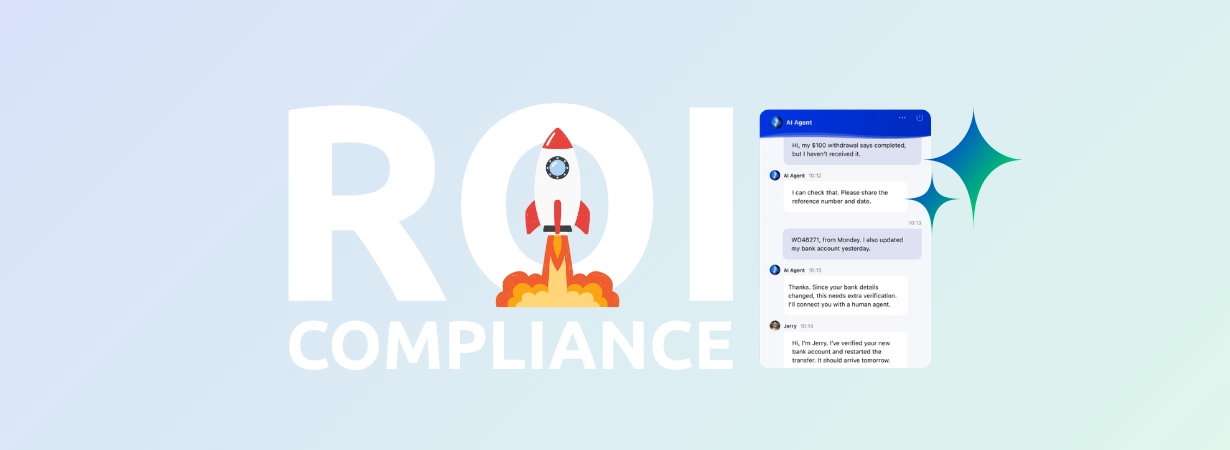
A major football fixture on a Saturday afternoon is a stress test for any operator’s support team. Deposit volumes spike, withdrawal questions flood + Read More about ai-powered support for igaming: maximize roi and compliance

10 Ways to Improve First Contact Resolution in Your Contact Center
A repeat contact is one of the quietest costs in a support operation. The customer who comes back a second time rarely shows up in a headline metric, but they cost you another agent’s time, another round of context-gathering, and a measurable drop in their willingness to stay. The frustrating part is how avoidable most of those second contacts are.
Despite companies using AI chatbots as the first support line, more than half of contacts still touch a person, and a good share of those people are handling something a better-designed system could have closed on the first pass.
First contact resolution (FCR) used to be treated as an agent-skill problem. Train people well, give them a script, and the resolution rate climbs. In a modern contact center that runs chat, messaging, email, social, and voice alongside AI, that framing no longer holds.
FCR is now a question of how you design the whole system: which channel handles what, how much your AI resolves on its own, and what happens in the seconds when a conversation passes from a bot to a human. This piece walks through ten ways to improve it, written for contact centers rather than call centers.
What Is First Contact Resolution?
First contact resolution, or FCR, measures the share of customer issues resolved in a single interaction, with no follow-up, callback, reopened ticket, or escalation required. It is one of the most-watched metrics in customer service because it ties so directly to satisfaction, cost, and loyalty at the same time.
The formula is simple:
FCR = (Issues resolved on first contact / Total issues) × 100
The complication, and the thing that trips up teams moving from a call-center mindset to a contact-center one, is the phrase “first contact.” On a phone line, a contact is a call, and the boundaries are obvious. In a multichannel operation, a single issue might begin in a bot conversation, move to a live chat, and finish with a follow-up email. Is that one contact or three?
There is no universal answer, which is why every contact center needs to define its own parameters before it measures anything:
- What counts as a repeat contact, and within what window
- How long your contact window runs before a new contact starts the clock again
- Whether helpful transfers to a specialist count against your rate
- What “resolved” means from the customer’s point of view, not just the agent’s
Without those definitions, your FCR number is just a feeling with a percent sign attached.
What Is a Good First Contact Resolution Rate?
The most cited authority on FCR benchmarking is SQM Group, which has measured the metric across hundreds of North American contact centers for over two decades. Their finding is consistent: a good FCR rate sits between 70% and 79%, world-class performance is 80% or higher, and only about 5% of contact centers ever reach that world-class tier.
The all-industry average lands at roughly 70%, which means close to a third of customers have to make contact more than once.
Those numbers move a lot depending on what your agents are handling. Simple orders and inquiries resolve at high rates. Billing, technical issues, claims, and complaints resolve at much lower ones, because they are genuinely harder problems.
A 65% FCR rate in a complex technical environment may be better performance than 80% on straightforward order questions, so benchmark yourself against your own issue mix, not just the headline average.
The reason leaders chase this metric is that the financial case is unusually clean. SQM’s research shows that for every 1% improvement in FCR, a contact center reduces operating cost by roughly 1% and lifts customer satisfaction by roughly 1%. Few metrics improve cost and experience in lockstep like that. Repeat contacts, by contrast, eat into both at once.
Why First Contact Resolution Matters More in a Contact Center
In a call center, a failed resolution produces a callback. In a contact center, it can fracture across channels. The customer who does not get a full answer in chat opens an email, then gives up and calls, and now one unresolved issue has generated three separate contacts, three sets of contexts to rebuild, and a customer who has explained the same problem three times. Multichannel support multiplies the number of places resolution can break down, which is exactly why FCR deserves more attention here, not less.
The stakes climb further in regulated industries. In iGaming, banking and credit unions, higher education, and government, first-contact resolution runs straight into identity verification, compliance checks, and rules about what data can move through which channel.
A banking customer cannot always get an account change resolved in a single chat, because the verification step is a legal requirement rather than a process inefficiency. Those constraints depress raw FCR and make the resolutions you do achieve more valuable, since the alternative is a frustrated customer bouncing between channels while sensitive information sits in limbo. Getting FCR right in these environments is partly a design problem and partly a trust problem, and the two are inseparable.
With the definitions and the stakes established, here are ten practical ways to move the number.
1. Resolve More at the AI Layer, and Measure Resolution Rather Than Deflection
Using a powerful AI Agent to handle queries from the get-go is one of the best ways to improve first contact resolution rates. The single biggest lever in a modern contact center is how much your AI resolves before a human is ever involved. Every contact a well-trained AI Agent closes on its own is, by definition, a first contact resolution, and it happens at a fraction of the cost of a human-handled interaction.
The trap is mistaking answers for resolutions. A bot that responds to 80% of incoming messages is not the same as a bot that resolves 80% of issues. Plenty of automation produces a confident sounding reply that leaves the customer no closer to a solution, which simply pushes the resolution downstream to an agent and turns one issue into two contacts. That is deflection dressed up as resolution, and it shows up later as a spike in repeat contacts and a dip in CSAT.
So measure both. Track your handling rate, the share of conversations the AI engages with, separately from your true resolution rate, the share it actually closes without a handoff. The 44.8% all-industry resolution figure from the Comm100 AI Live Chat Benchmark Report is the baseline a well-trained bot should aim to beat, and tightly scoped AI consistently outperforms broad, shallow deployments.
Ground the AI in your own knowledge base so it answers from verified content rather than improvising and watch the gap between what it answers and what it resolves. Closing that gap is where the real FCR gains live.
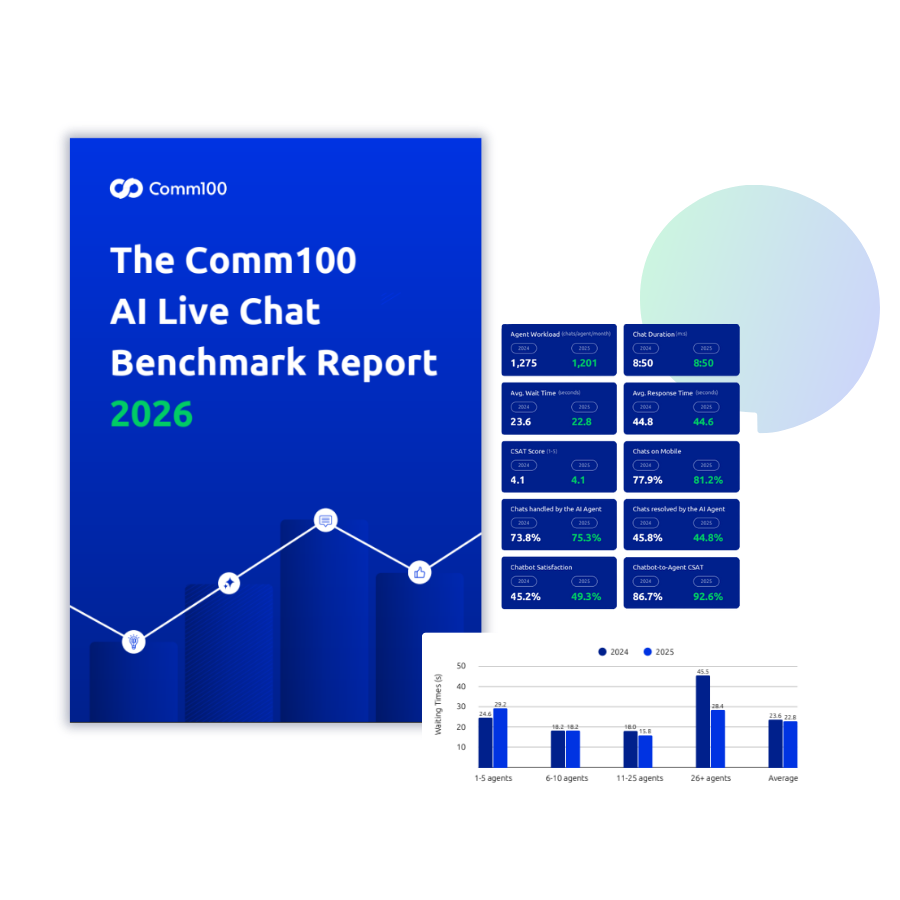
See the AI Live Chat Benchmarks
See how AI is performing across industries, including resolution rates, handoff satisfaction, and the metrics that matter most for improving first contact resolution.
Get the reportReport
2. Give Agents an AI Copilot So Research Stops Eating the Conversation
When a contact does reach a human, the clock on first contact resolution is already running, and the biggest threat to it is the time an agent spends hunting for information. Searching the knowledge base, switching between systems, scrolling back through history, and double-checking a policy all add minutes during which the customer waits and the odds of a clean resolution slip. An agent who has to put someone on hold to go find an answer is one step from a callback.
This is where an AI Copilot changes the math. Rather than resolving the contact itself, it works alongside the agent, surfacing the right answer from your knowledge base in the moment, suggesting accurate channel- and campaign-specific replies, and refining responses for clarity with a single click. The agent stops being a researcher and goes back to being a problem-solver. Because the Copilot pulls from the same verified knowledge as your AI Agent, the answer a customer gets from a person matches the answer they would have gotten from the bot, which matters enormously for consistency in regulated environments where a wrong answer carries real consequences.
It also clears the administrative drag that quietly lowers resolution quality. When the Copilot handles summary generation and conversation wrap-ups automatically, agents spend their attention on the customer in front of them instead of on notetaking.
3. Route to the Right Place the First Time
A contact that lands with the wrong agent or in the wrong queue is a repeat contact waiting to happen. Intelligent routing fixes this by directing each conversation to the person or team best equipped to resolve it, based on the signals that actually predict who can finish the job:
- The urgency of the request
- Its complexity, and whether it needs a specialist
- The customer’s history and previous reasons for contact
- Their account status, including whether they are a VIP or high-value customer
A VIP player or a high-value banking client should not wait in the same undifferentiated line as a routine FAQ.
Skills-based and intent-based routing matter even more across channels than they do on a single phone line, because the cost of a misroute compounds. Send a complex billing dispute to a generalist and you get a transfer, a re-explanation, and a longer path to resolution, all of which count against your FCR. Get the routing right at the first touch and the customer reaches someone who can actually finish the job.
Peak periods are where routing earns its keep. When volume spikes during an enrollment window, a product launch, or a crisis, Queue Management keeps the surge orderly so the right contacts still reach the right agents instead of everything collapsing into one overwhelmed queue. Resolution rates hold up under load only when the routing underneath them does.
4. Give Agents One Unified View of the Customer
Agents resolve issues faster when they are not digging for information right from scratch. Using tools like an AI Copilot ensures that agents have information available that they can use to create better answers and respond to a query more accurately.
A unified workspace pulls conversation history, channel context, and CRM data into one place, so the agent picks up exactly where the last interaction left off regardless of where it happened. In a Live Chat session that began as a bot conversation, the agent should see the full thread, the customer’s prior issues, and any account details the integration surfaces, all without leaving the screen. The less time an agent spends reconstructing context, the more of the interaction goes toward actually solving the problem, and the higher the chance it closes in one contact.
5. Build a Knowledge Base Your AI and Your Agents Both Rely On
Knowledge is the raw material of resolution, and in a contact center it now feeds two consumers at once: the AI Agent that resolves contacts on its own and the agents who handle everything the AI hands off. A strong knowledge base lifts both your automated resolution rate and your agents’ speed, which is why neglecting it quietly drags down FCR everywhere.
Organize it around the problems customers actually have rather than your internal product categories, because customers do not search the way your org chart is structured. Keep it current, treating it as a living resource with regular audits rather than something built once and forgotten, since an outdated article is worse than no article when it sends a confident wrong answer to a customer or a bot. And track which articles correlate with successful resolutions, so you can see where the knowledge is working and where the gaps are generating second contacts. A knowledge base maintained this way compounds: every improvement makes both the AI and the humans a little more capable of finishing the job the first time.
6. Empower Agents to Resolve Without Escalating
An agent who lacks the authority to resolve an issue cannot resolve it on first contact, no matter how skilled they are. When every refund, every exception, and every account change requires a supervisor’s sign-off, the system itself is manufacturing repeat contacts. Pushing decision authority down to the front line is one of the most direct ways to lift FCR, and it pays off in agent confidence as much as in the metric.
That said, not every transfer is a failure. Connecting a customer to a specialist who can actually solve a complex problem is often the fastest route to resolution, and penalizing agents for those handoffs only teaches them to keep struggling with issues outside their expertise while the customer’s patience drains away. The goal is to eliminate the unnecessary transfers, the ones caused by missing authority or poor routing, while supporting the helpful ones. Pair that authority with training that teaches agents to walk customers through how a problem was solved rather than just fixing it silently, and you reduce the follow-up contact where the customer hits the same wall again.
7. Use Analytics and Root-Cause Analysis to Kill Repeat Drivers
Most low FCR rates are not random. They cluster around a handful of recurring issues that generate second and third contacts over and over, and the fastest way to lift resolution is to find those drivers and eliminate them at the source. This takes both kinds of data. Quantitative signals tell you what is happening: which issue types reopen most often, where handle times balloon, which channels produce the most repeat contacts. Qualitative signals, drawn from customer feedback and conversation content, tell you why.
AI Insights gives managers real-time visibility into resolution tracking, sentiment, and critical-issue detection, which turns this from a quarterly review exercise into something you can act on while a trend is still forming. The discipline that matters most is root-cause analysis: tracing a wave of repeat contacts back to its origin instead of treating each one as an isolated event. If customers keep coming back about the same payment problem, the issue is rarely the individual agents. It is more often a gap in the knowledge base, a confusing step in the process, or a topic that never made it into training. Fix the cause and a whole category of repeat contacts disappears.
8. Balance Speed with Resolution Quality
It is dangerously easy to improve FCR on paper while making the customer experience worse. Lean too hard on average handle time and agents feel pressured to close conversations fast, which produces quick, incomplete fixes and a fresh wave of callbacks, the exact opposite of what FCR is supposed to capture. A contact that ends quickly but is unresolved is not a win, even though a careless dashboard might record it as one.
The protection against gaming the metric is to never look at FCR alone. Pair it with a small set of metrics that expose hollow resolutions:
- Customer satisfaction, to confirm the customer actually felt helped
- Customer effort score, to catch resolutions that took the customer too much work
- Repeat-contact rate, to surface the second touches a high FCR number can hide
If FCR is climbing while CSAT slips or repeat contacts creep up, the resolution rate is hollow. Watching those metrics together keeps the focus on genuinely finishing the job rather than on closing tickets, which is the only version of FCR worth improving.
9. Win the Handoff Between AI and Humans
In a contact center that runs AI alongside people, the handoff is where first contact resolution is most often lost, and it is the step the industry talks about least. When a bot reaches the limit of what it can resolve and passes the conversation to a human, two things can happen. Done badly, the customer is dumped into a queue and asked to start over, explaining to a person everything they just told the machine, which guarantees the interaction feels like a failure even if it eventually resolves. Done well, the agent receives the full context of the bot conversation and picks up seamlessly, and the customer barely notices the transition.
The data shows how much this matters. The bot-to-agent handoff satisfaction rate reached 92.6% across all industries in the benchmark report, with customers who interacted with a bot before reaching an agent rating the experience higher than average. That is a striking result: a well-designed handoff does not just avoid hurting the experience, it can actually improve it, because the customer gets the speed of automation and the judgment of a person without losing their place in between. The mechanics are what deliver it:
- Preserve the full conversation history through the transfer, so nothing gets re-explained
- Route the handoff to an agent equipped to resolve the specific issue, not just the next available one
- Arm that agent with an AI Copilot so they act on the context immediately rather than reading up on it while the customer waits
A controlled handoff turns the seam between AI and human from your biggest FCR risk into one of your strongest moments.
10. Design for the Constraints of Regulated Industries
For contact centers in iGaming, banking, higher education, and government, first contact resolution has to be engineered around requirements that other industries never face. Identity verification, age and KYC checks, compliance rules, and limits on what data can travel through which channel all add legitimate friction to the first contact. Ignoring those constraints in pursuit of a higher FCR number is how teams end up cutting corners that matter.
Improve Your FCR with Comm100
For organizations with the strictest data-residency and security requirements, on-premise deployment keeps sensitive interactions fully within their own environment, an option Comm100 supports and that cloud-only vendors like Zendesk and Intercom do not offer. When the system respects the compliance reality instead of fighting it, you resolve more on first contact precisely because you are not forcing customers off channel every time a rule applies.
With a unified, omnichannel platform and a full AI Suite, Comm100 was designed to help customer service teams improve their performance, offer superior support to respondents, while also leveraging the best-in-class technology.

Resolve More Conversations the First Time
Comm100 combines AI Agents, AI Copilot, omnichannel routing, and analytics to help contact centers improve first contact resolution efficiently and securely.
Request a demo todayRequest Demo