

Patients want to message their healthcare providers the same way they message everyone else. The Health Insurance Portability and Accountability Act (HIPAA), however, + Read More about secure vs standard messaging: hipaa compliance for healthcare

Live Chat Best Practices in 2026: What High-Performing Teams Do Differently
Most organizations have live chat. Far fewer are running it well.
The gap between a chat channel that exists and one that measurably improves customer service is wider than most CX leaders expect, and it usually has nothing to do with technology. It has everything to do with operational decisions that most teams have never made explicitly: how conversations are routed, where automation ends and human judgment begins, how agents are coached, and which metrics actually drive change.
This guide is not an introduction to live chat. It is a practical reference for CX leaders who already have a program in place and want to identify where it is underperforming and why. The practices below are organized around decisions, not a flat list of tips, because that is how high-performing teams actually think about this problem.
One number worth keeping in mind: 57% (data from Sauce Labs) of customers would switch to a competitor after three to four negative digital experiences. For many of them, those experiences happen in chat.
Set the Operational Foundation Before Optimizing Anything
The most common mistake in live chat programs is trying to optimize agent behavior while the underlying infrastructure is still misconfigured. Routing logic, concurrency settings, and SLA targets all determine the conditions agents work under. Get those wrong and no amount of training will fix the outcomes.
Define Quality With the Right Metrics
Most teams track first response time (FRT) as their primary chat metric. FRT matters, but it only tells you how fast agents pick up conversations, not whether those conversations are actually resolving anything.
The metrics that give CX leaders a complete picture:
- First Response Time (FRT): Set targets by queue, not as a single company-wide number. A billing queue likely warrants a tighter SLA than a general product inquiry queue.
- First Contact Resolution (FCR): The most direct indicator of quality and efficiency. If an issue requires three follow-up interactions to close, the fast first reply did not actually help.
- Customer Satisfaction Score (CSAT): Collect immediately post-chat and segment by issue type rather than averaging across all conversations.
- Customer Effort Score (CES): A useful complement to CSAT. It measures how easy the resolution felt, which often predicts loyalty better than satisfaction alone.
Industry data puts average live chat first response times between 30 seconds and just under three minutes. That is a benchmark floor, not a target. The FRT that matters is the one correlated with your own CSAT data. When your scores start to drop, that threshold is your real standard.
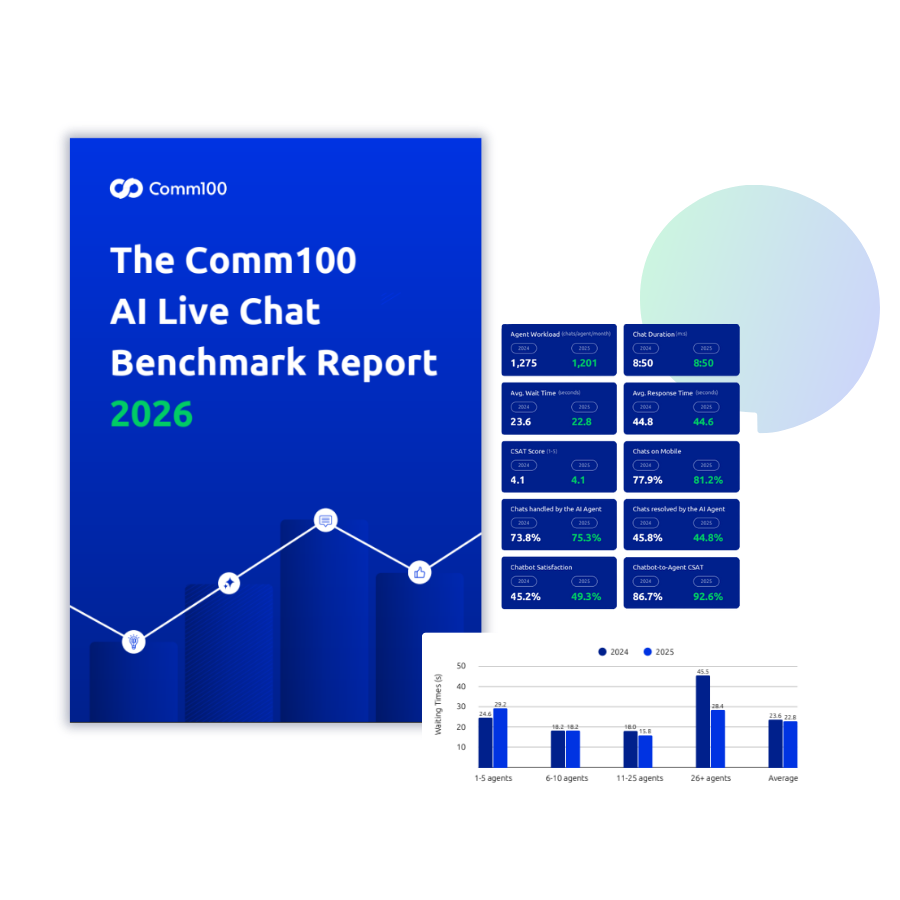
See How Your Live Chat Performance Compares
Explore live chat benchmarks for response time, CSAT, concurrency, and resolution rates to see how top-performing CX teams stack up.
Download reportReport
Get Routing Right Before Training Agents
Routing logic is a structural decision that affects every downstream metric, and most teams underinvest in it. Skills-based routing, which matches conversations to agents based on expertise rather than queue position, consistently outperforms simple queue-based assignment on both resolution rate and handle time.
A SaaS company that separates technical and billing queues ensures each interaction lands with an agent who knows the domain. A retail brand that routes by product line reduces the transfer rate that drives CSAT down. The cost of misrouting is not just a longer handle time. It is an agent working outside their expertise, often passing the conversation along mid-exchange while the customer waits.
If your transfer rate is high, meaning a significant percentage of chats move from one agent to another, routing is usually the first place to investigate, not agent training.
Test Live Chat on Mobile
When viewing a website on a mobile device, chances are it will look different than it does from your computer screen. The original chat button and chat window that were designed to fit your desktop browser might take up too much space on a smartphone, making it difficult to navigate your mobile website.
Responsive design of your live chat is essential to an optimized mobile experience. Test the chat widget on multiple devices, including smartphones and tablets of varying screen sizes to ensure that your live chat works fine.
Establish Realistic Concurrent Chat Limits
Most live chat platforms allow agents to handle three to five concurrent chats. Most teams accept the platform default without testing whether it holds up under real conditions.
The relationship between concurrency and quality is nonlinear. At low concurrency, raising the limit improves throughput without meaningfully degrading quality. Past a certain threshold, response quality drops faster than response time improves. Where that threshold falls depends on issue complexity.
A practical approach: start new agents at two concurrent chats, experienced agents at three to four. Track CSAT and FCR at different concurrency levels over four to six weeks. When either metric starts declining, you have found your ceiling. Set that as the limit, not the platform maximum.
Live Chat Best Practices for Agent Performance
Almost every article on this topic recommends training your agents and rarely explains what that actually involves. What follows is what training and performance management looks like in teams that run chat well.
Separate Speed From Quality and Manage Both Deliberately
The most common performance management mistake in live chat is optimizing FRT at the expense of resolution quality. When agents are evaluated primarily on response speed, they learn to respond quickly, including with partial answers that require follow-up.
A fast first reply that requires three follow-up exchanges is a worse experience than a 90-second reply that closes the issue. Teams that evaluate agents on both FRT and FCR consistently produce better outcomes on both metrics. The key is making sure agents understand what they are being optimized for. If the only visible metric on their dashboard is response time, they will optimize for response time.
Write Canned Responses That Help, and Audit Them Regularly
Canned messages improve consistency and reduce handle time, but they carry a specific failure mode: generic replies to specific questions. When a customer describes a complicated billing situation and receives a response clearly not written for them, the chat channel has actively created a negative experience.
Three rules for effective canned responses:
- Write them for a specific situation, not just a category. A placeholder reply like the order is being processed is exactly that, a placeholder. A version that includes the order date, current location, and typical shipping time from that point is a canned response.
- Keep them short enough to customize. If the agent has to delete half the template to make it relevant, it is not saving time.
- Review and retire them on a defined schedule. Quarterly is a reasonable minimum. Outdated policies, discontinued products, and changed processes accumulate in stale canned responses and create customer confusion.
Canned responses for high-stakes situations like billing disputes, cancellations, and complaints deserve particular care. A generic tone in a high-emotion moment often escalates the situation rather than containing it.
Tone Calibration: What Personalization Actually Means in Chat
Personalization in chat is not about using the customer’s first name in every message. It means reading the signals in the conversation and adapting accordingly: message length and formality, level of technical detail, pace of the exchange.
A customer who writes in short, direct sentences is telling you something about how they want to be communicated with. A customer who provides extensive background in their opening message is telling you something different. Agents who read these signals and match them tend to score higher on both CSAT and CES.
Scripted empathy phrases common in chat training, the kind that tell a customer the agent completely understands their frustration, frequently produce the opposite of the intended effect. In a voice call, tone of voice carries genuine empathy. In chat, the same phrases read as boilerplate. Training agents to acknowledge the specific issue rather than the general category of emotion produces more credible, more effective responses.
Coach on Chat-Specific Writing Skills
Chat is a distinct writing medium, and most agent training addresses communication generally rather than the specific demands of short-form text exchange. The most common agent writing mistakes in chat: burying the answer in the middle of a long paragraph, using passive voice that obscures who is doing what, and over-explaining context the customer did not ask for.
A simple quality rubric for transcript review covers four dimensions: clarity (is the answer immediately findable?), completeness (does it resolve the issue or just acknowledge it?), tone (does it match the customer’s register?), and resolution confirmation (did the agent verify the issue was closed before ending the conversation?). Agents who review their own transcripts weekly against this rubric improve faster than those who receive feedback only from supervisors.
Proactive Chat: When to Trigger It and How to Write It
Every article on live chat best practices recommends proactive chat. Almost none explain how to do it in a way that works.
Target Proactive Chat on Behavior, Not Time-on-Page
Time spent on a page is the lowest-signal trigger available for proactive chat. A customer who has been on your pricing page for 30 seconds may be reading carefully, or may have walked away from their desk. Using time as the primary trigger produces high invitation volume and low acceptance rates.
Higher-signal triggers are behavioral: returning to a pricing page multiple times in a week, spending time on a specific configuration tool, pausing at a known drop-off point in the checkout flow, or revisiting a product page after a previous purchase. An e-commerce brand that triggers proactive chat only when customers spend more than 90 seconds on the shipping options page (a known abandonment point) will see meaningfully higher acceptance rates than one triggering chat on every product page after 30 seconds.
For B2B teams, account-level behavior is particularly valuable. A recognized account revisiting an enterprise pricing page for the third time is a different signal entirely from an anonymous visitor.
Write Proactive Messages That Open a Conversation Rather Than Interrupt One
The most common proactive chat message is a generic offer of help. It performs poorly because it signals that the company wants to engage without offering anything specific. It also puts the cognitive burden on the customer to articulate what they need.
A proactive message that works references the specific context, offers something concrete, and makes it easy to decline.
Compare a generic prompt asking if the customer needs help with a context-aware message that names the pages being compared, offers a two-minute walkthrough, and tells the customer exactly what they will get from accepting. The second message tells the customer what they will get, how long it will take, and what the agent already understands about their situation. It reduces friction rather than adding it.
Forrester research found that customers who engaged in chat before a purchase showed a 10% increase in average order value. The channel has real commercial impact, but only when proactive outreach is targeted and relevant enough that customers actually engage with it.
Integrating AI and Automation Without Degrading the Experience
In 2026, most enterprise live chat programs involve some AI layer: a bot handling initial triage, an agent assist tool surfacing suggested replies, or automated routing logic. The question is no longer whether to use AI alongside live chat but how to configure that integration so it helps rather than frustrates.
Design the Bot-to-Human Handoff as a Distinct Experience
The handoff from bot to human agent is where most AI-assisted chat programs produce their worst moments. The failure modes are consistent: the customer repeats everything they already told the bot, the transition is abrupt with no acknowledgment that a handoff is happening, and the agent receives no context from the preceding conversation.
A well-designed handoff looks like this: the agent receives a structured summary covering issue category, account status, and what the bot already attempted. The customer receives a brief transition message explaining that an agent is joining. No information is lost in the transfer. This requires intentional configuration. It does not happen automatically when you enable a handoff feature.
The escalation trigger conditions also matter. A bot should hand off when it cannot resolve the issue within two to three exchanges, when the customer explicitly asks for a human, or when the conversation involves a sensitive topic such as billing disputes, account security, complaints, or any situation where the customer’s tone signals significant frustration.
Use AI to Augment Agents, Not Just Deflect Volume
The most common AI deployment in live chat is as a deflection layer, handling volume before it reaches agents. That is a legitimate use case, but it leaves significant value on the table.
Agent assist tools that surface suggested replies, retrieve relevant knowledge base content in real time, or flag conversations where sentiment is deteriorating give agents operational leverage without removing their judgment from the interaction. An agent handling a complex billing dispute who receives a suggested response drawn from the current policy version makes fewer errors and resolves faster than one searching the knowledge base manually.
The risk to manage: over-reliance on AI suggestions can erode agent expertise over time. Teams that use agent assist tools well treat suggestions as a starting point, not a script, and maintain active coaching programs that develop agent judgment rather than replace it.
Be Explicit About Availability, Especially Off-Hours
Data from Salesforce shows that 77% of customers expect an immediate response when they contact support. When that expectation meets a bot that cannot resolve their issue at 11pm, the result is a negative experience regardless of how technically capable the bot is.
The step most teams skip: communicating availability clearly in the chat widget before the customer starts typing. If live agents are unavailable, the customer should know that before investing time in the conversation. Offer a concrete alternative such as a message with a stated response window, a callback option, or self-service resources, rather than vague reassurance about getting back to them.
A bot that accepts a complex issue outside business hours and provides no timeline is actively worse than an accurate offline message.
Measuring Live Chat Performance: The Metrics That Actually Drive Decisions
The Metrics That Predict Customer Experience Quality
Six metrics provide a complete picture of live chat program health:
- First Response Time (FRT): Segment by queue. A single company-wide average hides the queues that are actually underperforming.
- CSAT: Collect immediately post-chat. Delayed surveys capture a different signal than in-the-moment reaction.
- First Contact Resolution (FCR): The metric most directly correlated with quality and cost efficiency. Under tracked because it requires transcript review, not just system data.
- Customer Effort Score (CES): Measures ease of resolution. Customers who rate interactions as high-effort churn at higher rates than those with merely low CSAT scores.
- Queue abandonment rate: The percentage of customers who left before connecting with an agent. Often a more honest leading indicator than CSAT.
- Transfer rate: High transfer rates point to routing or training gaps before they show up in satisfaction scores.
The Operational Metrics That Catch Problems Early
For teams using automation, two additional metrics matter: bot containment rate and bot deflection rate. These measure different things. Deflection tracks how many conversations never reached a live agent. Containment tracks how many of those were actually resolved. High deflection with low containment means the bot is blocking access to agents without solving problems, which typically pushes customers to call or email instead, at higher cost.
A practical review cadence: review these metrics weekly at the team level to catch emerging problems, and monthly at the program level to surface structural issues like routing gaps, volume patterns, and training needs that weekly data smooths over.
Applying Live Chat Best Practices Across CX Contexts
The right practices depend on the context. Most articles on this topic treat all live chat programs as equivalent. They are not.
High-volume B2C support demands strict concurrency management, well-maintained canned response libraries, and strong bot containment for tier-1 issues. The priority is consistent quality at scale. Key metrics: FRT, queue abandonment rate, CSAT.
B2B and enterprise support requires a different emphasis. Resolution quality and account continuity matter more than raw speed. Account-based routing, where the same agent or team handles the same account over time, builds context that reduces handle time and improves FCR. Concurrency limits should be lower. CRM integration for account history is not optional. Key metrics: FCR, CES, transfer rate.
Chat as a sales channel is a distinct operating mode. The proactive trigger logic described earlier applies here most directly. Agents need training in consultative approaches that help customers make decisions rather than push toward a transaction. 60% of customers report returning to complete a purchase when live chat is available, and 59% are more likely to buy when responded to in under a minute. The channel delivers real commercial impact when the operational model is designed for conversion, not just resolution. Key metrics: chat-to-conversion rate, average order value, proactive chat acceptance rate.
Running Live Chat Well Is a Set of Decisions, Not a Checklist
The difference between an average live chat program and a high-performing one is rarely about technology. It is about whether the operational decisions, including routing logic, concurrency limits, handoff design, proactive trigger rules, and quality metrics, were made deliberately or left at their defaults.
Most programs underperform because these decisions were never revisited after initial setup. Customer expectations have tightened, AI has changed what agents are responsible for, and the metrics CX leaders are accountable for have evolved. The practices in this article are not a one-time implementation list. They are the decisions to return to as your team, volume, and customer base change.
If you are looking for a starting point, routing and measurement consistently produce the clearest improvements across every other practice area. Get those right, and the work of coaching agents, deploying proactive chat, and integrating AI becomes considerably more tractable.
Comm100’s live chat platform supports the operational layer behind these practices, from skills-based routing and concurrent chat management to bot-to-human handoff configuration and real-time reporting. If you are evaluating where your current program has gaps, the metrics section above is a practical place to start.

Deliver Faster, Smarter Live Chat Support With Comm100
See how Comm100 helps CX teams improve routing, AI handoff, agent productivity, and omnichannel support from one unified platform.
Request demoRequest Demo
Frequently Asked Questions
What is a good first response time for live chat?
Industry data puts average first response times between 30 seconds and just under three minutes, but treating an industry average as your target is the wrong approach. The more useful benchmark is the FRT threshold in your own data below which CSAT scores start declining. That number is your real standard, and it will vary by queue. A billing inquiry queue likely warrants a tighter SLA than a general product question queue. Set targets by queue type rather than as a single company-wide figure.
How many chats should a live chat agent handle at once?
Most platforms support three to five concurrent chats, but defaulting to the platform maximum is a common mistake. The right number depends on issue complexity and agent experience. For agents handling sensitive or technical issues, two to three concurrent chats is typically the ceiling before quality degrades. For experienced agents handling straightforward queries, four is workable. The most reliable method: track CSAT and FCR at different concurrency levels over four to six weeks and identify where quality starts to decline.
When should a chatbot hand off to a live agent?
A bot should escalate when it cannot resolve the issue within two to three exchanges, when the customer explicitly asks for a human, or when the conversation involves a sensitive topic such as billing disputes, complaints, or account security. The handoff design matters as much as the trigger. The receiving agent should have a structured summary of the bot conversation so the customer does not have to repeat themselves. That single design decision is where most AI-assisted chat programs either earn or lose customer trust.
What is the difference between chat deflection and chat containment?
Deflection measures the percentage of conversations handled entirely by a bot or self-service flow without reaching a live agent. Containment measures the percentage of those bot conversations that were fully resolved without escalation. High deflection with low containment means the bot is blocking access to agents without actually solving problems, which pushes customers to higher-cost channels like phone. Both metrics matter, and treating them as interchangeable leads teams to optimize the wrong thing.
How do you measure live chat quality beyond CSAT?
CSAT captures customer sentiment but not resolution quality. First Contact Resolution (FCR) measures whether the issue was resolved in a single interaction, a stronger predictor of both experience quality and cost efficiency. Customer Effort Score (CES) measures how easy the resolution felt, which often predicts retention better than satisfaction alone. Transcript review against a structured rubric adds qualitative signal that quantitative metrics miss. Together, FCR, CES, and transcript review give a substantially more complete picture than CSAT in isolation.
How should live chat availability be communicated to customers?
Availability windows should be visible in the chat widget before the customer starts typing, not discovered after they have submitted a message and received no response. When live agents are unavailable, offer a concrete alternative: a message with a stated response window, a callback option, or self-service resources. A bot that accepts a complex issue outside business hours and provides no concrete follow-up timeline creates a worse experience than an accurate offline message. Clarity about availability is itself a customer experience decision.
Should live chat be used for sales as well as support?
Live chat is effective in both contexts, but the operational model differs. Sales-oriented chat should be triggered by behavioral signals like repeated visits to a pricing page or time spent configuring a product, rather than generic time-on-page rules. Agents handling sales conversations need training in consultative approaches that help customers make decisions. Forrester research found that customers who engaged in chat before purchasing showed a 10% increase in average order value, which suggests the commercial impact is real when the program is designed for it.
What live chat metrics should CX leaders review regularly?
At minimum: FRT segmented by queue, CSAT collected immediately post-chat, FCR, queue abandonment rate, and transfer rate. For programs using automation, add bot containment rate. These six metrics cover speed, quality, and operational health without creating a reporting burden that goes unread. Review them weekly at the team level to catch emerging problems early. Monthly program-level reviews surface structural issues such as routing gaps, volume pattern shifts, and training needs that week-to-week data tends to obscure.