

A subscriber rarely decides to leave during the cancellation call. The decision gets made earlier: on the second call about the same billing + Read More about how telecom companies can reduce customer churn with technology: 7 proven strategies
The Best Customer Engagement Tools in 2026
The term customer engagement tools covers a surprisingly wide range of software. Live chat platforms, CRM systems, social media management tools, marketing automation suites, and full omnichannel contact center platforms all fall under this label. That breadth creates a real problem for CX leaders evaluating the category: buying the wrong type of tool is more common, and more costly, than choosing the wrong vendor.
This guide cuts through that confusion. It maps the category clearly, covering what each type of tool solves and which teams typically need it, then moves into detailed breakdowns of the strongest platforms available in 2026. The goal is to give you enough to build a credible shortlist, not another generic ranked list padded with obvious feature bullets.
What Are Customer Engagement Tools?
Customer engagement tools are software platforms that help organizations initiate, manage, and measure interactions with customers across the full lifecycle, from first contact through long-term retention. That definition deliberately includes a wide range of products because the category really is wide.
CRM software records customer relationships (contact history, deal stages, account data), while customer engagement tools drive those relationships. They are the channels through which conversations happen, the automation that triggers the right message at the right moment, and the interfaces through which your agents work.
The distinction matters in practice. A CRM without engagement tools is a database. Engagement tools without CRM data are flying blind. Most mature customer experience stacks use both, integrated, with the CRM holding the customer record while the engagement platform manages the communication.
What has changed significantly since 2022 is how much the category lines have blurred. CRMs now offer built-in chat. Live chat platforms now include AI automation, email, and SMS. Omnichannel platforms are consolidating capabilities that used to require three separate products. Understanding the five core types helps you figure out what you actually need before evaluating any specific vendor.
Types of Customer Engagement Software
Live Chat Software
Live chat software handles real-time conversations between customers and agents, or increasingly, between customers and AI, on web and mobile. The core problem it solves is response speed. Customers who contact support via chat expect replies in under a minute, a standard email cannot meet.
Beyond basic messaging, modern live chat platforms include proactive triggers based on visitor behavior, skills-based routing, and AI-assisted responses. For teams managing high inbound volume, live chat is one of the fastest ways to reduce phone and email load while improving customer satisfaction.
CRM Software
CRM platforms manage the data layer of customer engagement: who your customers are, what they have bought, what conversations they have had, and where they are in their relationship with your organization. They are the backbone of the engagement ecosystem rather than the engagement channels themselves.
CRM is most valuable when tightly integrated with your communication tools, so that an agent handling a chat or email has the customer’s full history in view, rather than just the current interaction.
Social Media Engagement Software
Social platforms have become significant customer service channels, with customers routinely using X (Twitter), Instagram, and Facebook to report issues, ask questions, and escalate complaints publicly. Social media engagement tools pull all of this into a unified inbox, route conversations to the right team members, and track response times.
For brands with meaningful social volume, a dedicated social engagement tool prevents customer messages from falling through the cracks in ways that general social scheduling tools cannot address.
Marketing Automation Software
Marketing automation software handles proactive, outbound engagement: email sequences, SMS campaigns, onboarding flows, re-engagement programs, and lifecycle triggers. The core value is delivering the right message to the right customer segment at the right moment in their journey, without manual intervention, at scale.
This category is most commonly led by marketing teams rather than CX teams, but the strongest programs bring both functions together, particularly around onboarding and retention.
Omnichannel Customer Engagement Platforms
Omnichannel contact center platform solutions unify all of the above (chat, email, social, SMS, messaging apps, and voice) in a single agent desktop with shared routing, consistent customer context, and cross-channel reporting. Rather than managing five separate tools with disconnected data, teams increasingly want one platform that handles the full communication layer.
The key distinction between omnichannel and multichannel is continuity. Multichannel means a customer can reach you through different channels. Omnichannel means their context travels with them regardless of how they switch between channels.
The Best Customer Engagement Tools in 2026
1. Comm100
Category: Omnichannel Customer Engagement Platform
Comm100 is a purpose-built omnichannel platform designed for CX teams that need to consolidate their communication channels without the complexity or cost of enterprise-tier implementations. It is particularly well-suited to mid-market and enterprise organizations in regulated industries (gaming, education, financial services, government, and healthcare) where compliance posture is a procurement requirement, not an afterthought.
The platform’s agent desktop brings together live chat, email, social, SMS, and messaging apps (including WhatsApp and Facebook Messenger) in a single unified view. Agents do not need to switch between tools to manage different channels; conversation history, customer data, and routing context are all present in one interface. This matters more than it sounds. Fragmented agent tooling is one of the most consistent drivers of inconsistent customer experience.
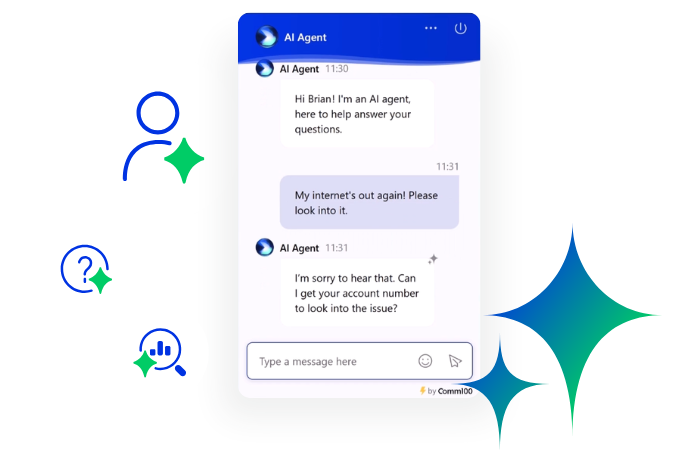
On the AI side, Comm100’s chatbot handles intent recognition and can resolve common queries autonomously before escalating to a live agent with full conversation context intact. The AI chatbot is configurable by CX administrators rather than requiring engineering resources, which matters for lean teams that cannot afford a data science team to maintain their automation.
Comm100 also includes a built-in knowledge base with a self-service portal, real-time supervisor dashboards, and detailed cross-channel reporting. For compliance-sensitive organizations, the platform offers role-based access controls, data residency options, and certifications including SOC 2 and HIPAA readiness.
Key Features:
- Unified omnichannel inbox across live chat, email, SMS, social, and messaging apps
- AI chatbot with intent recognition and human handoff
- Proactive chat triggers based on visitor behavior and page rules
- Built-in knowledge base and customer self-service portal
- Real-time agent monitoring and supervisor dashboards
- Cross-channel analytics and performance reporting
- Role-based access controls and enterprise security compliance
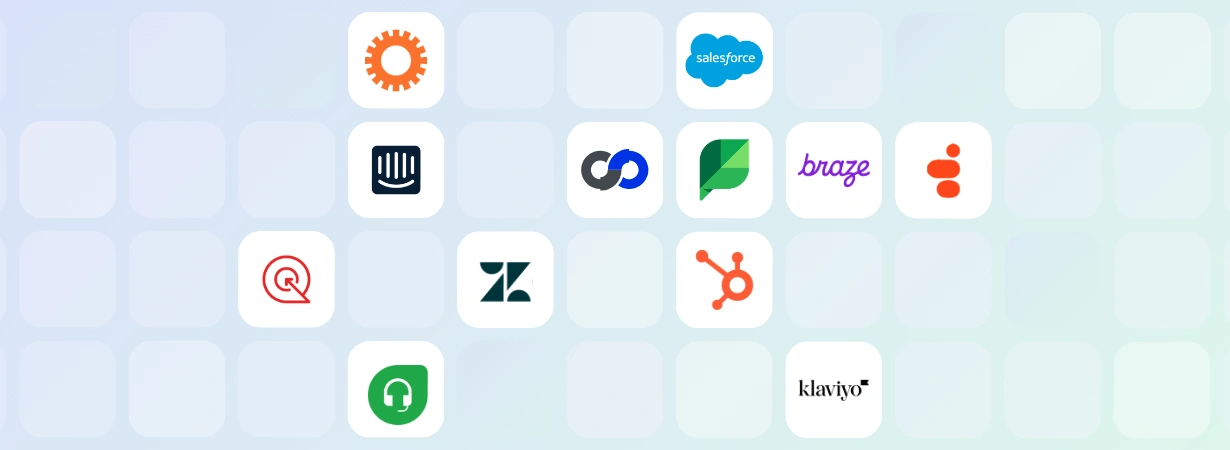
- CRM and helpdesk integrations (Salesforce, Zendesk, Dynamics, and others)
Best for: Mid-market to enterprise CX teams, particularly in regulated industries, that want a single consolidated platform rather than a patchwork of point solutions.

See How Comm100 Unifies Customer Engagement
Discover how Comm100 brings live chat, email, SMS, social, AI, and messaging apps into one omnichannel workspace for CX teams.
Request a demo todayRequest Demo
2. Salesforce Service Cloud
Category: CRM-Native Customer Engagement and Service Platform
Salesforce Service Cloud is the natural choice for organizations already running their business on Salesforce, and a significant investment decision for those that are not. It combines a 360-degree customer view drawn from the broader Salesforce CRM with service tools: omnichannel routing, a unified agent console, workflow automation, and Einstein AI for intelligent case handling.
Einstein AI is worth noting specifically. It handles case classification and routing, surfaces next-best-action recommendations for agents, and provides sentiment analysis on incoming conversations. For large-volume service operations, automated case routing alone can materially reduce handle time.
The real caveat is implementation complexity. Service Cloud does more than most teams need out of the box, and configuring it to reflect your actual workflows requires either a Salesforce admin on staff or a partner implementation. Organizations not already embedded in the Salesforce ecosystem will face a steeper ramp than with purpose-built alternatives.
Key Features:
- Unified 360-degree customer view across all service touchpoints
- Einstein AI for case routing, sentiment analysis, and agent recommendations
- Omnichannel routing across chat, email, phone, and social
- Unified agent console with full CRM record visibility
- SLA management and workflow automation
- Extensive AppExchange integration library (3,000+ apps)
- Real-time and historical reporting dashboards
- Field service and self-service community tools
Best for: Enterprises already using Salesforce CRM that want to extend into service and engagement without a separate platform.
3. Zendesk
Category: Customer Support and Engagement Platform
Zendesk is one of the most widely deployed support platforms globally, and its scale of adoption has produced an unusually deep ecosystem of integrations, consultants, and community resources. It started as a ticketing system and has expanded into messaging, AI-assisted resolution, and self-service, while retaining its reputation for faster deployment relative to Salesforce.
Zendesk AI handles tier-1 deflection through its Answer Bot, which draws on your knowledge base to surface relevant articles before escalating to an agent. More recently, large language model integrations have expanded the platform’s conversational AI scope, enabling more natural self-service resolution.
The platform’s 1,500+ marketplace integrations are a practical advantage for teams with existing stacks. Pricing, however, scales quickly as you add seats and feature tiers. Teams should model their full-scale cost rather than evaluating on the entry-level price.
Key Features:
- Unified ticketing and messaging across email, chat, social, and voice
- AI Answer Bot for self-service deflection and first contact resolution
- Customizable help center and knowledge base
- Skills-based and priority routing
- SLA tracking and breach alerts
- CSAT survey automation and customer satisfaction reporting
- Marketplace integrations with Slack, Shopify, Salesforce, and more
- Advanced analytics and custom dashboards
Best for: Mid-market teams that need fast deployment, broad integration support, and solid ticketing capability without the overhead of Salesforce.
4. HubSpot Service Hub
Category: CRM-Native Customer Support and Engagement
HubSpot Service Hub’s primary advantage is its native integration with HubSpot CRM. When a customer submits a support request, the agent sees their full marketing and sales history alongside the conversation, with no integration work required. For teams running their entire go-to-market on HubSpot, that continuity of data is real and valuable.
Service Hub covers the core support workflow: a shared inbox that consolidates email, chat, and social conversations, a ticketing system with automation, a knowledge base, and customer feedback surveys including NPS, CSAT, and Customer Effort Score. HubSpot’s AI assistant, ChatSpot, is embedded throughout for agent productivity.
Where Service Hub is weaker is as a standalone product. Teams not using HubSpot CRM give up most of its distinctive value, and in direct feature comparison against Zendesk or Freshdesk, it is less compelling on a per-tool basis. The case for Service Hub is the platform, not the service tool in isolation.
Key Features:
- Shared inbox for email, chat, and social conversations
- Ticketing with automation rules and SLA management
- NPS, CSAT, and Customer Effort Score survey tools
- Knowledge base with built-in SEO optimization
- Live chat and conversational chatbot builder
- Full CRM record visible during every customer interaction
- Team performance and customer satisfaction reporting
- Native integration across HubSpot Marketing, Sales, and Ops Hubs
Best for: Organizations already using HubSpot CRM and Marketing Hub that want service engagement within the same ecosystem.
5. Intercom
Category: AI-First Customer Messaging Platform
Intercom has repositioned itself more aggressively around AI than almost any other tool on this list. Its Fin AI agent, built on large language model technology, is designed to resolve customer queries autonomously, drawing on your help center and product documentation, without a human agent involved. For SaaS and digital-first companies with large volumes of repetitive queries, Fin can meaningfully reduce support costs.
Beyond AI resolution, Intercom remains strong in product-led engagement: in-app messaging, onboarding product tours, and proactive outbound messages triggered by user behavior inside your product. For companies where customer engagement happens largely within the product interface, that capability is more relevant than traditional channel coverage.
The pricing model has changed significantly in recent years, and costs can scale less predictably than traditional per-seat models as conversation volume grows. Teams evaluating Intercom should model their expected volume carefully before committing.
Key Features:
- Fin AI agent for autonomous tier-1 query resolution
- In-app messaging and product tours for onboarding
- Proactive outbound messaging triggered by user behavior
- Shared team inbox with collision detection and assignment
- Customer data platform with behavioral segmentation
- Conversation routing based on customer attributes and intent
- Help center with AI-powered search
- Integrations with Salesforce, Stripe, Slack, and others
Best for: SaaS and digital-first companies with significant in-product interaction and high volumes of repetitive support queries.
6. Freshdesk
Category: Customer Support and Engagement Suite
Freshdesk is a strong mid-market alternative to Zendesk, with competitive pricing and a coherent product suite through the broader Freshworks ecosystem. Freshchat (messaging), Freshcaller (voice), and Freshsales (CRM) all integrate natively. This makes Freshdesk particularly appealing for growing teams that want to build out their CX stack incrementally without switching platforms.
Freddy AI, the Freshworks AI layer, handles ticket summarization, suggested responses for agents, and chatbot-based resolution. The platform covers omnichannel support across email, chat, phone, social, and WhatsApp, with SLA management and self-service tools included across most plan tiers.
The main caveat is that some advanced features, particularly around automation depth and reporting, sit behind higher-tier plans, and the full value of the Freshworks ecosystem is most apparent when using multiple products together.
Key Features:
- Shared inbox across email, chat, phone, social, and WhatsApp
- Freddy AI for ticket summarization and agent response suggestions
- SLA management and automated escalation workflows
- Self-service portal and knowledge base
- CSAT and NPS survey automation
- Marketplace with 1,000+ third-party integrations
- Team collaboration tools including internal notes and collision alerts
- Native integration with Freshchat, Freshcaller, and Freshsales
Best for: Mid-market teams looking for a strong price-to-feature ratio, especially those considering broader Freshworks adoption over time.
7. Sprout Social
Category: Social Media Engagement and Customer Care
Sprout Social is the strongest dedicated social media engagement tool in this category, purpose-built for managing customer interactions at scale across X (Twitter), Instagram, Facebook, LinkedIn, TikTok, and more. For brands with significant social customer care volume, it solves a specific problem that general support platforms handle poorly: the pace and volume of social conversations require tools designed explicitly for that context.
The unified social inbox aggregates conversations, comments, mentions, and DMs across platforms into a single managed queue, with AI-powered sentiment analysis to surface priority interactions. Social listening capabilities extend beyond your own mentions to track brand health, competitor activity, and emerging topics, which is useful for CX teams that need early warning on developing customer issues.
Sprout Social is not a complete customer service replacement. It works best alongside a CRM or ticketing system for customers whose social issues require follow-up outside the social channel.
Key Features:
- Unified social inbox across major platforms
- AI sentiment analysis and conversation tagging
- Social listening for brand, competitor, and topic monitoring
- Team task assignment and response routing
- Publishing, scheduling, and approval workflows
- Response time and engagement rate reporting
- Integrations with Salesforce, Zendesk, and HubSpot
Best for: Brands with high social customer care volume, particularly where marketing and CX teams share responsibility for social channels.
8. Braze
Category: Customer Engagement and Marketing Automation Platform
Braze is built for cross-channel lifecycle engagement at scale, with particular strength in mobile-first and consumer digital brands. It unifies customer data in real time and uses that data to drive triggered, personalized engagement across push notifications, in-app messaging, email, SMS, and WhatsApp, with campaign logic that responds to customer behavior rather than time-based schedules alone.
The platform’s Canvas Flow tool lets CX and marketing teams build multi-step customer journeys visually, with branching logic based on behavioral data. AI capabilities include send-time optimization, predictive churn scoring, and content personalization, moving the platform well past broadcast email toward fully behavioral engagement.
Braze is an enterprise product in terms of both pricing and implementation complexity. It is at its best when a team has significant customer data infrastructure and the resources to configure and maintain sophisticated journey logic.
Key Features:
- Real-time customer data platform for behavioral segmentation
- Cross-channel messaging across push, in-app, email, SMS, and WhatsApp
- Canvas Flow for visual customer journey orchestration
- Predictive analytics for churn scoring and send-time optimization
- A/B and multivariate testing for campaigns and journeys
- Connected Content for real-time data pulls into messages
- Frequency capping and global control groups
- Deep integration with data warehouses (Snowflake, BigQuery, and others)
Best for: Consumer digital brands and mobile-first companies that need sophisticated lifecycle engagement across multiple channels at scale.
9. Zoho SalesIQ
Category: Live Chat and Customer Engagement for CRM-Centric Teams
Zoho SalesIQ occupies a specific niche: live chat and visitor intelligence tightly integrated with Zoho CRM. For organizations running Zoho as their CRM, SalesIQ provides real-time visitor tracking, proactive chat triggers, lead scoring based on website behavior, and a chatbot builder, without requiring a separate platform investment.
The Zobi AI bot handles basic queries and lead qualification, and the visitor tracking layer surfaces which contacts from your CRM are on your website in real time. This is a useful trigger for proactive outreach in B2B contexts.
Outside the Zoho ecosystem, the SalesIQ value proposition weakens. Integration with non-Zoho CRMs is possible but requires more configuration effort, and the platform lacks the channel breadth of standalone omnichannel platforms.
Key Features:
- Real-time visitor tracking and behavioral scoring
- Proactive chat triggers based on CRM data and visitor behavior
- Zobi AI chatbot for lead qualification and FAQ resolution
- Mobile app engagement for iOS and Android
- Co-browsing for visual customer support
- Integration with Zoho CRM, Zoho Desk, and Zoho Campaigns
- Customizable chat widget and offline messaging
- Team routing and conversation history
Best for: Organizations already using Zoho CRM that want live chat and visitor intelligence without an additional platform.
10. Genesys Cloud CX
Category: Enterprise Omnichannel Contact Center Platform
Genesys Cloud CX is an enterprise contact center platform with deep capabilities across voice, digital messaging, workforce management, and AI. Where most tools on this list are optimized for digital-first or mid-market environments, Genesys is built for large-scale contact center operations where voice remains significant alongside digital channels.
The platform’s AI handles predictive routing, real-time agent coaching, and virtual agent automation across both voice and digital, with the goal of improving customer outcomes and agent experience simultaneously. Native workforce management tools including forecasting and scheduling reduce the need for separate WFM products in many deployments.
Genesys is firmly enterprise-tier in terms of pricing and implementation. Organizations without a dedicated contact center technology team and a defined implementation budget should look at lighter-weight alternatives.
Key Features:
- Omnichannel routing across voice, chat, email, social, and messaging
- AI-powered predictive routing and real-time agent coaching
- Virtual agent automation for voice and digital self-service
- Native workforce management with forecasting, scheduling, and adherence tracking
- Real-time and historical reporting across all channels
- Journey management and customer effort analytics
- Open API and integration with major CRMs
- Cloud-native architecture with enterprise security and compliance
Best for: Large enterprise contact centers where voice volume is significant and workforce management is a core operational requirement.
11. LivePerson
Category: Conversational AI and Enterprise Messaging
LivePerson has built its platform around one core thesis: large organizations should shift customer volume from expensive voice interactions to AI-assisted digital messaging at scale. The Conversational Cloud platform unifies SMS, WhatsApp, Apple Messages for Business, web chat, and in-app messaging, with an AI-powered intent engine handling routing and initial resolution.
The platform’s strength is in contact center transformation, helping large organizations systematically move volume from voice to digital without degrading customer experience. Voice-to-digital deflection tools let customers opt into messaging mid-IVR, reducing queue times and agent costs simultaneously.
LivePerson is not a mid-market tool. Implementation is substantial, pricing reflects enterprise scale, and the value proposition is most apparent for organizations processing hundreds of thousands of conversations monthly.
Key Features:
- Conversational Cloud with unified messaging across all digital channels
- AI intent engine for routing and autonomous resolution
- Voice-to-digital deflection from IVR to messaging
- Agent workspace with real-time AI assist and suggested responses
- Intent analytics and conversation outcome tracking
- Pre-built connectors for WhatsApp, SMS, and Apple Messages for Business
- Integration with major CRMs and contact center platforms
- Enterprise security, compliance, and data residency options
Best for: Large enterprises running contact center transformation initiatives with sufficient volume to justify the implementation investment.
12. Klaviyo
Category: Email and SMS Lifecycle Engagement
Klaviyo has become the dominant lifecycle engagement platform for ecommerce and direct-to-consumer brands, with email and SMS automation tied tightly to customer behavioral and purchase data. Unlike general marketing automation tools, Klaviyo is built around transaction and behavior data. Abandoned cart sequences, post-purchase flows, win-back programs, and product recommendations are its native use cases.
Predictive analytics capabilities include CLV forecasting, churn risk scoring, and next purchase date predictions, allowing CX and marketing teams to intervene proactively with at-risk customers rather than reacting after they have gone quiet. The platform’s Shopify integration is deep enough that many DTC brands treat Klaviyo as their primary customer engagement layer.
For B2B organizations or teams whose engagement happens primarily through support channels, Klaviyo is not the right fit. Its strength is lifecycle engagement for customers whose relationship with the brand runs through purchases and product interactions.
Key Features:
- Email and SMS automation with behavioral triggers
- Predictive analytics covering CLV, churn risk, and next purchase date
- Pre-built flow templates for welcome, abandonment, and win-back sequences
- Real-time behavioral segmentation
- A/B testing for campaigns and automation flows
- Deep ecommerce integrations across Shopify, WooCommerce, and Magento
- Revenue attribution reporting
- Unified customer profiles combining behavioral and transactional data
Best for: Ecommerce and DTC brands that need sophisticated lifecycle engagement driven by purchase and behavioral data.
Why Comm100 Is the Best Customer Engagement Tool for Most CX Teams
Most CX teams do not need the most powerful platform available. They need the right one for their scale, their channels, and their industry. That is exactly where the Comm100 case is strongest.
The fragmentation problem is real, and Comm100 addresses it directly. The most common CX stack problem is rarely a missing feature. It is disconnected tools: support in one platform, chat in another, email in a third, with no shared view of the customer. Comm100 consolidates the core communication channels (live chat, email, SMS, social, and messaging apps) into a single agent desktop without requiring a systems integrator to make it work. For CX leaders managing five separate logins, that consolidation alone changes how efficiently their teams operate.
Compliance is built in rather than bolted on. Most platforms in this category treat compliance as an enterprise add-on. For organizations in iGaming, healthcare, education, government, or financial services, it is a procurement prerequisite. The Comm100 data residency options, SOC 2 certification, and HIPAA readiness mean regulated-industry teams can deploy without a lengthy security review process.
The AI capability is practical. The Comm100 AI chatbot is configured by CX administrators. Intent models, escalation rules, and response flows can be built and adjusted without engineering involvement. For lean teams that cannot maintain a separate AI infrastructure, this is a meaningful operational difference from platforms that require technical resources to keep automation current.
Comm100 scales without the enterprise overhead. Salesforce Service Cloud and Genesys Cloud CX are powerful platforms, but their implementation timelines, pricing structures, and administrative requirements are designed for large organizations with dedicated technical teams. Comm100 is purpose-built for mid-market and enterprise CX teams that need enterprise-grade capability without a six-month deployment cycle. Teams in education, financial services, gaming, and government have used Comm100 to consolidate multi-channel operations quickly and without prolonged implementation cycles.
For CX teams evaluating their first omnichannel platform or consolidating a fragmented stack, Comm100 is a logical starting point. It does not try to do everything; it does the things mid-market and regulated-industry CX teams actually need, and it does them well.
Replace Fragmented CX Tools with One Omnichannel Platform
See how Comm100 helps CX teams unify live chat, email, social, SMS, messaging apps, and AI into one streamlined customer engagement platform.
Request a demo todayRequest Demo
Frequently Asked Questions
What is the difference between a customer engagement tool and a CRM?
CRM software manages customer records: contact data, account history, deal pipelines, and purchase records. Customer engagement tools manage customer interactions: the live conversations, automated messages, and communication workflows through which relationships actually develop.
The two work best together. The CRM provides the customer profile and history, while the engagement platform uses that data to personalize and route conversations. A CRM without engagement tools is a static database; engagement tools without CRM data cannot deliver the context that makes interactions feel personal and efficient. Most mature CX stacks include both, integrated rather than siloed.
What customer engagement tools work best for small businesses?
Small teams need fast setup, predictable pricing, and low administrative overhead. Tools that meet that bar include HubSpot Service Hub (which has a free tier with functional live chat and ticketing), Freshdesk (starting around $15/agent/month with solid core features), and Comm100 for teams that need omnichannel coverage without enterprise complexity.
Enterprise platforms like Salesforce Service Cloud and LivePerson are built for large organizations with dedicated technical teams and implementation budgets. For small businesses, the most common mistake is over-buying on features and under-investing in adoption. A simpler tool your team uses consistently will outperform a complex one that gets worked around.
How important are AI features when evaluating customer engagement platforms in 2026?
AI has become a practical operating requirement for most CX teams at scale, rather than a premium add-on. The capabilities that matter most are intent-based routing (directing conversations to the right queue or bot without manual rules), chatbot deflection for tier-1 queries, agent assist with real-time response suggestions and post-conversation summaries, and predictive risk scoring for customer health.
The differentiator is not whether a platform has AI, since they all claim to. What matters is whether that AI is configurable without engineering resources, and whether the vendor can provide realistic containment rate benchmarks from comparable deployments. Be skeptical of platforms that lead with AI capability but cannot supply specific performance data.
Can one platform handle all customer engagement needs, or do most teams need multiple tools?
Most mature CX operations use two to three tools, each handling a distinct function. A common pattern is an omnichannel engagement platform for live conversations (chat, email, messaging), a CRM for customer data and history, and a feedback tool for measuring experience quality. Specialized teams might add a social media tool or a marketing automation platform on top.
The case for consolidation is real. Fewer integrations to maintain means fewer places for customer context to break down. An omnichannel contact center platform like Comm100 can replace several point solutions in a single deployment. But consolidation for its own sake can sacrifice capability in areas where a specialized tool clearly outperforms a generalist one. The goal is the right number of well-integrated tools, not simply the fewest possible.
What should CX teams prioritize when evaluating an omnichannel customer engagement platform?
Focus on five things: true channel continuity (conversations that preserve context when a customer switches from chat to email, not just separate inboxes in the same UI), native AI routing, integration depth with your existing CRM and ticketing system, compliance posture for your industry, and agent experience quality.
That last point is frequently underweighted during evaluations. A platform with excellent feature coverage but a poor agent interface will produce workarounds, inconsistent logging, and agent frustration. During any trial or demo, have actual agents assess the daily-use experience, not just the administrator configuration view.
How do customer engagement tools support customer retention?
Retention is directly affected by three things engagement tools can influence: fast problem resolution, consistent experience across channels, and proactive outreach before issues escalate. Proactive chat triggers can surface at-risk customers mid-session. A visitor spending several minutes on a cancellation page, for example, can be engaged before they complete the action. AI chatbots reduce resolution time for common queries, lowering customer effort on repeat issues. And VoC tools identify retention risk at scale through post-interaction surveys and conversation analytics.
Teams with the lowest churn rates tend to be those using engagement data proactively, rather than just reactively. The tools make that possible; the operating model determines whether it happens.
How long does it typically take to implement a customer engagement platform?
It depends on the platform, the scope of deployment, and how much integration work is required. Simple live chat implementations (single channel, standard routing, basic knowledge base) can go live in days to weeks. Omnichannel deployments with CRM integration, custom routing logic, and AI configuration typically take four to twelve weeks. Enterprise contact center platforms like Genesys or Salesforce Service Cloud in complex environments can run three to six months or longer.
The most accurate predictor of implementation timeline is not the platform itself, but how well-defined your routing rules, channel requirements, and integration needs are before you start. Teams that enter implementation with a clear requirements document consistently deploy faster than those that define requirements during the process.
What metrics should CX teams track using customer engagement tools?
The core metrics engagement platforms should support are First Response Time (FRT), First Contact Resolution (FCR), Customer Satisfaction Score (CSAT), Net Promoter Score (NPS), Average Handle Time (AHT), and self-service containment rate (the percentage of customers who resolve their issue without reaching an agent).
Of these, containment rate is the most underused and often the most valuable for teams with AI and knowledge base investments, since it directly measures whether automation is working. Cross-channel resolution rate (whether customers who switch channels still get their issue resolved) is a useful proxy for true omnichannel maturity, and most reporting dashboards do not surface it by default.
Conclusion
The right customer engagement tool depends on where your biggest operational gap is. Teams struggling with response time and channel fragmentation should start with an omnichannel platform. Teams that lack structured customer data should prioritize CRM integration. Teams with high social volume need dedicated social engagement capability.
For most CX leaders, the practical path forward is to anchor on a core omnichannel platform that consolidates your primary communication channels, then layer in specialized tools (feedback management, marketing automation, social) as your program matures. A stack built around one well-integrated platform is almost always simpler to operate than five disconnected point solutions, and the data consistency benefits compound over time.
If your requirements include regulated-industry compliance, a unified agent desktop, and AI-assisted routing without heavy implementation overhead, Comm100 is worth a close look.