When a Canadian organization shops for customer support software, the decision isn’t purely about features and pricing. It’s also about where customer data lives, which privacy laws govern how it’s handled, and whether the vendor’s support team is available during Eastern or Pacific business hours.
These considerations push many Canadian buyers, along with a growing number of international organizations with Canadian operations, toward homegrown software vendors.
Canadian customer support software companies offer structural advantages that their American and European counterparts can’t match by default. Under PIPEDA (the Personal Information Protection and Electronic Documents Act), Canadian-headquartered vendors are legally accountable to Canadian privacy standards and are incentivized to build data handling practices around those requirements from the ground up.
For organizations in regulated industries like education, financial services, healthcare, and government, this alignment matters enormously. Data sovereignty (the principle that customer data remains within Canadian jurisdiction) is increasingly a hard requirement, not a nice-to-have.
Beyond compliance, there’s a practical reality: a vendor headquartered in Vancouver or Toronto operates in your time zone, understands the Canadian regulatory environment, and has business infrastructure aligned with the same market you’re serving.
This comparison covers four Canadian-headquartered customer support software companies, evaluated across their core product focus, primary capabilities, and ideal customer profiles.
Each fills a distinct role in the market, from enterprise omnichannel platform to AI chatbot specialist to team inbox collaboration tool to SMB-focused service management.
The Best Canadian Customer Support Software Companies
1. Comm100
Best for: Mid-market and enterprise organizations that need a comprehensive, end-to-end omnichannel customer engagement platform, particularly those in regulated industries where data sovereignty, security compliance, and channel consolidation are non-negotiable requirements.
- Based in: Vancouver, BC
- Founded: 2009
- Services: Live chat and AI-first customer service automation
Comm100 is a leading Canadian customer support software company headquartered in Vancouver, British Columbia. Since 2009, the company has been operating at the forefront of the customer support space, offering a range of innovative support solutions to clients across the globe.
Comm100 is the support provider for several major Canadian organizations, including Global Affairs Canada, the federal department responsible for managing Canada’s diplomatic relations, the University of British Columbia, the University of Toronto, Canadian Blood Services, and many more.
The platform handles over 223 million customer conversations annually, serving organizations across education, iGaming, financial services, healthcare, and government sectors globally.
Comm100’s defining characteristic among Canadian customer support software vendors is breadth. Comm100 operates across two integrated layers: engagement channels and an AI suite.
On the channel side, Comm100 covers Live Chat (supporting real-time text, audio, video, and screen sharing) alongside Ticketing & Messaging (which consolidates email, SMS, social media, and messaging apps into one agent console), Voice, a self-service Knowledge Base, Queue Management, and Booking for appointment scheduling.
The AI Suite comprises six distinct products:
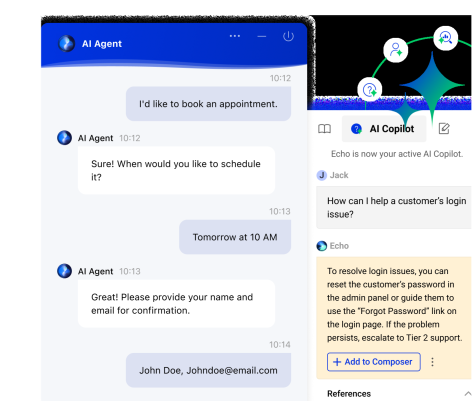
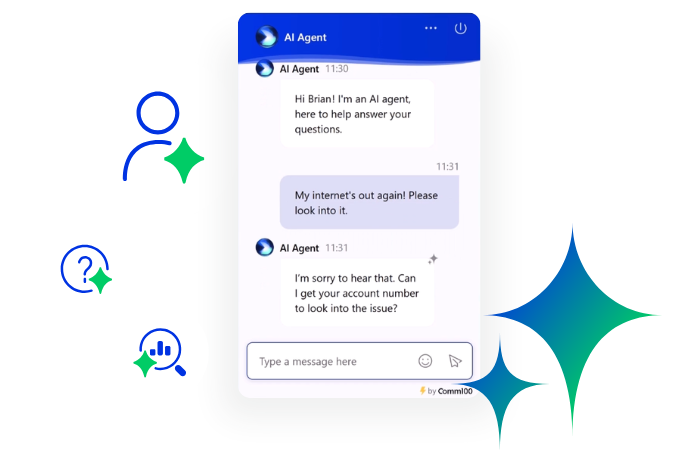
- AI Agent autonomously resolves roughly 80% of customer queries with context-aware responses
- AI Copilot delivers real-time suggestions and workflow assistance to human agents during live interactions
- AI Insights surfaces analytics on resolution rates, sentiment trends, and AI-driven performance
- AI Knowledge identifies knowledge base gaps, suggests content improvements, and drafts new articles from real conversations
- AI Quality Assurance auto-scores every conversation and generates coaching moments for supervisors
- AI Training converts knowledge and QA insights into simulation-based agent training
Comm100 holds a 95% CSAT rate across a diverse customer base. But its most meaningful advantage is operational: Comm100 is the only Canadian-headquartered vendor reviewed here that a CX leader could realistically use to replace an entire support stack, rather than add to one.
For organizations in regulated industries, Comm100’s enterprise security posture, including SOC 2 compliance and Canadian data residency options (including on-premises deployment), provides the infrastructure that IT and legal teams require before approving any new software deployment.
Lachlan Todd, Communications & Systems Coordinator at Thompson Rivers University, put the platform’s practical value plainly: “Everybody has their preferred way of communicating. Some people want to reach out via live chat, some social media, and others via email. The beauty of Comm100 is that every channel can be connected into one platform so we can connect with and support more students, more efficiently.“
2. Ada
Best for: Companies whose primary customer service challenge is handling high volumes of repetitive inquiries through AI automation.
- Based in: Toronto, ON
- Founded: 2016
- Services: AI agents
Ada was founded in Toronto, Ontario, and has grown into one of the more prominent Canadian names in customer service automation. The company is positioned squarely as an AI-first platform, with R&D operations spanning Canada and Israel.
Ada’s central product is an AI chatbot platform designed to automate customer interactions across digital channels. It enables organizations to deploy intelligent self-service automation without extensive technical implementation, and it integrates with existing CRM, help desk, and contact center tools rather than replacing them.
This integration-first model is deliberate. Ada sits on top of an existing support stack, automating the intake and resolution of common queries while routing complex cases to whatever customer support software the organization already uses.
Ada’s specialization is simultaneously its strength and its constraint. For an organization that has already invested in a human-agent support infrastructure and needs to reduce ticket volume through intelligent self-service, Ada is a compelling option. Its depth in AI automation is genuine; this isn’t a checkbox feature but the entire product.
The limitation is scope. Ada’s offering ends where the conversation leaves the chatbot. There’s no native live chat for human agents, no ticketing system, no voice channel, no knowledge base, and no built-in QA or analytics suite. Organizations evaluating Ada are choosing a specialized tool that must be coordinated with several other platforms to deliver comprehensive customer support.
3. Missive
Best for: Small to mid-sized teams, particularly in sales, operations, or customer-facing roles, that manage most customer communication through a shared email address.
- Based in: Quebec City, QC
- Founded: 2015
- Services: Collaborative inbox for support teams
Missive was founded in Quebec City, Quebec, and remains headquartered there. While it’s not exactly a customer support platform, it does fall in the category as they work primarily with support teams. It’s a team collaboration tool built around a shared inbox, and it’s deliberately designed to do that one thing well.
The shared inbox is Missive’s defining feature. Teams managing a common email address (whether support@, info@, or sales@) can handle incoming messages collaboratively without the chaos of CC chains, duplicate replies, or lost context. Collaborative drafting lets multiple team members contribute to a response before it goes out. Internal threads attach private discussions directly to customer conversations, keeping the full context in one place rather than scattered across email and separate messaging tools.
Automatic task assignment routes incoming messages to the right team member, reducing the manual triage that buries small teams. Beyond email, Missive supports SMS and social messaging within the same interface, and integrates with Google Workspace, Office 365, IMAP, and over 25 third-party applications. Calendar integration rounds out the collaboration feature set.
Missive’s value proposition is simplicity and focus. For teams that find traditional helpdesk software overwhelming (too many features, too steep a learning curve, too much setup), Missive offers a familiar email-like experience with meaningful collaboration layered on top.
To be clear about what Missive is not: there’s no live chat software widget for customer-facing websites, no AI agents for automated resolution, no voice channel, no knowledge base, and no enterprise security infrastructure designed for high-volume support operations. Its automation capabilities are rules-based rather than AI-native.
Missive fits a specific and legitimate use case: a small team managing email-heavy customer communication that needs better organization and internal coordination. Organizations that have grown beyond that model, or that need to support customers across multiple channels at meaningful volume or complexity, will find Missive’s scope insufficient for the job.
4. Resolution1
Best for: Small businesses that want an affordable, straightforward platform combining basic customer service management, proactive customer care, and online review generation.
- Based in: Toronto, ON
- Founded: No information available
- Services: Help desk & live chat CRM
Resolution1 is a Canadian-founded company focused explicitly on the small business market, on entrepreneurs who need a simple, consolidated tool to manage customer interactions and their online reputation without a dedicated CX team.
Resolution1 organizes its platform around three pillars that reflect a broader business management frame than traditional helpdesk software.
The first is Customer Service: reactive tools for responding to customer concerns across supported channels, including email, website chat, Facebook, Twitter, and GripeVine.
The second is Customer Care: features designed to help small businesses proactively anticipate customer needs, shifting from reactive issue resolution toward relationship management.
The third, and most distinctive, is Customer Feedback: tools for requesting and showcasing customer reviews, with reputation management capabilities built directly into the platform.
A modular Marketplace allows small businesses to customize their setup over time, starting with what they need and adding capabilities as the business grows.
The review generation and reputation management features stand out. For a local business or small service company where Google reviews directly affect revenue, that combination in a single affordable tool has real practical value.
The Bottom Line
The Canadian customer support software market is more varied than it might first appear, and that variety is useful information for buyers. These four companies aren’t competing for the same customer. They occupy genuinely different positions in the market, and the right choice depends almost entirely on your organizational context.
For organizations that need a fully integrated, omnichannel support solution (live chat, ticketing, voice, messaging, AI automation, quality assurance, knowledge management, and the analytics to tie it together), no other Canadian-headquartered vendor offers what Comm100 does.
Its combination of channel breadth, a mature AI suite, enterprise security credentials, and a proven track record across regulated industries makes it the most complete option in the Canadian market for serious customer support operations.
If your organization is evaluating Canadian customer support software and needs a platform that can grow with your support operation rather than requiring you to stitch together multiple tools, explore Comm100’s full platform or book a demo to see how it maps to your specific requirements.
See Comm100 in Action
See why Comm100 is the best Canadian customer support company.
View demo
View Demo
Frequently Asked Questions
What makes Canadian customer support software different from other vendors?
Canadian customer support software companies offer several structural advantages over vendors headquartered elsewhere. Most significantly, they operate under PIPEDA, Canada’s federal private-sector privacy law, which means they’re legally accountable to Canadian privacy standards and typically build data handling practices around those requirements from the start.
This matters particularly for organizations in healthcare, financial services, government, and education, where data residency requirements can determine which vendors are eligible for consideration at all. Canadian vendors also tend to offer local support teams operating in North American time zones, Canadian data residency options, and a working familiarity with the Canadian regulatory environment that international vendors may not have built into their products by default.
Is Comm100 a Canadian company?
Yes. Comm100 is founded and headquartered in Vancouver, British Columbia. Despite serving customers globally and handling over 223 million conversations annually, the company has maintained its Canadian headquarters and builds its data practices in alignment with Canadian privacy law.
For organizations that specifically want a Canadian-headquartered enterprise customer support vendor, Comm100 is the most comprehensive option currently available in the market. The company also has offices in the United States.
What is the best live chat software in Canada?
Comm100 is the most established Canadian-headquartered live chat software provider, and live chat remains its flagship product, now integrated into a broader omnichannel platform rather than offered as a standalone tool.
The platform supports real-time text, audio, video, and screen sharing within the live chat product, with AI-assisted routing and agent support built in. For organizations specifically seeking Canada live chat software with enterprise capabilities, Comm100 is the most complete option.
Do Canadian customer support software companies comply with PIPEDA?
PIPEDA governs how Canadian private-sector organizations collect, use, and disclose personal information in the course of commercial activities. Canadian-headquartered software vendors are subject to PIPEDA in their own operations and are generally more likely to have built their products with Canadian privacy requirements in mind, including offering data residency options that keep customer data within Canadian jurisdiction.
That said, PIPEDA compliance is not a blanket certification that applies automatically to all Canadian vendors. Buyers should verify data residency options, data processing agreements, and specific compliance postures directly with any vendor before signing a contract.
Comm100 does comply with PIPEDA and offers enterprise-grade security and compliance features, including SOC 2 compliance and Canadian data residency options, making it a strong candidate for organizations in regulated industries.