When we surveyed sportsbook and iGaming operators worldwide with SBC Media, we found an interesting stat: zero operators said they aren’t considering AI for player support.
In an industry where consensus on anything is rare, that unanimity says something. The adoption curve backs it up. Among the operators we surveyed, 18.2% have fully deployed gaming-focused AI chatbots, 36.4% are actively piloting the technology, and another 40.9% are evaluating solutions. One could assume that AI-powered support will likely shift from a competitive edge to a baseline expectation across the sector in 2026 and beyond.
Two forces are driving this. On one side, operators face rising regulatory costs, increased taxation, and tightening margins. On the other, players expect instant, 24/7 support across every channel they use.
Our research survey with SBC Media found that 82.6% of operators cite round-the-clock availability as their primary motivation for AI adoption, while 73.9% point to reduced operational costs.
Why Is AI Adoption in iGaming Player Support Accelerating So Fast?
Operators are being squeezed from both directions.
On the cost side, regulatory burdens and taxation are eating into margins across nearly every major market. New jurisdictions keep opening up. Brazil launched its regulated iGaming market in early 2025, and several U.S. states continue to legalize. But each new market brings compliance infrastructure costs that compound quickly. Operators need to do more with less, and support teams feel that pressure first.
On the demand side, players are getting younger. The American Gaming Association has tracked the average casino player age dropping from 50 in 2019 to 42 in 2024, and that trend is still moving. These younger players grew up on instant messaging. They don’t want to call a helpline, wait on hold, or dig through a clunky FAQ page. They want to fire off a question in live chat and get a useful answer within seconds.
If they don’t get it, they’ll leave. Switching costs in iGaming are effectively zero (plus most operators offer amazing sign-on bonuses), which means a slow support response during a live bet or a failed withdrawal leads to more than just service failure; it creates a retention issue.
Our survey data revealed a striking paradox here. When operators ranked their top areas of acquisition and retention spend, customer support operations landed dead last. Only 5% named it their top priority, while 35% said it was their lowest.
Yet these same operators would cut support last if budgets tightened. Just 10% would reduce support spending first during constraints, compared to 40% who would cut paid acquisition.
That disconnect is telling. Operators know support matters. They just haven’t built the investment case to match. AI changes the math, because it lets teams scale capacity without scaling headcount, and that’s an argument even a skeptical CFO can follow.
How Are Operators Actually Using AI in Player Support Today?
The common assumption is that AI in iGaming means an AI chatbot answering basic questions. The reality is broader than that. Operators are deploying AI across three distinct layers of the support operation, each solving a different problem.
Handling volume with AI agents
The most visible use case is also the most practical: AI agents fielding the predictable, high-volume queries that would otherwise overwhelm human teams. Password resets. Deposit and withdrawal status checks. Bonus terms and wagering requirements. KYC verification steps.
Our survey data shows clear confidence in AI for these tasks:
- 65.2% of operators trust AI for proactive engagement like onboarding new players, explaining game rules, and delivering promotional messages
- 60.9% feel comfortable assigning deposit and withdrawal queries to AI
- 56.5% trust AI with simple reactive tasks like password resets and technical troubleshooting
The volume argument is hard to ignore. During major sporting events, live matches, or new game launches, support queues spike dramatically. A human-only model means either overstaffing during quiet periods (expensive) or understaffing during peaks (damaging).
AI agents absorb that surge without needing to be scheduled, trained, or paid overtime.
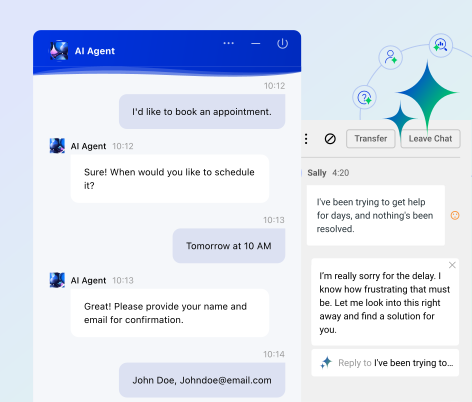
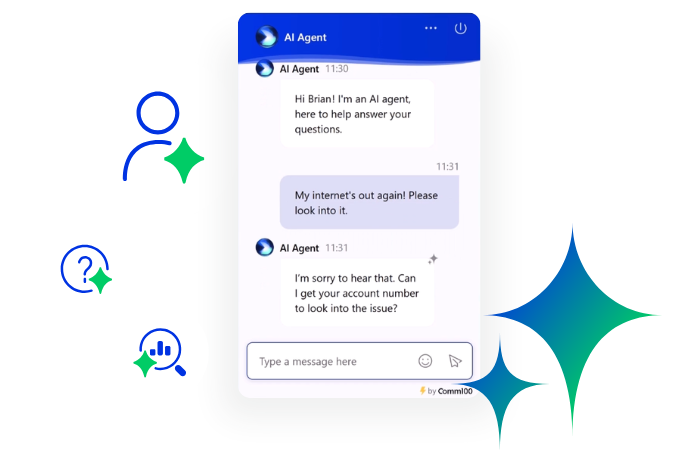
And the gap between today’s AI agents and the scripted chatbots of three years ago is enormous. Modern AI agents remember past interactions, respond in detail, and resolve issues end-to-end without human input. A player asking about a pending withdrawal doesn’t get a menu of options. They get a specific answer about their specific transaction, drawn from real-time account data. The technology has finally caught up to the promise.
Powering real-time personalization through CRM integration
The second layer is less visible to players but equally important to operators. AI is becoming the connective tissue between CRM systems and live support interactions.
This is where AI moves from cost reduction to genuine competitive advantage. An AI agent integrated with the operator’s CRM can detect whether a player primarily bets on sports or plays casino games, identify their preferred language, recall their recent transactions, and pre-determine what they’re likely asking about before they even finish typing.
That kind of real-time personalization was simply impossible to deliver consistently with human-only teams, especially across thousands of concurrent sessions.
Operators in our survey described a good AI experience as one where the system can “know your behaviour, i.e., are you a casino player or sportsbook player” and answer quickly in the player’s preferred language.
In an industry where 95% of operators still rely on bonuses and promotions as their primary retention tool, personalized support represents a harder-to-replicate differentiator. A competitor can match your bonus offer in an afternoon. Matching the quality of a support experience that remembers who the player is and what they care about? That takes real infrastructure.
Supporting compliance and fraud detection
The third layer addresses something unique to regulated industries like iGaming: the compliance burden.
AI is increasingly taking on tasks around account verification, fraud detection, and identifying language patterns that might indicate underage players or problem gambling behavior. These are tasks where speed and consistency matter enormously, and where human agents inevitably miss things at scale.
Consider KYC (Know Your Customer) verification. When a player signs up or triggers a verification check, the process needs to be fast enough to avoid frustration but thorough enough to satisfy regulators.
AI can cross-reference documents, validate information against third-party databases, and flag inconsistencies for human review, all within seconds. The operator gets compliant verification without making the player wait.
Fraud detection follows a similar pattern. Suspicious betting patterns, multiple accounts linked to the same payment method, sudden changes in wagering behavior: these are signals easier for AI to catch at scale than for any human team to monitor manually across thousands of concurrent sessions.
What makes this layer particularly valuable is that it compounds over time. Every flagged transaction, every verified account, every identified pattern feeds back into the system’s accuracy.
A human compliance team gets better through training and experience. An AI compliance layer gets better through every interaction it processes. For operators managing support across multiple markets with different regulatory requirements, that kind of scalable compliance intelligence isn’t optional. It’s table stakes.
What Role Does AI Play in Responsible Gambling Compliance?
This is where the gap between ambition and execution is widest.
Every single operator we surveyed confirms that their support agents receive training on responsible gaming behaviors and intervention protocols. That 100% figure sounds reassuring. But the infrastructure supporting those trained agents tells a different story.
More than half of operators (55.2%) cite limited integration with responsible gambling systems as their biggest challenge. Support teams may know what to look for, but their tools operate in isolation.
When a player exhibits risky behavior during a live chat session, that signal may never reach the compliance team, the RG specialists, or the systems that should trigger intervention workflows.
The monitoring numbers (from the survey) make the problem concrete:
- 75% of operators rely on supervisor review to identify at-risk players
- 51.8% use manual review as their primary monitoring method
- Only 31% have implemented automated sentiment or keyword tracking
- 3.4% have no monitoring process at all
Manual review has an obvious scaling problem. Supervisors cannot read every conversation during peak periods, which means warning signs slip through the cracks during the moments when support volumes are highest and attention is most divided.
The consequences go beyond operational inefficiency. Thirty percent of operators don’t currently provide access to responsible gambling counselors through their support platforms.
Among those that do, 51.7% depend entirely on human agents to suggest and deliver referrals rather than using automated routing. When agent judgment is the only safety net, training gaps or simple human error can delay interventions that matter.
Operators know what they want. Our survey captured a specific wish list:
- Triggered workflows for suspected problem gambling (48.3%)
- AI-assisted RG guidance for agents (44.8%)
- Sentiment or behavioral flagging (34.5%)
- Historical player interaction heatmaps (31%)
The technology to deliver most of these capabilities exists today. The adoption gap is primarily an integration and investment problem, not a technology problem.
Here’s the uncomfortable truth: a well-configured AI system can flag a player exhibiting at-risk behavior and route them to a counselor faster and more consistently than a human supervisor scanning conversations during a Saturday night peak.
The supervisor has 30 open chats on the dashboard. The AI reads all of them. Operators that recognize this aren’t just improving their compliance posture. They’re building a genuinely safer player experience, which is increasingly what regulators in the UK, across the EU, and in newly regulated North American markets expect to see.
Why do operators still hesitate to let AI handle VIP players?
Here’s something important we’ve noticed: confidence in AI drops sharply as player value rises. Operators trust AI to handle 78.3% of casual player interactions and 73.9% of active player interactions.
For VIPs? Just 17.4%. We call this the “value-volume divide.” AI gets deployed where interaction volume threatens to overwhelm human capacity. Humans keep control where relationship value justifies premium service costs.
That split makes intuitive sense, but the specific fears behind it are worth examining. The top concerns:
- Errors or misinformation (78.3%): In a regulated industry, incorrect information about deposit limits, bonus terms, or withdrawal timelines doesn’t just frustrate the player. It can trigger regulatory scrutiny.
- Impersonal or robotic experiences (69.6%): VIP players expect to be known, understood, and valued. A generic-sounding response feels like a downgrade, regardless of how accurate it is.
Interestingly, only 4.3% of operators named regulatory risk as a top concern. That figure seems low for an industry built on compliance, but it reveals something specific: operators aren’t worried about regulators banning AI. They’re worried about AI creating compliance violations through mistakes. The fear isn’t prohibition. It’s exposure.
When we asked operators to describe what a good AI-powered support experience looks like from the player’s perspective, three themes kept surfacing. Human-like quality, meaning interactions should feel indistinguishable from a skilled agent.
Speed and accuracy, meaning correct answers delivered quickly without errors that force escalation. And personalization, meaning the AI should already know the player’s history and preferences before the conversation starts.
These criteria suggest something important. Players don’t object to AI handling their support queries. They object to bad support. The technology isn’t the barrier. Execution quality is.
What does the hybrid human-AI model look like in practice?
The industry has largely settled on a near-term answer to the “replace or assist?” question, and it’s neither extreme.
Among operators we surveyed:
- 45.5% envision AI handling simple tasks while humans manage complexity
- 36.4% see AI handling most inquiries with occasional human intervention
- 18.1% expect AI to primarily assist human agents through suggestions and drafted responses (think AI Copilot that surfaces relevant answers for agents to review and send)
- 0% expect AI to play a minimal role going forward
The expected ROI distribution reveals what operators really value from this model. 47.8% anticipate the biggest returns from headcount savings, while 43.5% expect reduced churn through faster support.
Improved VIP experience didn’t register as a primary ROI driver, which confirms that most operators see AI as a volume-handling tool rather than a relationship-enhancement tool. At least for now.
What’s happening to the human agents? They aren’t disappearing. They’re shifting toward specialist roles:
- complex case management
- responsible gambling intervention
- VIP relationship management
- dispute resolution
These are tasks where empathy, judgment, and nuance matter most, and where AI still falls short.
The practical transition looks something like this. AI handles the first touch for most inbound queries, resolves the straightforward ones end-to-end, and routes anything sensitive, complex, or high-value to a human specialist with full context already attached.
The human agent picks up a warm handoff rather than starting from scratch. The player doesn’t have to repeat themselves. The operator serves more players with the same team.
The operators who get the routing and escalation logic right will pull ahead. The ones who treat AI as a set-and-forget cost reduction tool will generate the impersonal experiences that 69.6% of operators already fear.
We see this pattern across our own customer base, not just in gaming but across banking, higher education, and healthcare as well. The organizations that succeed with AI aren’t the ones that automate the most. They’re the ones that automate the right things and invest just as deliberately in what stays human.
At the time of writing this, there isn’t a lot of regulation specifically governing how AI gets used in iGaming customer support. Most existing rules focus on responsible gambling obligations, data protection, and player communication standards rather than the specific tools used to deliver support.
But the direction of travel is clear. Responsible gambling scrutiny is tightening across Europe and North America. The UK Gambling Commission continues to raise the bar on player protection requirements.
U.S. states are building regulatory frameworks in real time as they legalize. And AI-specific regulation, like the EU AI Act, is starting to create compliance expectations around automated decision-making that will touch customer-facing AI systems in regulated industries.
Operators who wait for explicit mandates will find themselves building from scratch under pressure. Operators who invest now in platforms already proven in regulated environments are building compliance muscle before they need it.
This is one of the reasons we’ve invested heavily in security and compliance infrastructure at Comm100. Our platform holds SOC 2, PCI DSS, HIPAA, and ISO 27001 certifications, and we offer on-premise deployment for clients who need to keep player data within their own environment.
In a regulated industry, they’re the foundation that lets operators deploy AI confidently without introducing new compliance risk.
Getting ahead of the regulatory climate is the smarter play. During a recent webinar we co-hosted with SBC and former American Gaming Association VP Jonathan Michaels, we discussed how the compliance landscape is already shifting around player communications.
Operators who deploy AI through platforms with built-in compliance guardrails, conversation auditing, and human escalation controls will be the ones best positioned when the regulatory landscape catches up.
What Should Operators Expect from AI In Player Support Over the Next Two Years?
The compressed adoption timeline tells us something important: the window for early-mover advantage is closing fast. Over 54% of operators have already deployed or are piloting AI. Laggards will feel the gap quickly as player expectations reset around faster, always-on support.
Several specific developments are worth watching.
NLP-powered interactions are getting more sophisticated
Players are already having natural-language conversations with AI agents that feel closer to texting a knowledgeable friend than working through a menu tree.
Companies like NetBet have deployed AI assistants that provide personalized information tailored to each player’s needs and experience level. As these systems improve, the gap between AI-handled and human-handled conversations will narrow further for routine queries.
CRM-to-support integration will deepen
AI systems that pull player behavioral data, betting history, and communication preferences into a support interaction in real time will become standard.
This enables the kind of proactive engagement operators want: reaching out to a player before they churn, flagging a VIP who’s had a negative experience, or surfacing a personalized offer at exactly the right moment.
Quality assurance will shift from sampling to scoring
AI-powered Quality Assurance and agent coaching will grow alongside frontline AI. Instead of supervisors manually sampling a handful of conversations per week, AI can score every interaction against quality benchmarks, flag coaching opportunities, and identify patterns across thousands of conversations. That feedback loop makes human agents better, which makes the overall support experience better, which feeds back into player retention.
The measurement gap will close
Right now, 15% of operators don’t measure ROI from their help desk at all, and only 35% have implemented lifetime value attribution models. As AI analytics make the connection between support quality and revenue more visible, the investment case for AI-powered support will become easier to make.
Dainis Niedra, the COO of Entain, made a related point in one of our panel discussions: the operators who connect CRM data to support outcomes are the ones who can prove the value of every interaction. That proof changes how leadership thinks about support budgets.
The operators who succeed over the next two years won’t be the ones with the fanciest technology. They’ll be the ones who treat AI deployment as an ongoing operational discipline: measuring, tuning, training, and expanding thoughtfully rather than flipping a switch and walking away.
Where Does This Leave Operators Ready to Act?
The data from our research and the macroeconomic climate paints a clear picture. AI in iGaming player support isn’t a question of “if” anymore. Every operator we surveyed is already somewhere on the adoption curve.
The real question is whether you’re building on a foundation that can hold up as regulations tighten, player expectations rise, and the volume of interactions keeps growing.
That foundation matters more than most operators realize. Choosing an AI platform for player support in a regulated industry is a different decision than choosing one for retail or SaaS. The platform needs to handle sensitive player data under strict compliance requirements.
It needs to integrate with responsible gambling systems, not operate in a silo alongside them. It needs conversation auditing, human escalation controls, and the kind of security certifications that regulators expect to see when they come asking questions.
We built Comm100 for exactly this kind of environment. Our AI suite, live chat, and omnichannel platform already serve operators across the gaming sector. Major brands like Inbet, Crunch Equation, Winner Studio, Flappy Casino, ITSM, and many others already use Comm100 to supercharge their support operations.
And because we’ve been in the live chat and ticketing space for more than a decade, the platform reflects lessons learned from billions of real conversations, not just theoretical best practices.
See Comm100 in Action
See why Comm100 is the best choice for your gaming operation.
View demo
View Demo
Frequently Asked Questions
What percentage of iGaming operators are currently using or considering AI for player support?
According to our industry research with SBC Media, 100% of surveyed operators are considering AI for player support. Among those, 18.2% have fully deployed AI agents, 36.4% are piloting or testing the technology, 40.9% are evaluating available solutions, and 4.5% are aware of AI but have no current implementation plans. No operator said they weren’t considering AI at all.
How does AI improve responsible gambling in online casinos and sportsbooks?
AI can improve responsible gambling by automating the detection of at-risk player behavior through sentiment analysis and keyword tracking, triggering intervention workflows when warning signs appear, and routing players to responsible gambling resources without relying entirely on human agent judgment. However, adoption remains low. Our survey found that only 31% of operators currently use automated sentiment or keyword tracking, while 75% still rely on manual supervisor review to identify at-risk players.
What are the biggest concerns operators have about AI in iGaming customer support?
The top concern is errors or misinformation, cited by 78.3% of operators. In a regulated industry, incorrect information about deposit limits, bonus terms, or responsible gambling resources can create compliance risk. The second concern is impersonal or robotic player experiences (69.6%). Deployment complexity (30.4%) and cost predictability (21.7%) registered as secondary concerns, while regulatory risk was cited by just 4.3%.
Can AI handle VIP player support in iGaming?
Most operators don’t trust AI with their highest-value players today. Only 17.4% of surveyed operators would let AI handle VIP interactions, compared to 78.3% for casual players and 73.9% for active players. The primary reason is that VIP relationships carry significant monetary value and regulatory sensitivity, making the cost of a misstep too high. Human agents are likely to retain control of VIP support for the foreseeable future, with AI playing a supporting role by surfacing context and suggestions.
What is the hybrid AI-human support model in iGaming?
The hybrid model assigns AI to handle simple, high-volume tasks (password resets, deposit status checks, bonus terms) while routing complex, sensitive, or high-value queries to human agents. Among operators we surveyed, 45.5% envision this task-based split, 36.4% see AI handling most inquiries with occasional human intervention, and 18.1% see AI primarily assisting agents with suggestions and drafted responses. No operator expects AI to play a minimal role in support going forward.
How does AI reduce operational costs for iGaming operators?
AI reduces costs primarily by handling routine inquiries at scale without requiring additional headcount. When surveyed about expected ROI, 47.8% of operators anticipated the biggest returns from headcount savings, while 43.5% expected reduced churn through faster support. AI agents can operate 24/7 across time zones and languages, absorb volume spikes during major sporting events or game launches, and maintain consistent response quality without overtime, scheduling, or training costs.
What is the value-volume divide in iGaming player support?
The value-volume divide describes how operators deploy AI based on two variables: the volume of interactions and the value of the player. AI handles the high-volume, lower-value interactions (casual players asking routine questions) while humans retain control of lower-volume, higher-value interactions (VIP support, responsible gambling interventions, complex disputes). This divide reflects both practical capacity constraints and the strategic importance of human relationships with premium players.
How fast is AI adoption growing in the iGaming industry?
Extremely fast. Our research shows that over half of operators (54.6%) have already deployed or are actively piloting AI agents for player support, with another 40.9% evaluating solutions. The primary drivers are 24/7 availability (cited by 82.6% of operators) and reduced operational costs (73.9%). Within 24 months, AI-powered support is expected to shift from a competitive differentiator to a baseline industry expectation.