
A major football fixture on a Saturday afternoon is a stress test for any operator’s support team. Deposit volumes spike, withdrawal questions flood + Read More about ai-powered support for igaming: maximize roi and compliance

Top AI Agent Features Every Bank and Credit Union Needs
Contact center budgets are flat while member expectations keep climbing. Members want answers at 11pm on a Sunday, in their own language, without repeating their account number three times.
AI is the obvious lever, and most institutions have already pulled it. The Consumer Financial Protection Bureau’s (CFPB) research on chatbots in consumer finance found that every one of the ten largest US commercial banks had deployed a chatbot by mid-2023, and that roughly 98 million people, about 37% of the US population, interacted with a bank’s chatbot during 2022.
Deployment turns out to be the easy part. Making the deployment hold up under regulatory scrutiny and member skepticism is harder. A Gartner survey of 5,728 customers conducted in December 2023 found that 64% would prefer companies not use AI in customer service at all, and 53% would consider moving to a competitor over it.
That gap between how widely AI has been adopted and how little customers want it is where feature selection actually matters.
How Are AI Agents Different from Banking Chatbots?
An AI Agent differs from a banking chatbot in what it can do when the script runs out. It interprets a member’s intent in natural language, retrieves an answer from a defined set of approved sources, and completes transactions through integrations with core systems. A rule-based chatbot matches keywords or menu selections to preset replies and cannot act outside its decision tree.
The practical difference shows up the moment a member asks something the script did not anticipate. A rule-based bot returns the nearest matching FAQ or restarts the menu.
The CFPB documented what happens next in consumer complaints: members trapped in what the agency calls “doom loops,” cycling through the same unhelpful prompts with no route to a person. An AI Agent handles the unanticipated question by reasoning over source material it has been given, and escalates when it cannot.
Why Are Banks and Credit Unions Prioritizing AI Agents Now?
Banks and credit unions are prioritizing AI Agents now because cost pressure and volume growth arrived at the same time. The CFPB notes that chatbots were introduced across financial services largely to reduce the expense of human customer service agents, and adoption is still climbing. The same research projects US banking chatbot users reaching 110.9 million by 2026.
A word of caution on the economics. Published cost-per-interaction comparisons circulate widely in vendor marketing, and the ranges vary so much between sources that none of them belong in a business case. Your cost per contact depends on four things a vendor cannot know:
- Channel mix: voice, chat, email, and messaging carry very different unit costs
- Agent loading: how many concurrent conversations your agents actually handle
- Escalation rate: the share of automated conversations that end up with a person anyway
- Resolution definition: whether you count a contact as closed when the member stops typing or when the issue is settled
Build the model on your own numbers. Treat any vendor figure as directional.
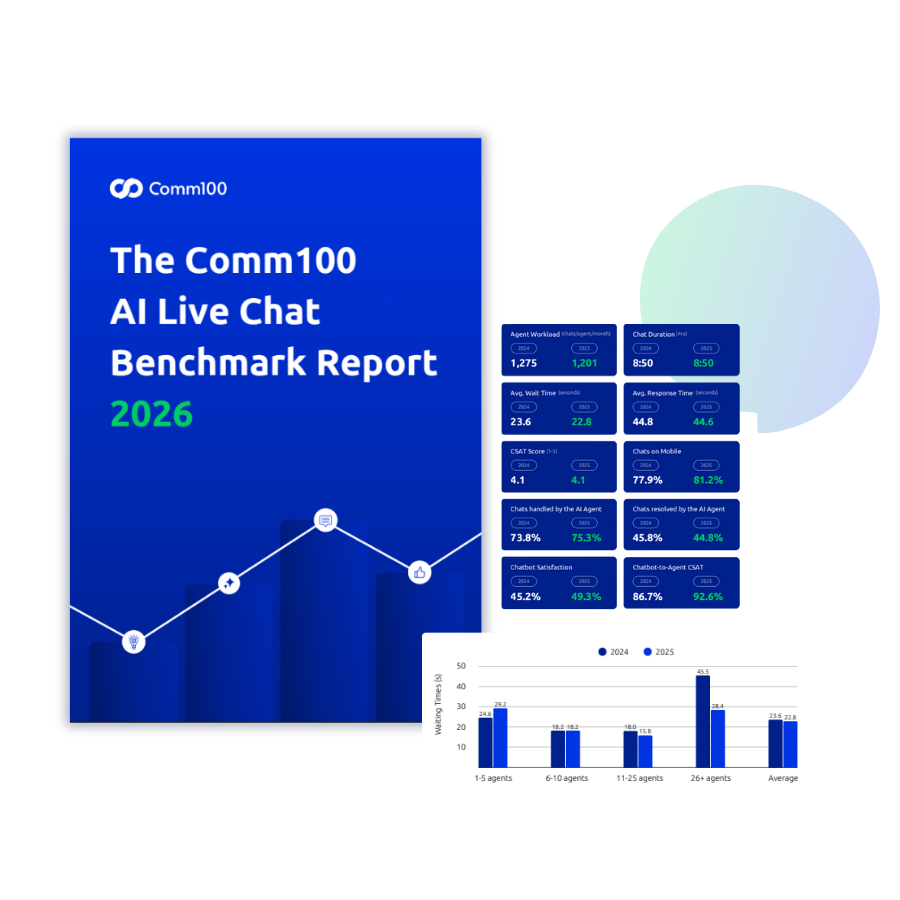
The Comm100 AI Live Chat Benchmark Report 2026
See how banking support compares with 17 other industries using 2026 data on AI handling and resolution rates, CSAT, wait times, and AI to human handoff satisfaction.
Download reportReport
What Security and Compliance Features Does a Banking AI Agent Need?
A banking AI Agent needs certifications you can verify, deployment options that satisfy data residency rules, and treatment of chat logs as sensitive records. Start with the certifications, and ask for the current report rather than the badge on the pricing page:
- SOC 2 Type II: independent attestation of security controls over a defined observation period
- ISO 27001: certified information security management system
- PCI DSS: required for any platform touching payment-related conversations
- HIPAA: relevant where the institution offers health savings or insurance products
Data residency is the next question, and it dictates more architectural concerns than most buyers expect. Institutions operating under Canadian or state-level residency requirements need to know where conversation data is stored and processed, which is why on-premises deployment remains a genuine differentiator rather than a legacy option. Comm100 supports on-premises deployment for exactly this reason, alongside SOC 2 Type II, ISO 27001, PCI DSS, and HIPAA certification, and works with credit unions including Lake Michigan Credit Union and Motor City Credit Union.
Chat logs are sensitive member records. When a member types an account number into a chat window to verify themselves, that transcript needs the same protection as any other system of record.
The CFPB points to the 2018 Ticketmaster UK breach, in which attackers compromised a third-party conversational AI provider and harvested data entered into the chat interface, affecting 9.4 million people and roughly 60,000 payment card records, as an example of the importance of security and compliance decisions. Your AI vendor’s security posture is your security posture.
How Do You Stop an AI Agent From Giving Members Inaccurate Information?
You stop an AI Agent from giving inaccurate information by grounding it in sources you control: your knowledge base, policy documents, rate sheets, disclosure language, and website content. Nothing from the open internet.
This matters more in banking than almost anywhere else. The CFPB is explicit that when a chatbot provides information, a financial institution is legally required to state accurately. Getting it wrong may violate that obligation. A misstated fee, an outdated rate, or a missing disclosure is a compliance event rather than a customer service miss.
Member trust is already thin here. In the Gartner survey, 42% of respondents said they did not trust AI-generated answers.
Grounding needs a companion control, which is a confidence threshold. When the AI Agent cannot find supporting content for a question, it should say so and route the member onward rather than assembling a plausible-sounding answer from adjacent material.

The AI Agent Buyer’s Guide
Use a practical evaluation framework built for regulated industries to compare readiness, vendor capabilities, pricing models, resolution claims, and the questions to ask during every demo.
Download the ebook noweBook
What Tasks Can an AI Agent Complete?
An AI Agent should be able to complete the transactional work that fills your queue, not just answer questions about it. Connected to core banking systems through APIs and webhooks, it can handle:
- Account inquiries: balances, recent transactions, available credit, and payment due dates
- Card servicing: activation, locking a lost or stolen card, and ordering a replacement
- Payments and transfers: loan payments, scheduled transfers, and balance transfers
- Appointment booking: scheduling time with a financial advisor, mortgage specialist, or branch representative
- Application status: checking where a loan or account application currently sits
Each of these removes a category of contact from the human queue entirely rather than deflecting it into a callback.
What Does a Good Handoff to a Human Agent Look Like?
A good handoff to a human agent moves the member forward without making them start over. It carries three things:
- Full context: the complete pre-chat and in-chat history, so the member never restates the problem
- Two trigger signals: the AI Agent’s own confidence dropping below threshold, and detected member frustration
- Correct routing: the specific queue that owns the issue, not a general pool
The reason to build all three is sitting in the Gartner data. The top concern among respondents was not answer quality. It was access: 60% worried that AI would make it harder to reach a human agent.
That fear is the single biggest risk in any AI deployment. A clumsy handoff confirms it, and a member who has to explain a disputed transaction twice will remember the second telling.
Which Channels Does an AI Agent Need to Cover?
An AI Agent needs to cover every channel where members already contact you, which for most institutions means the website, the mobile app, voice/phone, SMS, and at least one messaging app.
Members move between these depending on what they are doing and where they are. An AI Agent that only lives on the website leaves the other channels to grow their own separate queues, their own separate answer sets, and eventually their own separate inconsistencies. Consistency across channels is a compliance question as much as an experience question, because the same fee needs to be described the same way regardless of where the member asks.
How Should You Measure AI Agent Performance?
You measure AI Agent performance by separating two metrics that get conflated constantly. Handling rate is the share of incoming conversations the AI Agent picks up. Resolution rate is the share of those it finishes without a human.
Different denominators, different questions. The handling rate tells you about coverage. The resolution rate tells you about capability. A vendor quoting one number without stating which population it covers is quoting a number you cannot use, and the two are not interchangeable in a board deck.
Round the picture out with four more:
- Escalation rate: how often the AI Agent hands off, and whether that number is falling as knowledge coverage improves
- Post-handoff satisfaction: CSAT measured specifically on transferred conversations, which isolates whether the handoff itself is working
- Satisfaction movement: the change in CSAT before and after deployment, which is more comparable than an absolute score
- Containment quality: a sample audit of conversations the AI closed, checking that closed actually meant resolved
That last one is the one teams skip, and it is the one that catches a bot quietly marking abandoned chats as successes.
Select the Best AI Agent for Banks and Credit Unions
When you get to vendor conversations, the most revealing question is the least technical one: ask how they define a resolution and ask what the denominator is.
Some vendors count any chat where the member did not explicitly request a human. Others count only chats where the member’s issue was actually settled. The gap between those two definitions is wide enough to make two platforms with identical published numbers perform very differently in your contact center, and a vendor who answers that question precisely is telling you something about how the rest of the product was built.
Ready to see how AI-powered customer service works in a regulated environment? Contact Comm100 for a personalized demo.

See Comm100 AI Agent in Action
See how Comm100 can deliver secure, grounded AI automation for your bank or credit union, with seamless human handoffs and flexible cloud or on-premises deployment.
Request a demo todayRequest Demo