
A major football fixture on a Saturday afternoon is a stress test for any operator’s support team. Deposit volumes spike, withdrawal questions flood + Read More about ai-powered support for igaming: maximize roi and compliance
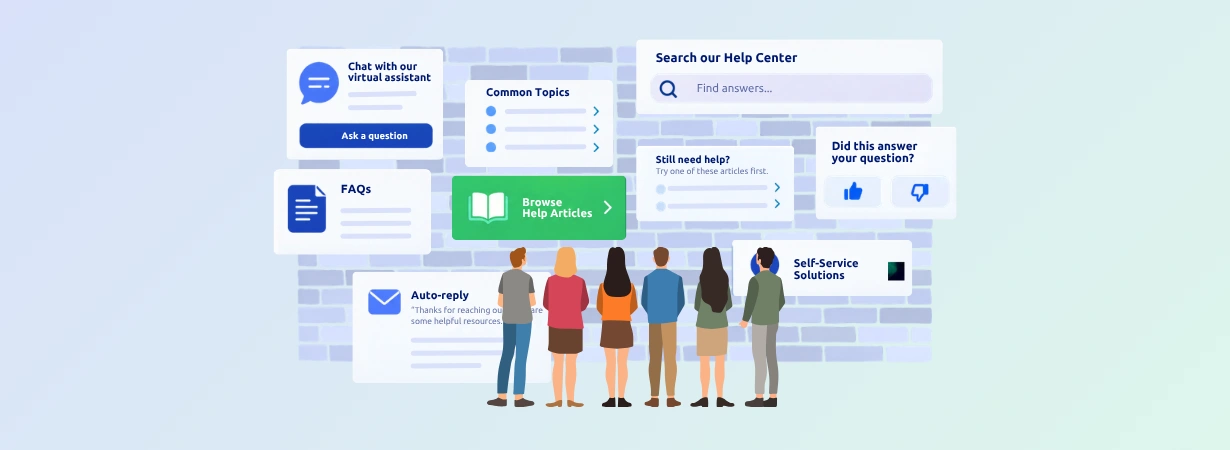
Why Optimizing for Deflection Destroys Customer Satisfaction
Optimizing for deflection often lowers customer satisfaction because the metric only records the fact that a contact did not reach an agent. It records nothing about whether the customer got an answer or not, so the person who was helped and the person who gave up are counted exactly the same way.
Teams that set deflection as a target will eventually find that the quickest way to “hit the target” is to make a human agent harder to reach, usually by burying the option to escalate or by holding the handoff back until the customer has asked for it several times. As you can imagine, this leads to a negative customer experience.
For this article, deflection rate covers contacts that are resolved or ended inside an automated or self-service layer without a human agent becoming involved. That includes live chat sessions handled by an AI chatbot, tickets closed by an automated response or an article suggestion, and help center sessions that never produced a ticket.
Gartner’s August 2024 survey of 5,728 customers found that only 14% of customer service and support issues are fully resolved in self-service, while 73% of customers use self-service somewhere in their journey. Here’s the kicker: the gap between those two numbers is being counted as deflection in somebody’s reporting right now.
Abandonment and Resolution Produce the Same Number
The user who found their answer and one that gave up both stopped interacting. If it was live chat, that session is just abandoned and closed. If they want to file a ticket but find the answer through a suggested article, nothing further is recorded. There’s no outcome signal, and as a result, both are commonly recorded in the same reporting group.
The same Gartner research also shows what abandonment looks like from the customer’s side. 45% of customers who started in self-service said the company did not understand what they were trying to do, and the most common cause of self-service failure, at 43%, was that customers could not find content relevant to their issue. Those customers are sitting inside somebody’s deflection numerator, indistinguishable from the people who were genuinely helped.
This is why AI resolution rate and deflection rate are not interchangeable, even though dashboards often treat them as though they were.
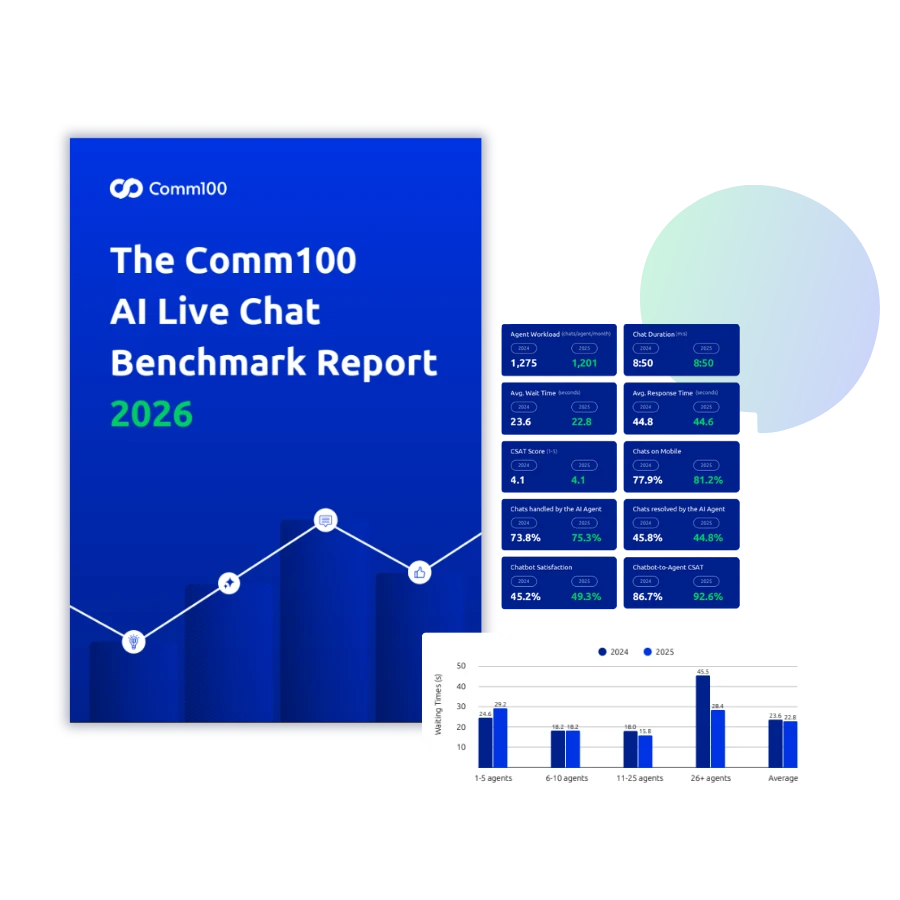
The Comm100 AI Live Chat Benchmark Report 2026
Explore insights from more than 220 million live chat interactions, including AI resolution rates, customer satisfaction, and bot-to-agent handoff performance.
Get the reportReport
Friction Raises Deflection Faster Than Better Answers
Improving answer coverage requires knowledge work, content maintenance, intent analysis, and retraining. Conversely, raising the cost of reaching a human takes an afternoon and a configuration change:
- Bury the escalation option three menus deep
- Require three exchanges before offering a handoff
- Remove the chat entry point outside business hours
- Gate the contact form behind a mandatory search
You may have seen this on many sites. Both paths raise deflection. Both show up in the same reporting cell. But making it more difficult for customers to reach you is generally a practice that’s frowned upon.
Most of the effort a customer feels is not inside the chatbot conversation. It is in the transition out of it: re-explaining the problem, losing context, restarting in a different channel, waiting in a second queue.
Friction-based deflection often lowers the deflection for the next period. Making the exit hard teaches customers to skip the automated layer entirely on their next contact, so the metric eats itself over two or three quarters while looking healthy in each individual month.
Deflected Contacts Return Unhappy
The measurement consequence matters significantly here. Customer satisfaction (CSAT) is captured on the contact where a human is present, which is usually the customer’s second or third attempt. By then the rating reflects the entire journey, including the efforts they had to put in to connect to a human agent.
The agent’s score absorbs all of it. Teams often read the result as an agent quality problem and invest in coaching that cannot fix a routing failure. Tracking first contact resolution across the whole journey rather than per interaction is what surfaces this.
Timing can also hide the connection further. Deflection is usually reported weekly or monthly, while the re-contact often lands outside the reporting window, so the deflected chat and the frustrated follow-up might not appear in the same view.
50% of Service Journeys Start on External Channels
Deflection is calculated over contacts that entered channels you own. That population might not be fully representative of your customers.
Gartner’s July 2025 survey of 5,801 customers found that 51% of service journeys now begin on third-party platforms including search engines, YouTube, and generative AI tools, rising to 74% among Gen Z customers. Those customers report a 62% success rate finding what they need on third-party platforms, against only 22% who start, stay, and resolve entirely within a company’s own channels.
A deflection rate can rise because the answers improved. It can also rise because the customers most likely to be dissatisfied stopped entering the funnel at all and went to a search engine, a subreddit, or an AI assistant instead. Nothing in the number separates those two stories.
Making support knowledge visible and accurate outside your own properties is the only real defense, which is why knowledge base quality has become a discovery problem rather than a content problem. Tools like Comm100 AI Knowledge are built around finding gaps in existing articles and drafting new content from real conversations, which can be picked up by AI assistants.
Deflection Saves in Support but Revenue Absorbs the Cost
Cost per contact is real, and deflection genuinely reduces it. The problem is attribution asymmetry. The saving is booked in the service cost line inside the quarter, while the effect of high-effort experiences lands in retention and repurchase, in a different line, over a longer horizon, where nobody traces it back to a chatbot configuration.
Whether the savings arrive at all is a separate question. Gartner predicted in June 2025 that by 2027, half of organizations expecting to significantly reduce their customer service workforce will abandon those plans. A December 2025 Gartner survey of 321 service leaders, fielded in October 2025, found only 20% had actually reduced agent staffing because of AI, and 55% reported stable staffing while handling higher volumes. The realistic return is more work absorbed per agent, not fewer agents.
Calculate the Real ROI of AI Agent
Use your support volume and expected resolution rate to estimate additional team capacity, annual value, ROI, and payback period.
Calculate ROIROI Calculator
The Fix: Rebuilding Escalation Paths
The handoff carries most of the effort a customer actually feels, which makes it the place to start. A team that changes nothing except the transition out of AI automation will usually see satisfaction move before any improvement in answer coverage shows up in the numbers.
Begin with three or four recent transcripts where the AI chatbot could’ve responded better, analyze them end to end, and watch what the customer had to do to reach a person.
- Make the route to a person visible on every turn: no customer should have to guess the phrasing that summons help. The Comm100 AI Agent transitions to human agents based on triggers you define, rather than waiting for the customer to insist three times.
- Send the context with the customer: the agent picking up should already know what was tried. A smooth handoff includes a summary of the conversation with the transfer, which removes the re-explaining step that generates most of the effort customers report.
- Escalate on sentiment, not only on failure: tools like AI Insights can automatically transfer an AI Agent chat to a human when negative sentiment is detected. That catches the customer who is receiving technically correct answers and getting angrier with each one.
- Measure the handoff on its own: ask a Customer Effort Score question immediately after a transfer, separate from the interaction as a whole, so “the bot could not help” stays distinguishable from “getting to a person was hard.”
Widening automation before fixing the handoff pushes more customers through the weakest part of the journey, which is why deflection programs so often show a good first quarter and a bad second one.
The takeaway: an effortless escalation path protects next period’s deflection, because customers who transition easily come back to self-service instead of routing around it.
Close the Knowledge Gaps
Every automated layer generates a record of the questions it could not answer. That said, most teams don’t fully extract enough value out of them. That record is the most direct route to raising deflection through answer quality, and it costs nothing to produce because the automation is already collecting it.
- Unresolved questions and unhelpful replies: the AI Agent’s response reports surface both, alongside the ratings customers give their experience on a 1 to 5 scale. Sort by volume and fix the top ten before adding a single new intent.
- Articles that exist but do not answer: AI Knowledge finds knowledge gaps, corrects articles, and drafts new content from real conversations. Keeping the knowledge base updated is also critical to ensuring that those answers are surfaced by AI assistants for people searching outside your platform.
An AI agent grounded in verified knowledge sources and pointed at the intents it handles well produces a deflection number that survives a second look.
Use an Omnichannel Support Platform for More Accurate Reporting
Every measurement problem described above shares a root cause: the customer’s journey crosses channels and the reporting does not. When those channels sit in separate tools with separate customer identifiers, the second contact never attaches to the interaction that caused it, and net resolution rate cannot be calculated at all. Teams end up reporting gross deflection because gross deflection is the only number their data actually supports.
Consolidation fixes that before any metric definition does. A single conversation history spanning live chat, ticketing and messaging, and social channels means the same customer stays recognizable whichever door they come through. It also makes the composition shift visible, because satisfaction by intent category can be compared across the automated and human queues rather than inside one channel’s silo.
Comm100 unifies every channel into one platform for this reason, empowering support teams with greater visibility, performance metrics, and a clearer view of where the gaps lie.

Measure Resolution Not Just Deflection
Discover how Comm100 unifies AI Agent, Live Chat, Ticketing & Messaging, and conversation analytics to help your team track resolution, customer effort, and satisfaction across the complete support journey.
Request a demo todayRequest Demo
FAQs
What is a good deflection rate?
A suitable deflection rate is between 50-65% for support teams with standard automation. For mature AI deployments with an AI chatbot and other tools like AI Copilot, deflection rates can rise to 80% or even more.
What is the difference between deflection rate, containment rate, and resolution rate?
Containment describes a single automated channel: the share of sessions entering a chatbot that end without a transfer. Deflection describes the whole contact portfolio: the share of all contacts that never reached a human. Resolution describes outcomes, meaning whether the customer’s problem was actually solved. Containment and deflection can both look strong while resolution is weak.
Does ticket deflection always reduce CSAT?
No. Deflection earned through better answers and an easy path to a person usually raises satisfaction, because customers get resolution without waiting in a queue. Satisfaction falls when deflection is produced by friction, when the escalation loses conversation context, or when automation absorbs the easy intents and nobody splits satisfaction scores by intent type to see what actually changed.
How do you stop abandoned chats from being counted as deflected?
Subtract the customers who come back. Define a re-contact window, with 72 hours as a reasonable default, and exclude any automated interaction followed by further contact from the same customer about the same issue. Session-end signals alone will not do this, because an abandoned chat and a resolved chat both end with the customer closing the window.