
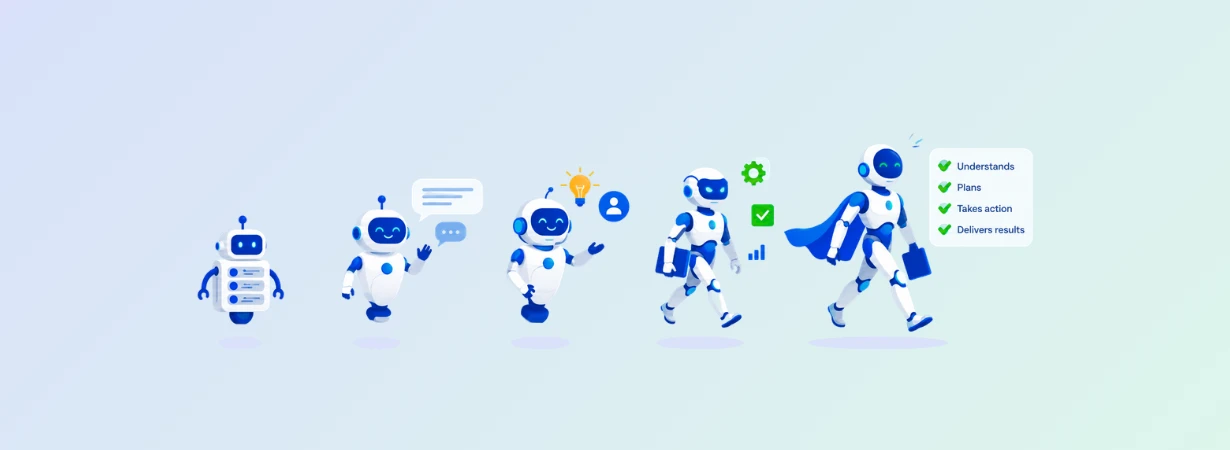
In the customer support realm, “agentic” describes a system that can take action in your business systems to resolve a request, rather than + Read More about from chatbots to agents: what “agentic” actually means in support

Everything You Need to Know About AI in Customer Service: A Detailed Guide
Customer service leaders are facing an uncomfortable truth: the AI solutions they implemented two years ago are already obsolete.
While early adopters celebrated basic chatbots that could handle password resets and store hours, a new generation of AI has emerged that doesn’t just automate simple tasks. It transforms the entire support experience. The difference isn’t incremental. It’s fundamental.
The gap is widening fast. Organizations still relying on rule-based chatbots and basic automation are watching competitors deliver experiences that feel almost telepathic.
Customers expect instant, contextual responses across every channel. They want their history remembered whether they switch from chat to email to phone. They demand resolutions, not transfers.
This isn’t about replacing human agents with robots. The most successful companies are discovering something that many would consider counterintuitive: the right AI makes human agents more valuable, not less.
When AI handles the routine inquiries, triages complex issues, and provides real-time assistance, agents can focus on relationship building, problem-solving, and revenue generation.
Whether you’re optimizing existing AI investments or building your first intelligent support system, the principles remain the same. Success requires understanding not just what AI can do, but how different AI technologies work together to create experiences that drive both customer satisfaction and business growth.
What is AI in Customer Service?
AI in customer service is the application of artificial intelligence technologies to enhance how businesses interact with their customers and curate more personalized experiences.
This includes machine learning, natural language processing, automation, sentiment analysis, predictive analytics, and generative AI working together to create more efficient and personalized support experiences.
Current AI systems understand context, maintain conversations across multiple channels, and can handle complex scenarios that previously required human intervention.
Think of AI customer service in three distinct layers:
- Customer-facing AI that directly interacts with customers through chatbots, voice assistants, and automated responses
- Agent-assisted AI that provides real-time support, suggestions, and insights to human representatives
- Backend AI intelligence that analyzes patterns, routes conversations, and optimizes operations behind the scenes
- AI-enhanced knowledge bases that help bridge content gaps and surface relevant information.
- AI-powered quality assurance to help maintain a consistent level of support performance.
- Onboarding supported by AI that helps on-ramp new agents and ensure they’re ready.
Current AI capabilities extend far beyond basic automation. Today’s systems can detect customer sentiment in real-time, automatically escalate frustrated customers to senior agents, and even predict which customers are likely to churn based on conversation patterns.
It maintains context across multiple channels, so when a customer starts a conversation on chat and continues via email, the AI remembers everything.
The scope of AI implementation varies significantly across organizations. Some focus on automating frequently asked questions, while others deploy comprehensive systems that handle complex inquiries, analyze customer behavior patterns, and provide predictive insights for business decision-making.
Customer service AI solutions ensure that people get responses within seconds, without burdening support agents unnecessarily. When they reach out for help, the system already has context about their account, previous interactions, and current situation.
Instead of navigating through options or explaining the problem multiple times, customers simply describe what they need. The AI understands not just their words, but their intent, and either resolves the issue immediately or connects them with the right human agent who’s already briefed on the situation.
The Current State of AI in Customer Service
The numbers tell a compelling story. We’re living through the most significant transformation in customer service since the invention of the telephone, and artificial intelligence is driving that change at unprecedented speed.
Our 2025 Live Chat Benchmark Report, which analyzed over 220 million live chat interactions, reveals that AI chatbots now handle 73.8% of customer interactions, up from 62.7% in 2023. This 17.7% year-over-year increase represents one of the fastest adoption curves in enterprise software history.
But this is just the beginning. The broader market data paints an even more dramatic picture of transformation.
Market Growth and Investment Patterns
The global AI customer service market was valued at $13 billion in 2024 and is projected to reach $83.9 billion by 2033, representing a compound annual growth rate of 23.2%. This isn’t gradual adoption; it’s exponential growth driven by proven business results.
According to Accenture’s latest research, companies with AI-led processes achieve 2.5x higher revenue growth, 2.4x greater productivity, and 3.3x greater success at scaling generative AI use cases compared to their peers.
The financial impact is equally impressive, with companies seeing average returns of $3.50 for every $1 invested in AI customer service, while leading organizations achieve up to 8x ROI, based on research conducted by IDC.
Customer Expectations and Behavior Shifts
The customer side of the equation reveals equally dramatic changes. Gartner research shows that 85% of customer service leaders will explore or pilot customer-facing conversational generative AI solutions by the end of 2025.
Gartner also predicts that by 2029, agentic AI will autonomously resolve 80% of common customer service issues without human intervention, and customers are already adjusting their interaction patterns to align with this trajectory.
Our benchmark report confirms these behavioral shifts, as we’ve noticed a substantial rise in interactions with AI chatbots. Gartner’s research also indicates that by 2028, 70% of customer service journeys will begin and be resolved through conversational, third-party assistants built into mobile devices, suggesting customers will increasingly bypass traditional support channels entirely in favor of AI-enabled alternatives.
This shift represents more than convenience. It reflects a fundamental change in how customers approach problem-solving, with AI becoming their default first option rather than a fallback when human agents are unavailable.
The Importance and Key Benefits of AI in Customer Service
The question isn’t whether AI will transform customer service. It’s whether your organization will lead that transformation or be left behind by it.
Modern customer service faces four converging pressures that make AI adoption not just beneficial, but essential for organizational survival.
Managing Higher Volumes
Customer service volumes are increasing faster than organizations can hire and train quality agents. Every business is experiencing higher inquiry loads while simultaneously struggling with agent retention, training costs, and quality consistency.
The mathematics are simple: when inquiry volume grows at 15-20% annually while quality hiring grows at 3-5%, the gap can only be filled through intelligent automation.
Without AI, organizations face a choice between compromising service quality or accepting unsustainable cost increases. Neither option builds competitive advantage.
A Rise in Customer Expectations
Customers no longer compare your service to your competitors; they compare it to the best digital experiences they’ve had anywhere.
When consumers interact with AI-powered services daily through their smartphones, banking apps, and shopping platforms, they expect similar responsiveness and intelligence from every business interaction.
The expectation isn’t just faster service. It’s contextual understanding, personalized responses, and seamless transitions between channels. These capabilities require AI infrastructure to deliver consistently at scale.
Economic Imperative
AI in customer service isn’t about cutting costs; it’s about unlocking value that’s impossible to achieve through human effort alone.
While AI can reduce operational expenses, its real value lies in enabling experiences that drive customer lifetime value, reduce churn, and create competitive differentiation.
Organizations using AI strategically report not just cost savings, but revenue increases through improved customer satisfaction, faster issue resolution, and the ability to scale personalized service to every customer interaction.
Maintaining Competitive Advantage
Every month that passes, AI capabilities become more sophisticated and customer expectations rise accordingly.
Organizations that implement AI thoughtfully today build capabilities and capture learning curves that become increasingly difficult for competitors to match.
Core AI Technologies Transforming Customer Support
Four foundational AI technologies are driving the customer service revolution. Understanding how these work, both individually and in concert, helps explain why modern AI systems can accomplish what seemed impossible just a few years ago.
1. Natural Language Processing (NLP)
Natural language processing enables machines to understand, interpret, and respond to human language in meaningful ways. In customer service, NLP transforms how systems comprehend customer inquiries, moving far beyond simple keyword matching to genuine understanding of intent and context.
Current NLP systems can parse the difference between “I can’t log in” and “I don’t want to log in anymore,” routing each to appropriate solutions. They understand implied meaning, handle typos and informal language, and maintain context across multi-turn conversations.
Key NLP capabilities transforming customer interactions:
- Intent recognition that identifies what customers want to accomplish, not just the words they use
- Entity extraction that pulls specific information (account numbers, product names, dates) from conversational text
- Context maintenance that remembers conversation history and references throughout interactions
- Multi-language support that enables auto chat translation
2. Machine Learning
Machine learning provides the foundation that makes AI systems continuously improve through experience. Rather than following pre-programmed rules, machine learning algorithms analyze patterns in customer interactions to make increasingly accurate predictions and decisions.
In customer service, machine learning operates behind the scenes to optimize everything from conversation routing to response suggestions. Systems learn which approaches work best for different customer types, time periods, and issue categories.
The technology enables predictive capabilities that were previously impossible. Machine learning algorithms can identify customers likely to churn based on interaction patterns, predict which issues will escalate to human agents, and optimize staffing levels based on historical demand patterns.
Advanced machine learning models also power recommendation engines that suggest relevant help articles, products, or services based on customer behavior and preferences, turning support interactions into revenue opportunities.
3. Generative AI
Third on the list is generative AI, which represents the newest and most transformative technology in customer service, primarily different types of AI agents.
Unlike traditional systems that select from pre-written responses, generative AI creates original, contextually appropriate responses in real-time.
This technology enables conversations that feel natural and personalized rather than scripted. Generative AI can explain complex policies in simple terms, adapt tone and language to match customer preferences, and provide detailed explanations tailored to specific situations.
Here are some key generative AI applications reshaping customer service delivery:
- Dynamic response generation that creates personalized explanations rather than templated responses
- Content creation for help articles, FAQs, and training materials that stay current with product changes
- Conversation summarization that helps agents quickly understand previous interactions
- Multi-modal support that can process and respond to text, voice, and eventually visual inputs
The technology also enables more sophisticated agent assistance, generating suggested responses that agents can modify rather than creating responses from scratch.
4. Sentiment Analysis
Sentiment analysis adds emotional intelligence to customer service systems by computationally analyzing language patterns to detect and interpret customer emotional states. At its core, the technology works by examining multiple layers of linguistic data to understand not just what customers are saying, but how they feel about it.
The process begins with lexical analysis, where algorithms examine words against emotion dictionaries that assign sentiment scores. But sentiment analysis goes far deeper than simple word counting.
Syntactic parsing analyzes sentence structure to understand how grammar affects meaning. For instance, the phrase “not happy” contains a positive word but expresses negative sentiment through negation.
Contextual evaluation considers surrounding text and conversation history, like the word “fine” might be positive in isolation but negative when following complaints about service quality.
Machine learning models trained on millions of labeled conversations learn to recognize these nuanced patterns, including cultural variations in emotional expression.
Modern systems also examine linguistic patterns beyond individual words. Response length changes, punctuation usage, and capitalization patterns can indicate emotional shifts. A customer who starts with detailed explanations but switches to short, clipped responses likely signal growing frustration.
Real-time sentiment detection enables proactive intervention. When systems detect rising frustration through language pattern analysis, they can immediately route conversations to human agents, adjust communication tone, or offer additional assistance before minor issues escalate into major problems.
The 8 Most Impactful AI Applications Across Customer Service Operations
AI has fundamentally transformed how customers interact with self-service systems. For decades, customer service was built around managing scarcity; limited agent availability, concentrated expertise, and fixed operating hours.
AI doesn’t just solve these constraints; it redefines what can be accomplished. Let’s talk about some of the most impactful AI applications across customer service operations today.
1. AI Chatbots or AI Agents
There’s actually a sharp difference between chatbots and AI agents or AI-powered chatbots. Chatbots still carry baggage from the era of phone trees made digital. AI chatbots, or AI agents, are much more powerful; they are systems that can actually get things done rather than just deflect inquiries.
Understanding the key differences between AI agents and chatbots helps organizations choose the right approach for their specific needs. The psychological shift is profound. Traditional chatbots operated on the assumption that customers needed to be filtered, triaged, and eventually passed to someone who could actually help.
Modern AI agents operate on the reverse assumption: most customer needs can be resolved immediately, and human escalation is the exception rather than the rule.
This inversion changes customer behavior in unexpected ways. When people believe they’re talking to something that can actually solve their problem, they provide better information, show more patience with clarifying questions, and report higher satisfaction even when interactions take longer. The mere possibility of resolution transforms the entire emotional context of the conversation.
Advanced AI agents can perform actions that customers previously assumed required human intervention: processing refunds, updating account information, scheduling appointments, or configuring complex product settings. Organizations can implement different types of AI agents depending on their specific use cases and customer needs.
The implementation approach varies significantly across industries and platforms. Companies looking to improve customer support on messaging platforms like Telegram can leverage AI agents to handle multiple conversations simultaneously while maintaining personalized responses.
For organizations with strict compliance requirements, on-premises AI solutions ensure data sovereignty while delivering advanced AI capabilities.
Industry-specific applications reveal the versatility of AI agents. In the gaming market, AI can help operators maximize engagement with high-value players while tracking key performance metrics that drive business outcomes.
The technology is also revolutionizing sports betting by providing instant odds updates, personalized recommendations, and real-time problem resolution. For instance, players can just ask an AI agent for personalized recommendations or get tailored offers based on their playing habits.
Higher education institutions are finding value in AI agents for student support. University chatbots can handle everything from admissions inquiries to course registration, while comprehensive student support strategies ensure frictionless experiences throughout the academic journey.
Government agencies are also embracing AI to improve service delivery by providing 24/7 access to information and services that traditionally required office visits or phone calls during business hours.
Another key benefit of using AI agents is that they can converse in hundreds of languages, while also understanding cultural linguistic differences. This capability is particularly transformative for global organizations serving diverse communities, where language shouldn’t determine the quality of service someone receives. With auto-chat translation, even when the conversation is passed on to a human agent, they have complete clarity on what the conversation is about.
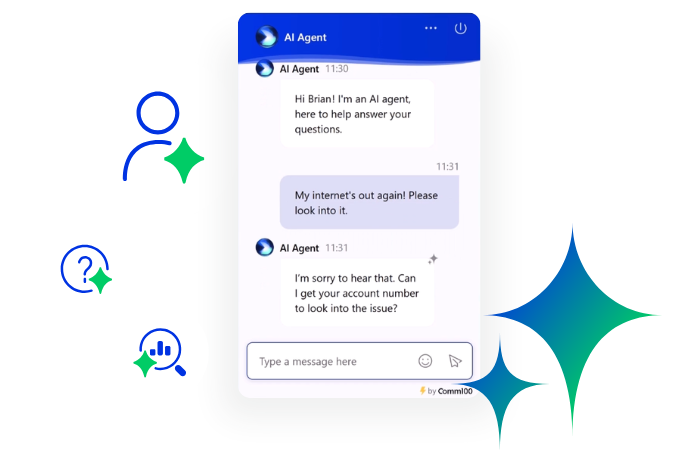
AI Agent
Try out Comm100’s AI Agent and see how it resolves customer needs instantly while empowering your support team.
Learn moreSolution
2. Intelligent AI Copilots
The most successful AI implementations don’t replace human judgment; they augment it by eliminating the tedious cognitive overhead that prevents agents from focusing on complex problem-solving.
AI copilots in customer service handle the mental busy work, such as:
- pulling up customer history
- suggesting relevant knowledge articles
- drafting responses based on company tone guidelines
- automatically updating records after interactions
This frees human agents to focus on understanding nuanced customer situations and building rapport.
The psychological impact on agents is significant. Instead of feeling like they’re being replaced by AI, agents experience AI as removing frustration and increasing their effectiveness. Systems like Comm100’s AI Copilot can auto-populate custom fields, generate interaction summaries, and provide real-time suggestions without interrupting the natural flow of conversation.
This approach helps organizations streamline customer service operations while maintaining the human touch where it matters most. The technology also enables consistent quality regardless of agent experience level.
New agents get the same contextual suggestions and response guidance as veterans, while experienced agents can override or modify AI suggestions based on their judgment.
3. AI Insights
AI Insights transform the vast amount of interaction data that every organization collects into actionable intelligence that drives strategic decision-making, with tools like an AI presentation maker helping teams turn those insights into clear, shareable visuals for stakeholder reporting.
Traditional customer service analytics focus on backward-looking metrics like resolution times and satisfaction scores. AI Insights operates in real-time, analyzing every conversation as it happens to detect patterns, emotions, and opportunities that human managers would miss across thousands of daily interactions.
Real-time sentiment analysis represents the most immediate application. Rather than only relying on post-interaction surveys, AI can detect emotional shifts mid-conversation and trigger appropriate responses.
When negative sentiment emerges, systems can automatically escalate to human agents or adjust communication approaches before minor issues become major problems. Other key features include:
- Classifying resolutions automatically based on outcomes such as resolved, pending, or requiring follow-up
- Recognizing patterns and highlighting recurring issues before they turn into systemic problems
- Performance insights reveal which approaches consistently drive better outcomes
AI can identify which products consistently generate support requests, which communication approaches lead to higher satisfaction, and which customer segments require different service strategies.
Advanced implementations can correlate customer service data with broader business metrics, revealing how support interactions impact revenue, retention, and brand perception. This connection helps justify customer service investments and demonstrates the strategic value of superior support experiences
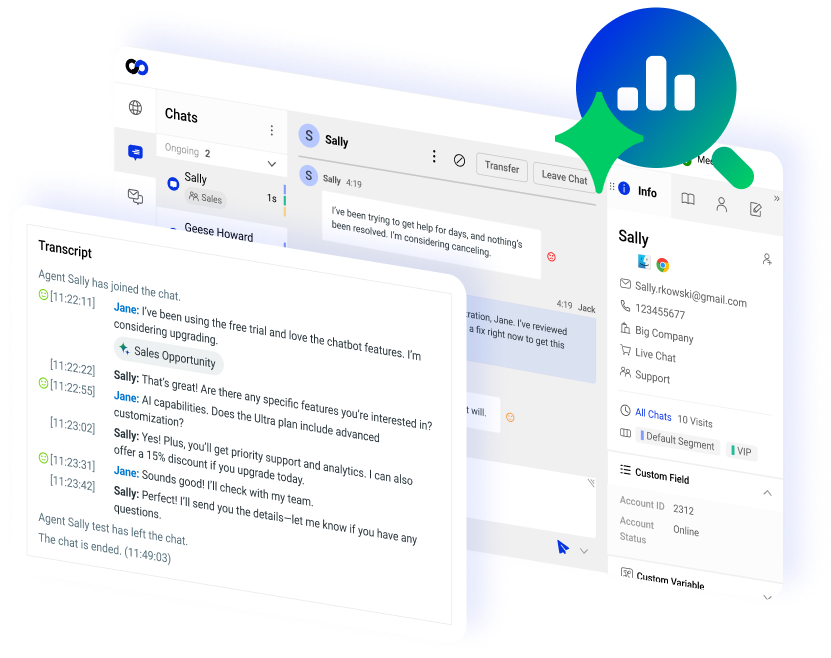
AI Insights
See Comm100’s AI Insights in action and turn every interaction into actionable intelligence.
Learn moreSolution
4. AI Knowledge Base
If you ask me, knowledge bases represent the most underappreciated revolution in customer service. Traditional help documentation was written for humans to read sequentially. AI-powered knowledge bases are designed for machines to search, synthesize, and explain dynamically.
The difference is like comparing a library to a personal research assistant. Traditional knowledge bases require customers to know what they’re looking for and where to find it. AI-powered systems can understand vague descriptions, connect disparate pieces of information, and generate explanations tailored to specific situations.
More importantly, AI knowledge bases learn from every interaction. When customers consistently ask questions that aren’t well-covered in existing documentation, the system identifies these gaps automatically. When certain explanations consistently lead to follow-up questions, the AI can suggest improvements or generate alternative explanations.
The system becomes a feedback loop between customer needs and organizational knowledge, ensuring documentation evolves in real-time rather than through quarterly review cycles that always lag actual customer problems.
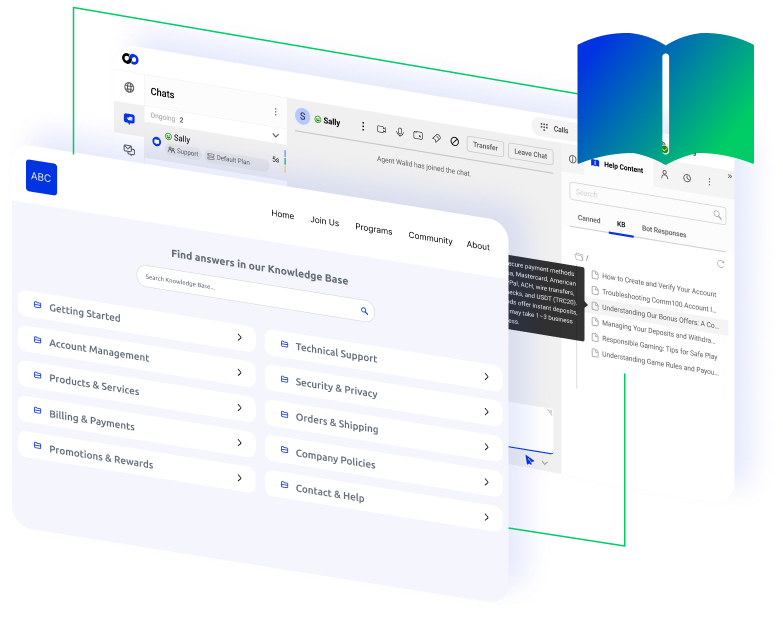
AI Knowledge Base
Discover how Comm100’s AI Knowledge Base delivers instant, accurate answers and improves support quality.
Learn moreSolution
5. AI-Powered Ticketing & Messaging
Ticketing systems have traditionally been organizational tools disguised as customer service solutions. They help companies track and manage workload but often create frustration for customers who get reference numbers instead of answers.
AI transforms ticketing from administrative overhead into intelligent workflow orchestration. Unlike traditional systems that force customers to navigate department boundaries, modern AI-powered platforms like Comm100’s Ticketing & Messaging operate as unified command centers that consolidate all customer interactions.
The unified approach leads to a slew of benefits:
- Channel consolidation brings email, SMS, social media, and instant messaging into a single interface
- Context is preserved throughout conversation history, even as customers switch from one channel to another
- Automated routing directs inquiries based on content and customer history rather than requiring customers to select departments
The real innovation lies in eliminating artificial constraints. Traditional systems require customers to know whether their issue belongs to billing, technical support, or account management.
The technology also supports sophisticated workflow automation where rules and configurations can be set to handle routine processes without human intervention, contributing to more effective customer service automation while ensuring complex issues receive appropriate attention.
6. AI Quality Assurance
Traditional quality assurance in customer service suffers from sampling bias and subjectivity. Human supervisors can only review a tiny fraction of interactions, and their assessments inevitably reflect personal perspectives and organizational blind spots.
AI quality assurance can analyze every single customer interaction against consistent criteria, identifying patterns that human reviewers miss.
The system can detect when agents consistently struggle with specific types of inquiries, when certain scripts lead to customer frustration, or when resolution approaches that seem successful create follow-up problems.
More importantly, AI QA can identify positive outliers. When certain agents consistently achieve better outcomes than their peers, AI can analyze their approaches and suggest best practices for broader adoption. The system learns what excellence looks like rather than just flagging problems.
7. AI Onboarding
New agent onboarding traditionally requires months of training followed by months of close supervision. AI-powered onboarding inverts this timeline by providing immediate competency augmentation while agents learn.
Rather than memorizing policies and procedures before handling real customers, new agents can begin taking interactions immediately with AI providing real-time guidance, response suggestions, and policy reminders.
The AI essentially serves as an invisible mentor, ensuring quality while agents develop expertise through actual practice.
This approach dramatically reduces time-to-productivity while improving learning outcomes. Agents develop skills through real customer interactions rather than theoretical training, while AI ensures customer experience doesn’t suffer during the learning process.
Organizations can leverage conversational marketing principles to create more engaging training experiences that mirror actual customer interactions.
The technology also enables continuous skill development rather than front-loaded training. As products, policies, or procedures change, AI can provide just-in-time guidance to all agents rather than requiring separate retraining sessions.
This flexibility is particularly valuable for industries with specific retention challenges, such as gaming operators implementing proven player retention strategies while ensuring their support teams can effectively communicate these programs to customers.
8. Voice AI
Voice conversations don’t exist in isolation anymore. The days of separate phone systems, email platforms, and chat tools are ending, replaced by unified contact centers where voice becomes one seamless component of the complete customer journey.
Modern voice AI integration transforms how contact centers operate by connecting phone interactions with every other customer touchpoint.
When someone calls after starting a chat conversation or sending an email, agents instantly see the complete interaction history. The customer doesn’t repeat their story; the conversation continues exactly where it left off. The AI even generates a summary of the call and logs it.
An AI voice chatbot can take multiple calls simultaneously, handling initial voice interactions using natural language processing specifically trained for conversational flow. Unlike text-based chatbots that can pause between responses, voice AI maintains conversational rhythm while processing complex requests in real-time.
Quality assurance becomes more sophisticated when voice AI operates within broader customer experience platforms.
Every call can be analyzed for sentiment, compliance, and effectiveness, with insights correlated against customer satisfaction data from other channels to provide comprehensive performance visibility.
Measuring Success: KPIs and Benchmarking
The difference between AI implementations that deliver transformational value and those that become expensive experiments lies in measurement discipline.
McKinsey’s latest research reveals that organizations tracking well-defined KPIs for generative AI solutions show the most significant bottom-line impact, yet less than one in five companies currently implement proper AI performance measurement.
Our benchmark data provides industry context for these baselines. Organizations should measure their current performance against industry standards: average chat duration (8 minutes 50 seconds), customer satisfaction scores (79.9%), and chatbot resolution rates (46%) before deploying AI solutions.
The baseline establishment process requires capturing both quantitative metrics and qualitative factors. Document current agent productivity levels, customer effort scores, and operational costs alongside harder-to-measure elements like agent job satisfaction and customer loyalty indicators.
A Three-Tier KPI Framework for Customer Service
Leading organizations categorize AI performance indicators into outcome metrics that tie directly to business value and process metrics that track intermediate improvements. Here’s our three-tier KPI framework for tracking the success of your AI implementation:
Tier 1: Financial Impact Metrics
These metrics directly connect AI performance to business outcomes and justify continued investment:
- Cost per resolved interaction comparing AI-handled versus human-handled cases
- Agent productivity improvement measured through handled volume increases
- Revenue impact from improved customer satisfaction and reduced churn
- Total cost of ownership reduction including infrastructure, training, and operational savings
McKinsey research indicates that organizations implementing AI effectively see 3-15% revenue increases, with customer operations representing one of the four areas delivering 75% of generative AI’s potential value.
Tier 2: Operational Performance Indicators
These metrics track AI system effectiveness and optimization opportunities:
- Resolution accuracy rate for AI-handled interactions
- Escalation percentage from AI to human agents
- Customer effort score measuring interaction simplicity
- Response time improvement across all interaction types
Tier 3: Strategic Capability Metrics
These indicators measure AI’s contribution to organizational capability building:
- Knowledge base improvement rate through AI-identified gaps
- Agent skill development enabled by AI assistance
- Service availability expansion through 24/7 AI coverage
- Multilingual support capability enhancement
Industry Benchmarking and Competitive Positioning
Our benchmark research reveals significant industry variation that organizations must consider when setting performance targets.
iGaming operators achieve 1,751 chats per agent monthly with 5-minute 44-second resolution times, while government agencies average 53 chats per agent with longer, more thorough interactions.
Benchmarking should account for industry-specific factors: compliance requirements in financial services, seasonal variations in education, or crisis response capabilities in government. Organizations performing above industry medians demonstrate AI implementation effectiveness, while those below benchmarks identify optimization opportunities.
ROI Calculation and Justifying Investment
Calculating AI ROI requires comprehensive analysis of both tangible and intangible benefits balanced against total implementation and maintenance costs.
Direct financial benefits include reduced operational costs, increased agent productivity, and improved customer retention. A 1.5 percentage point churn reduction on 10,000 customers worth $500 each annually translates to $75,000 saved quarterly. When AI enables one agent to handle 30% more interactions, salary costs per interaction decrease proportionally.
Indirect benefits prove harder to quantify but often exceed direct savings. Improved customer satisfaction drives word-of-mouth marketing, enhanced agent experiences reduce recruitment costs, and 24/7 service availability creates competitive advantages that influence market positioning.
Conclusion
Organizations that master AI implementation now will define competitive standards for the next decade, while those that delay face increasingly difficult catch-up scenarios as customer expectations evolve around AI-enabled experiences.
However, implementation success depends entirely on choosing the right technology partner with proven expertise, comprehensive platform capabilities, and deep understanding of industry-specific requirements. And, perhaps the most important part is to always keep an eye out for the next generation of AI tech and applications, and being open to integrating them into existing workflows.
Comm100 stands at the forefront of this transformation. As one of the leading AI customer service platforms globally, we’ve partnered with organizations across major industries to implement AI solutions that deliver real business results.
Our clients range from Fortune 500 enterprises to rapidly growing mid-market companies, all leveraging our comprehensive AI-powered platform to revolutionize their customer experiences.
The Comm100 AI advantage lies in our integrated approach. Rather than cobbling together multiple point solutions, our platform unifies AI agents, intelligent routing, real-time sentiment analysis, and comprehensive analytics within a single ecosystem that serves the customers, agents, and managers in a continuous learning loop and is always improving.
This integration eliminates the complexity and compatibility issues that plague organizations attempting to build AI capabilities from disparate vendors.
Ready to transform your customer service with AI? Schedule a personalized demo to see how Comm100’s comprehensive AI platform can revolutionize your customer experience while delivering measurable business results.

Transform Customer Service with AI
Schedule a personalized demo and see how Comm100’s AI platform can revolutionize your customer service.
Request a demo todayRequest Demo
FAQs
1. How are companies using AI in customer service?
Companies deploy AI across multiple customer service functions: AI chatbots handle routine inquiries like password resets and order status checks, while AI agents manage more complex interactions including account modifications and troubleshooting.
AI copilots assist human agents with real-time suggestions and automated documentation. Intelligent routing systems direct customers to appropriate specialists based on inquiry content and history.
Sentiment analysis monitors conversations to identify frustrated customers for immediate escalation. Organizations also use AI for predictive analytics to identify at-risk customers and proactive outreach campaigns.
2. Is AI going to replace customer service?
AI will not replace customer service but will fundamentally change how it operates. While AI agents can handle up to 80% of routine inquiries autonomously, human agents remain essential for complex problem-solving, emotional situations, and relationship building.
The future lies in human-AI collaboration where AI handles repetitive tasks and provides intelligence to enhance human capabilities. Research shows that AI actually makes agents more effective by eliminating administrative overhead and providing contextual assistance, allowing them to focus on high-value interactions that require empathy and creative problem-solving.
3. How do you engage customers using AI?
AI enables proactive customer engagement through multiple channels. Intelligent AI chatbots initiate conversations based on browsing behavior or previous interaction patterns.
Personalized messaging systems send targeted communications at optimal times using customer preference data. AI-powered knowledge bases provide instant, accurate answers to complex questions, enabling more nuanced conversations.
4. What is the future of AI in customer service?
The future centers on seamless omnichannel experiences where AI maintains context across all touchpoints, whether it’s email, live chat, a phone call, or a messaging app.
Predictive AI will anticipate customer needs before problems arise, enabling proactive resolution. Integration with third-party platforms will allow customers to resolve issues through voice assistants and mobile apps without contacting companies directly.
5. How to ensure data security when deploying AI for customer service?
Data security requires multiple layers of protection. Choose AI platforms like Comm100 that comply with enterprise-grade security certifications like SOC 2, ISO 27001, PCI DSS and laws like HIPAA and GDPR. Implement data encryption both in transit and at rest.
Use an on-premises AI deployment for industries requiring complete data sovereignty. Establish strict access controls and audit trails for all AI interactions. Regularly review and update security protocols as AI capabilities expand.
Ensure AI training data excludes personally identifiable information through proper anonymization techniques.
6. How can you implement AI in customer service?
Start with clear business objectives and baseline performance measurements. Choose a comprehensive platform that integrates multiple AI capabilities rather than point solutions. Begin with low-risk applications like FAQ chatbots before expanding to complex interactions.
Ensure proper data integration to provide AI systems with complete customer context. Train staff on AI collaboration rather than replacement concepts. Implement gradual rollouts with performance monitoring and optimization cycles.
Establish escalation protocols for seamless handoffs between AI and human agents. Plan for ongoing refinement as AI systems learn from interactions and customer feedback.