Two numbers define the AI chatbot debate in customer service right now: how many conversations AI chatbots can close without any human intervention, and whether customers are okay with that.
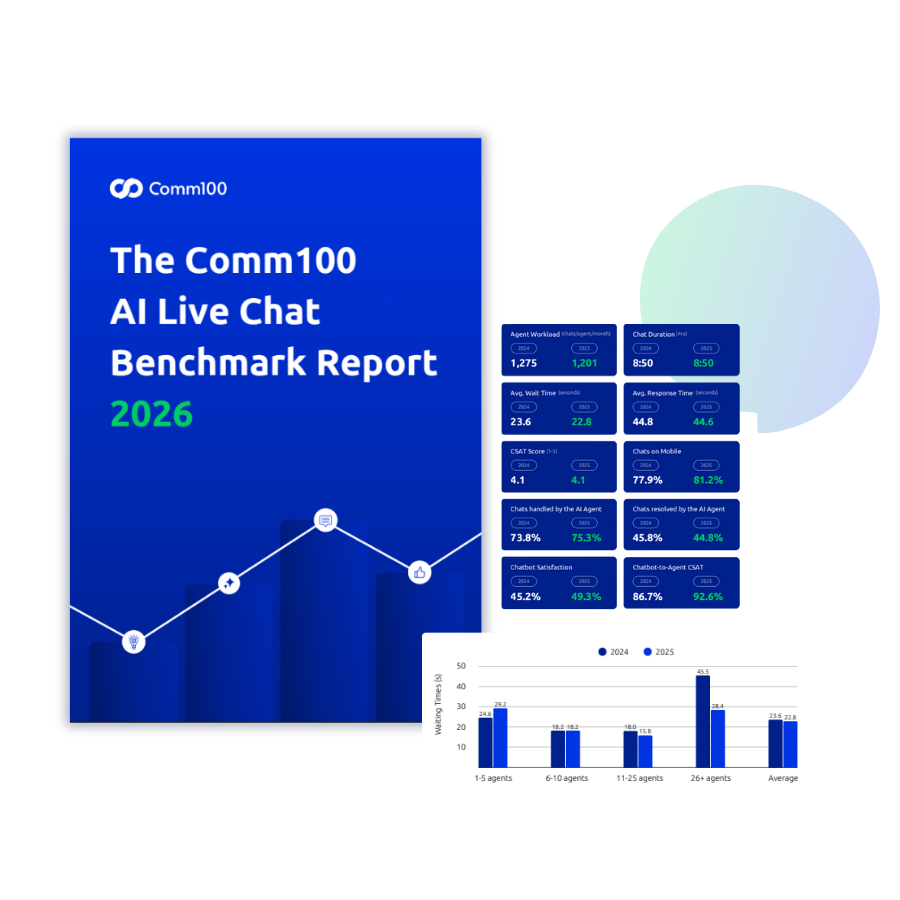
Based on our findings in the Comm100 AI Live Chat Benchmark Report, the answer to the first question is 44.8%.
The answer to the second is more interesting than a single figure can capture, because the relationship between resolution rate and satisfaction turns out to be weaker than most people assume.
Industries with high AI resolution rates don’t always produce high customer satisfaction. Industries with low resolution rates sometimes score above average. And the customers who pass through an AI chatbot before reaching an agent are more satisfied than the overall average, not less.
What Percentage of Chats Can AI Chatbots Resolve Without a Human?
Across all industries, AI chatbots fully resolve 44.8% of conversations without any human involvement. That figure dropped slightly from 45.8% the prior year, a 2.3% dip that raises a fair question: is AI chatbot performance actually getting worse?
No. The denominator changed.
Comm100’s AI Agent now handles 75.3% of all incoming chats, up from 73.8%. As AI chatbots field a wider range of queries, they encounter more conversations that fall outside their training: unusual phrasing, multi-part questions, emotional situations, or requests that require access to systems the bot can’t reach.
As we noted in the report: a broader net catches more fish, but also more debris.
2026 AI Live Chat Benchmark Report
Explore benchmark data from 220M+ live chat interactions covering chatbot resolution rates, AI handling rates, CSAT, and agent productivity.
Download report
Report
What Resolution Rate Should You Expect? The Industry Breakdown
Underneath the 44.8% average sits a range that spans from 97.7% to 38.1% across industries. Where your sector falls on that spectrum depends less on how advanced your AI is and more on the nature of the questions your customers ask.
1. Non-Profit: 97.7% sits at the top. Non-profit inquiries tend to follow narrow, well-defined patterns: donation processes, event information, volunteer signup, and program eligibility. The AI chatbot resolves nearly everything because nearly everything falls within a small set of predictable intents. It could also be because the entrance to chat isn’t obvious, or no human agent is available.
Manufacturing: 78.4% and Education: 75.9% both score well above the average. Manufacturing queries often relate to order status, specification lookups, and product compatibility checks, each with a clear right answer.
Education queries around registration deadlines, course prerequisites, and financial aid processes follow similar patterns: structured questions with structured answers.
Banking & Finance: 75.2% performs well for a heavily regulated sector. Account balance inquiries, branch hours, fee structures, and card activation requests all lend themselves to AI chatbot resolution. The queries that don’t resolve tend to involve account-specific disputes or transactions that require identity verification steps the bot can’t perform.
Government: 67.6% and Technology: 67.3% cluster in the mid-range. Government inquiries often involve eligibility assessments or multi-department routing that the bot can start but not finish.
Technology queries run into a different wall: troubleshooting sessions that require back-and-forth diagnosis, log analysis, or configuration steps that exceed what a bot can do in a single interaction.
Telecommunications: 63.9% resolves fewer than you might expect given that Telecom AI chatbots handle 99.9% of incoming volume. This is intentional. Telecom operators use bots primarily as an intake and classification layer. The AI greets every customer, identifies the issue type, collects account details, and routes to the right team. Resolution often isn’t the goal at the bot layer. Accurate categorization is.
Health & Pharma: 45.8% lands right at the overall average. Regulatory constraints on what a bot can and cannot say about medical topics, combined with the clinical specificity of patient questions, limit how much the bot can resolve alone.
iGaming: 38.1% sits at the bottom. Nearly half of all bot-handled iGaming chats transfer to a human agent. Players interact with support during active sessions: mid-game, mid-bet, or immediately after a withdrawal attempt. Urgency is high, tolerance for wrong answers is low, and many requests involve account-specific actions (payout processing, bonus disputes, identity verification) that require human authorization.
The Number That Matters More Than Resolution Rate
Most CX leaders track resolution rate as their primary bot performance metric. The data suggests a different number deserves more attention: the escalation burden.
Escalation burden measures what percentage of bot-handled chats fail to resolve and transfer to a human agent instead. That gap represents conversations where the bot engaged with the customer, collected some information, attempted to help, and then transferred to a human agent anyway.
These transferred chats carry extra weight. The customer has already invested time in a bot interaction that didn’t solve their problem, and they now expect the agent to pick up exactly where the bot left off. When that handoff works well, the customer barely notices. When it doesn’t, they’re more frustrated than if they’d gone directly to a human.
How wide is the spread? Consider these figures:
iGaming carries the heaviest escalation burden. For every 100 incoming chats, the bot engages with about 76. Of those 76, it resolves 29 (38.1% of bot-handled chats) and transfers 47 to agents. About 62% of bot-handled iGaming chats end up in an agent’s queue.
Telecommunications follows. For every 100 chats, the bot handles virtually all of them and resolves about 64. The remaining 36 transfer to agents, roughly 36% of bot-handled volume.
Government: the bot handles 94 of every 100 chats, resolves about 64, and transfers roughly 30 to agents.
Banking & Finance: the bot handles 97 of every 100 chats, resolves about 73, and transfers roughly 24.
Education carries the lightest burden among high-volume sectors. The bot handles 90 of every 100 chats, resolves about 69, and transfers roughly 22. About 24% of bot-handled education chats require escalation to a human, or roughly 1 in 4.
Why does this matter? Escalation burden determines how much of your agent workload is “warm transfer” work, where the agent inherits a partially completed conversation, versus “cold start” work, where the agent begins from scratch.
A high escalation burden doesn’t mean your AI chatbot is failing. In Telecom and iGaming, the bot is designed as a triage layer, not a resolution engine. But if your escalation burden is high and your handoff satisfaction is low, that’s a specific, diagnosable problem.
Two Automation Strategies: Narrow and Deep vs. Broad and Shallow
The team-size data points to two distinct automation strategies, and each one produces a very different resolution profile.
Small teams (1–5 agents) run narrow and deep. Their AI chatbots handle 54.3% of incoming chats but resolve 89.0% of what they touch. These bots are scoped tightly: they cover a small number of well-defined intents, and they answer those intents accurately.
Everything outside that scope goes directly to an agent. The result is a high-resolution rate against a low handling rate. The AI does less, but what it does, it does well.
Large teams (26+ agents) run broad and shallow. Their AI handles 67.5% of incoming volume but resolve only 41.2%. These bots are configured to engage with a wider range of queries, often as a front door for the entire support operation.
They greet every customer, attempt initial classification, collect account details, and try to resolve. When they can’t, they transfer with context. The resolution rate is lower because the AI Agent is stretched across many more intent categories, some of which it handles well and others it was never going to resolve alone.
Neither strategy is wrong. They serve different operational goals. The narrow-and-deep approach works well when a small team needs to protect limited agent capacity by deflecting a known set of repetitive questions. The broad-and-shallow approach works when a large operation needs every conversation triaged and categorized before it reaches a human, even if the bot only closes a portion of them.
Mid-sized teams (11–25 agents) sit between these two models at 92.5% handling and 47.8% resolution. They route nearly everything through the bot but resolve less than half.
Their AI agent acts as mandatory intake: every customer interacts with it first, and the bot determines whether to resolve, transfer, or escalate based on intent classification. At this scale, the bot functions less as a standalone resolution engine and more as a sorting mechanism that ensures agents receive conversations pre-categorized, with context already attached.
Does a Higher Resolution Rate Mean Higher Customer Satisfaction?
You’d expect so, but the data says otherwise.
iGaming resolves just 38.1% of bot-handled chats, the lowest rate in the dataset. Its overall CSAT score: 4.1 out of 5, exactly the industry average.
Education resolves 75.9%, nearly double iGaming’s rate. Its CSAT: 3.7, the second-lowest among the 18 industries tracked.
Government resolves 67.6% and scores a 4.3 CSAT, well above the average and above sectors with higher resolution rates.
Technology resolves 67.3% and matches Government’s 4.4 CSAT, among the highest in the dataset.
AI chatbot resolution rate and customer satisfaction, it turns out, have a loose relationship at best. Several factors explain why.
First, resolution rate measures what the bot does. CSAT measures the entire experience, including the human interaction that follows a bot transfer. A sector with low bot resolution but excellent agents (iGaming, where agents are trained for speed and accuracy under time pressure) can score well overall despite mediocre bot performance.
A sector with high AI chatbot resolution but undertrained or understaffed human agents (education, where budget constraints often limit agent hiring and training investment) can score poorly despite strong bot numbers.
Second, customer expectations differ by industry. iGaming players expect to be transferred to a human for anything beyond basic FAQ. That expectation is set. When the transfer happens quickly, they’re satisfied.
Education students contacting a university expect the system to have their answer, whether it’s an AI chatbot or a human. When a bot resolves the question, they’re neutral. When the bot can’t and the human takes time, frustration builds faster because the expectation was “this should have been simple.”
Third, the type of conversation matters more than the channel. A bot that resolves a straightforward account question contributes to satisfaction. A bot that resolves the same question but provides a slightly wrong answer, forcing the customer to come back, damages satisfaction more than if a human had handled it from the start. Resolution rate doesn’t capture answer quality.
Are Customers More Satisfied When Bots Hand Off to Humans?
Yes, by a significant margin. Bot-to-agent handoff satisfaction reached 92.6% in 2025, up from 86.7% the prior year. Compare that to the overall CSAT of 4.1 out of 5 (which translates to roughly 82% on a satisfaction scale). Customers who started with a bot and then connected with an agent rated the experience 10+ points higher than the average customer.
That result seems counterintuitive. Why would adding a step (bot interaction) before the human conversation improve satisfaction?
Look at what the bot does during that initial interaction. Before transferring, the bot collects the customer’s question, identifies intent, gathers relevant details (account number, order ID, issue category), and routes to the appropriate team. The agent who picks up the chat doesn’t start cold.
They see the conversation history, the customer’s stated issue, and the information the bot already collected. The agent can skip the “how can I help you today?” opener and move directly to resolution.
Compare that to a direct-to-agent chat where the customer types “I have a problem” and the agent spends the first two minutes asking qualifying questions. The bot-assisted path is faster to resolution from the agent’s perspective and less repetitive from the customer’s perspective.
Team size adds another layer to this pattern. Small teams (1–5 agents) saw handoff satisfaction reach 99.4%, up from 88.5%. That 12.3% jump is the largest of any team size, and the 99.4% figure is the highest in the entire dataset.
In small teams, the agent who receives a bot transfer often helped configure the bot in the first place. They know exactly what the bot can and cannot handle. They know what information the bot collected and what format it arrives in. The handoff is smooth because the agent anticipates precisely what the bot will send.
Larger teams show strong improvements too (6–10 agents: 92.4%, 11–25 agents: 90.9%, 26+ agents: 90.5%), but the small-team spike suggests that proximity between the people deploying the chatbot and the people receiving its transfers produces better outcomes. In larger organizations, the team that configures the bot is often separate from the agents who handle escalations, and that distance creates friction.
Is Chatbot Satisfaction Getting Closer to Human Agent Satisfaction?
Chatbot satisfaction is climbing toward human levels, but there’s still a significant gap.
Human agent CSAT sits at 4.1 out of 5 (roughly 82% satisfaction). Chatbot satisfaction, measured separately, came in at 49.3% for 2025, up 9.1% from 45.2% the prior year. That 9.1% improvement was the largest year-over-year gain across every metric in the 2026 report.
Three years ago, chatbot interactions were a source of friction for most customers: rigid decision trees, frequent dead ends, and transfers that felt like starting over. The jump to 49.3% reflects real improvements in how bots handle conversations: better natural language understanding, more accurate intent recognition, and the ability to pull from knowledge bases in real time rather than relying on pre-scripted flows.
A more useful way to read these numbers: chatbot satisfaction at 49.3% and handoff satisfaction at 92.6% together describe a support model where the AI does two things well: resolve the conversations it can handle fully (driving the 49.3% upward) and hand off the ones it can’t with enough context that the human interaction is better than if the customer had gone directly to an agent (the 92.6% figure).
Importantly, if your handoff satisfaction is high, your customers have already accepted that the AI agent is a gateway, not a destination.
The AI’s job is triage and deflection. The agent’s job is resolution and relationship. Both can score well without the bot needing to match human-level satisfaction on its own.
What Does Your Resolution Rate Actually Tell You?
Resolution rate is a diagnostic, not a scorecard. Here’s what different ranges indicate about your bot’s design and deployment:
Above 75% resolution (Non-Profit, Manufacturing, Education, Banking): The AI covers the most common intents well and your knowledge base content is thorough enough to support accurate answers. The risk at this level is complacency. Check whether the remaining 25% of unresolved chats share common patterns that could be addressed with new intents or updated KB articles.
50-75% resolution (Government, Technology, Telecommunications): Your chatbot handles a broad range of queries but hits limits on conversations that require judgment, multi-step processes, or system access the bot doesn’t have.
The opportunity here is to improve the handoff experience for the 25–50% that transfer, rather than trying to push the resolution rate higher by forcing the bot to handle conversations it shouldn’t.
Below 50% resolution (Health & Pharma, iGaming): The AI functions more as an intake layer than a resolution engine. That’s appropriate for industries where regulatory constraints, account-specific actions, or high-urgency situations demand human involvement. It could also mean that the AI chatbot needs better setup, knowledge sources, or more fine-tuning.
The metric to watch here is handoff satisfaction, not resolution rate. If handoff satisfaction is above 90%, the bot is doing its job even if it rarely resolves on its own.
If your resolution rate is falling while your handling rate is rising, that’s not a red flag. It means your bot is engaging with more types of conversations and encountering more edge cases. Track whether handoff satisfaction is holding or improving. If it is, your bot is growing its scope responsibly.
If your resolution rate is falling while your handling rate is flat or falling, that’s a different story. It means the bot is resolving fewer of the same types of conversations it was already handling, which points to degraded performance: stale KB content, outdated intent models, or changes in customer language that the bot hasn’t adapted to.
All The Numbers Tell the Same Story
AI customer service software is no longer a luxury; most companies have already embraced the technology. On top of that, they are seeing rapidly improving results, which ultimately translate to significant ROI.
If you’re already using live chat software, deploying an AI chatbot is the next logical step. The Comm100 AI Agent can help you resolve up to 80% of all incoming queries.
Increase Your AI Resolution Rate in Customer Support
Learn how Comm100 AI Agents automate common customer inquiries, reduce escalation burden, and help support teams resolve more conversations automatically.
Book a demo today
Request Demo
Frequently Asked Questions
What percentage of customer service chats can AI chatbots resolve without a human?
Across all industries, 44.8% of chats are fully resolved by AI chatbots without human involvement, based on 2025 data from the Comm100 2026 AI Live Chat Benchmark Report.
The range spans from 97.7% in Non-Profit to 38.1% in iGaming. Industries with structured, predictable inquiry types (registration deadlines, account FAQs, order status) tend to resolve at higher rates. Industries with high-urgency, account-specific, or regulatory-sensitive queries tend to resolve at lower rates and instead use bots as an intake and triage layer.
What is a good chatbot resolution rate?
It depends on your industry and bot strategy. Above 75% (achieved by Non-Profit, Manufacturing, Education, and Banking & Finance) indicates strong intent coverage and thorough knowledge base content.
Between 50–75% (Government, Technology, Telecommunications) suggests a bot that handles broad volume but transfers more complex queries to agents. Below 50% (Health & Pharma, iGaming) typically reflects a deliberate intake-and-classify model rather than a resolution-first approach. In all cases, handoff satisfaction (92.6% across all industries) is a better indicator of automation quality than resolution rate alone.
Does AI chatbot support lower customer satisfaction?
No. Overall CSAT held flat at 4.1 out of 5 for two consecutive years while AI chatbot handling increased from 73.8% to 75.3%. Chatbot-specific satisfaction jumped 9.1% to 49.3%, the largest year-over-year improvement of any metric tracked.
The bot-to-agent handoff satisfaction rate reached 92.6%, 10+ points above the overall CSAT average. Customers who interact with a bot before reaching an agent actually rate the experience higher than the average customer, because the bot pre-qualifies the conversation and gives the agent a head start on resolution.
What is a good CSAT score for live chat?
Across all industries, CSAT averages 4.1 out of 5. Scores range from 4.9 (Real Estate) to 3.6 (Telecommunications) across the 18 industries tracked. A score between 4.0 and 4.3 represents a healthy baseline for most sectors. Above 4.3 is exceptional and usually reflects investment in personalization or proactive support. Below 3.8 warrants investigation into agent training, handoff quality, or whether systemic product issues are driving down scores regardless of service quality. Always benchmark against your specific industry rather than the cross-industry average.
What is the difference between chatbot handling rate and resolution rate?
Handling rate (75.3% across all industries) measures the percentage of chats where a bot engages with the customer first. Resolution rate (44.8%) measures the percentage of chats the bot resolves completely without human involvement. The 55.2-point gap between them represents conversations where the bot started the interaction but couldn’t finish it, requiring transfer to an agent. This gap, the escalation burden, is the metric that determines how much additional agent workload your bot creates through transfers versus how much it eliminates through full resolution.