Comm100 has spent more than 15 years at the forefront of customer support technology. Products have come and gone. Some we iterated on, some we retired. But our commitment to the organizations and teams who depend on us has never wavered. Our median retention period for enterprise clients is 5+ years. That kind of loyalty isn’t built on features alone.
Many of our customers have been around since before AI burst onto the scene. We’ve been building customer service technology since 2009, helping pioneer live chat when it first made its first debut. We’ve spent over fifteen years learning what actually helps support teams and what just creates new problems dressed up as solutions.
That’s why our approach to AI was measured, deliberate, and practical. We started with a simple question: where can AI genuinely improve the support experience, and how can we apply our deep expertise in customer support for regulated industries to do it right?
How We Approach AI at Comm100
Our approach to AI at Comm100 is rooted in data-driven research, close communications with our customers, and a deep analysis of the challenges that support teams face.
We regularly conduct internal research to see how specific processes can be automated, and more importantly, if those automations are actually valuable and can drive meaningful gains for our clients.
Customer support in regulated industries has a structural problem that predates AI by decades. Support teams face a difficult combination: high inquiry volumes, complex compliance requirements, and a shrinking pool of qualified agents willing to work in environments where every interaction carries regulatory weight.
For years, the only lever organizations had was headcount. Need to handle more queries? Hire more agents. Need to extend to 24/7 coverage? Add another shift. That approach doesn’t scale, and in sectors where training a single agent on compliance protocols can take weeks, it doesn’t move fast enough either.
When AI in customer service matured enough to understand context, remember conversational history, and generate responses grounded in approved knowledge rather than open-ended guesswork, the calculus changed, and so did our roadmap.
How We Build AI Products
When we started building AI products, we didn’t begin with the technology. We began with the workflow. We sought to answer three critical questions:
- Where do support teams spend time they shouldn’t have to?
- Where do customers most often get stuck?
- Where does scale break things that worked fine when volumes were lower?
Comm100’s AI-first omnichannel support platform is used across regulated industries like higher education, gaming, healthcare, government organizations, financial institutions, and more. We know that our clients hold our products to a very high standard.
That’s why our approach to building AI products focused on three things from the start: reliability, control, and transparency.
Reliability means the AI does what it’s supposed to do, every time. No hallucinations. No improvised answers that sound confident but aren’t accurate. In industries where a wrong response can create compliance risk or erode customer trust, we know that “mostly right” isn’t good enough.
As for control, it’s all about enabling our customers to decide how the AI behaves. They train it on their data. They define its boundaries. They determine when it escalates to a human. The AI works for them, always.
Transparency means no black boxes. When the AI gives an answer, you can trace where it came from. When it doesn’t know something, it says so. Our customers don’t have to wonder what the AI is doing or why.
We Started at the Frontline
The most obvious bottleneck in any support operation is the front door. Customers arrive with questions, and someone must answer them. Many of those questions are routine. Predictable. It’s the kind of thing an agent has answered hundreds of times before.
We saw teams buried under volume they couldn’t escape. Hiring more agents, whether onshore or offshore, helped, but only temporarily. Training took time. Turnover erased progress. In certain industries like higher ed, seasonality is a big factor, with institutions often struggling to scale up during specific times of the year.
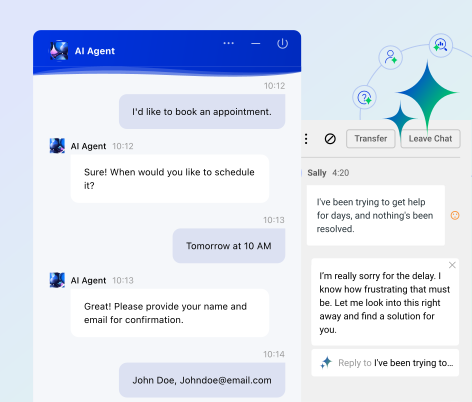
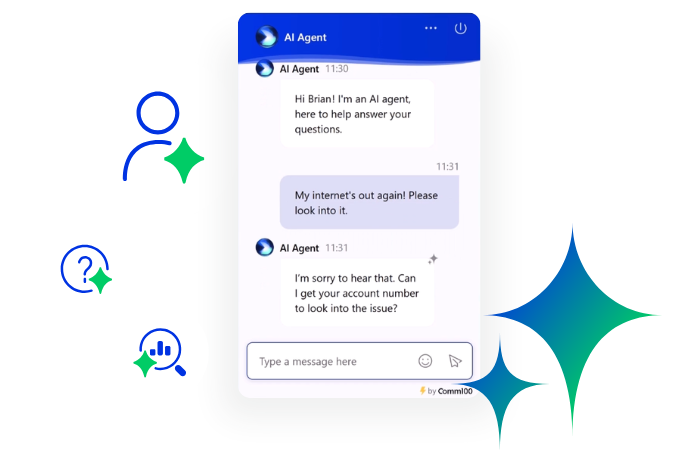
We built the Comm100 AI Agent to handle conversations that don’t generally require human judgement. Common, repetitive queries like password resets, account information, or general policy questions with clear answers all fall in this bucket.
The goal wasn’t to replace agents. It was to free them from the repetitive work that consumed their capacity and left them too drained for the conversations that actually needed their expertise.
The Comm100 AI Agent solved that problem and offered substantial flexibility to institutions that deal with seasonality changes throughout the year. The AI Agent is grounded in verified sources so it wouldn’t hallucinate or improvise on its own, a problem that’s all too common with conventional chatbots.
See Comm100 in Action
Discover how Comm100’s AI-powered platform streamlines conversations, boosts agent productivity, and delivers reliable support at scale.
View demo
View Demo
What About the Conversations AI Couldn’t Handle Alone?
Not every question fits neatly into a knowledge base article. Customers have complex issues, edge cases, and situations that require a human to navigate. We knew our AI Agent would escalate these, and we knew agents would still be handling significant volume.
The question became: how do we make those agents faster without making them robotic or sacrificing quality?
That was our original thinking behind the Comm100 AI Copilot. Agents often have to dig through a series of detailed documents before finding answers, which takes time.
We also heard the same frustrations in nearly every conversation with support teams. Agents typing out responses they’d written a hundred times before. Spending more time on post-conversation documentation than on the conversation itself.
They categorize conversations, tag issues, write summaries, and populate wrap-up fields. They juggle multiple chats simultaneously while trying to keep context straight across all of them.
The core principle behind building the Comm100 AI Copilot was to enable agents to focus on doing what they do best: deliver quality service at scale, while allowing AI to focus on their ancillary tasks.
Next: Augmenting the Reporting Layer with AI
Customers using our products know that they get access to detailed analytics right out of the box. As we released more AI-focused products, we had to solve another challenge: managers had more data to deal with, but much less clarity.
For instance, Comm100 Analytics already offers usage information for our products. You can see the number of high confidence answers generated with AI Agent, for instance.
Managers already had visibility into volume metrics, CSATs, and other datapoints. What we wanted was to give them insight into the story underneath.
We wanted to build out a more comprehensive reporting layer that would empower managers with leading indicators instead of focusing only on lagging ones.
- Which topics are causing the most customer frustration?
- What is the general sentiment of a conversation?
- Where are agents struggling, and where are they quietly excelling?
- Are customers at risk of churning, and if so, which ones?
Getting those answers meant reading transcripts. Lots of them. Manually. Nobody had time for that, and sampling a handful of conversations wasn’t representative of what was actually happening across thousands of interactions.
As a result, this was often ignored. So we built Comm100 AI Insights to do what humans can’t do at scale: read every conversation, detect patterns, and surface what really matters.
The AI analyzes sentiment in real time, flagging when customers shift from neutral to frustrated. It tracks resolution status across conversations, identifying which issues are truly closed versus stuck in limbo.
We introduced a Spotlights feature that you can customize using natural language. Managers can define exactly what they want to track, whether it’s chats that mention a particular feature, negative sentiment, or really anything they want to track.
The AI surfaces those specific interactions automatically, turning vague concerns into concrete evidence.
The goal wasn’t another dashboard with more charts to interpret. It was intelligence that leads directly to action. If an insight doesn’t help someone coach better, staff smarter, or intervene faster, it doesn’t belong in the product.
Leveraging AI to Maintain Knowledge at Scale
If you’re with me till now, you should have a pretty good understanding of our philosophy here at Comm100 for building new products.
After addressing the core support workflow, we turned our attention to the operations surrounding it, which are equally important. These are challenges that don’t show up in daily metrics, but quietly drain time and resources.
In the customer support industry, all documentation has a half-life. The moment you publish an article, it gradually starts drifting from reality. Products change. Policies update. New questions emerge that nobody anticipated.
Every enterprise support team we’ve worked with knows this, and every team used to struggle with the same thing: maintaining a knowledge base is critical work, but it competes with everything else. It usually loses.
The traditional approach was simple: periodic audits. Schedule a review, assign someone to go through articles, update what’s stale, fill in what’s missing. In theory, it works.
In practice, those audits get postponed, then postponed again, until a customer reaches out asking for clarity because a proposed method in the KB doesn’t work.
We built Comm100 AI Knowledge around a different idea: what if the knowledge base could tell you what was wrong with it?
From basic things like flagging typos, inaccuracies, missing steps, or outdated references to mining real conversations and proposing unanswered customer questions or interactions, Comm100 AI Knowledge was built to automate the (often) tedious, but critically important task of keeping your knowledge base fresh.
Naturally, it leverages AI to draft solutions, update articles, and revise entire sections. As always, the control lies with our users: they can decide the scope of the audit and can track every change from what we call the Analysis Dashboard.
Making Quality Systematic
We’ve seen some ingenious applications of AI since these tools rolled out. One, which is admittedly very common now, is how anyone can feed a large piece of text to AI and ask it to review it, or analyze something specific.
In customer support, that capability has obvious value. Conversations generate text. Lots of it. And buried in that text are signals that matter: frustration building, compliance risks, agents going off-script, customers on the verge of leaving.
Historically, quality assurance in support organizations is a sampling exercise. Supervisors usually review a handful of conversations each week, and hope that the sample represents the whole picture.
In certain industries like gaming, where the number of weekly conversations can go well beyond the 100k mark, sampling 2-5% of interactions is unlikely to show the whole picture.
We built Comm100 AI Quality Assurance to give supervisors greater insights into the quality of conversations. We knew managers and supervisors wanted to coach better, but they were limited by time. The work of detecting problems would consume the hours that should have gone into solving them.
It was created to remove common issues like reviewer bias, ensuring transparency, and offering structured feedback to agents.
The AI evaluates interactions against your criteria, your knowledge base, your standards, and tells you exactly where an agent went off track and why. No bias from who happened to review which conversation. No inconsistency between reviewers. Just systematic coverage across everything.
But we were deliberate about what the AI should and shouldn’t do:
Detection belongs to AI. Flagging issues, scoring interactions, surfacing patterns across thousands of conversations. Machines do this faster and more consistently than humans ever could.
Judgment belongs to humans. Deciding what matters, how to coach, when context changes the interpretation. Managers can override any AI assessment before it reaches an agent.
Coaching stays human. When the AI surfaces something worth addressing, it takes one click to turn that finding into a coaching moment. Add context, assign follow-up, share it with the agent directly in their console.
The Final Piece of the Puzzle: Streamlining Onboarding
We knew that if AI already understood the conversations happening across an organization, that same intelligence could inform training and onboarding too. It’s a challenge that most companies are all too familiar with.
Everyone agrees that it matters, but very few organizations do it well. New hires often sit through hours of reading and coaching videos, and then are expected to hold their own in live conversations.
The idea for Comm100 AI Training stemmed from a foundational belief: creating a harmonious relationship between humans and technology.
The same AI that handles customer conversations can simulate them for practice. The same knowledge base that powers your bot can generate quizzes automatically. The same scoring logic that evaluates live interactions can grade training exercises before an agent ever touches a real customer.
New agents enter a simulated chat environment where AI plays the customer. These aren’t scripted role-plays with predictable questions and canned answers.
The AI responds dynamically based on what the agent types, escalating frustration when appropriate, asking follow-up questions, throwing curveballs. It mirrors the unpredictability of real conversations without the stakes.
For managers, the system provides visibility without micromanagement. A dashboard tracks each agent’s progress, scores, and knowledge gaps. You can see who’s ready to go live and who needs more time on specific topics. No more guessing. No more discovering gaps after a customer complaint.
Naturally, this doesn’t replace human mentorship. Senior agents still have wisdom to share. But most of the repetitive work of getting someone up to speed can happen asynchronously, at the new hire’s own pace, without consuming your best people’s time.
When mentors do engage, they can focus on nuance and judgment rather than basic knowledge transfer.
We Are Just Getting Started
We are merely a couple years into the AI age, and are already seeing some fantastic products in the market. AI can help automate a lot of repetitive tasks and analyze large data sets, but what it can’t do is make critical judgment calls. It is going to struggle with nuance, which underscores the importance of humans in the customer support industry.
At Comm100, we are confident that we’re headed in the right direction. But hey, the best way to judge is to see it in action for yourself. Give our AI Suite a try and see how it helps improve your operations.
See Comm100 in Action
Discover how Comm100’s AI-powered platform streamlines conversations, boosts agent productivity, and delivers reliable support at scale.
View demo
View Demo