Customer experience quality in North America has dropped for an unprecedented third consecutive year, reaching its lowest point since Forrester began tracking it. According to Forrester’s 2024 US CX Index, 39% of brands saw significant CX quality declines, with performance dropping across all three dimensions: effectiveness, ease, and emotion.
This decline comes at a time when customer expectations continue to rise. Salesforce’s 2024 State of Service report found that 88% of customers say good service makes them more likely to purchase again, while 86% of agents and 74% of mobile workers report that customer expectations are getting higher.
The gap between what customers expect and what they receive represents both a challenge and an opportunity for CX leaders.
This guide provides practical strategies for optimizing your five core communication channels: self-service, live chat, email, SMS, and phone support. Each section includes actionable recommendations and quick wins that can be implemented immediately to improve customer satisfaction and operational efficiency.
Self-Service: Build a Foundation That Actually Resolves Issues
Self-service has enormous potential, but most organizations aren’t realizing it. According to Gartner’s 2024 survey of 5,728 customers, only 14% of customer service issues are fully resolved through self-service. Even for issues customers describe as “very simple,” only 36% resolve fully without human assistance.
The problem isn’t that customers don’t want to help themselves. Harvard Business Review research found that 81% of customers attempt to resolve issues on their own before contacting support. The disconnect lies in execution: 43% of self-service failures occur because customers simply can’t find content relevant to their issue.
How to Improve Self-Service Resolution Rates
You need to start by structuring knowledge around customer questions, not internal categories. Your knowledge base should mirror the language customers use when searching for help.
That said, knowledge bases tend to go out of date over time if they’re not proactively maintained. Tools like AI Knowledge can make it easy for support teams to automate article audits and keep them current. It uses AI to scan your knowledge base periodically, identify any knowledge gaps or outdated information, and can draft full articles that you can upload to your knowledge base.
Start by auditing your support tickets monthly to identify the exact phrases customers use, then ensure your knowledge base articles match that vocabulary. An AI-powered knowledge base can automatically surface content gaps and suggest new articles based on unanswered queries.
Then, deploy AI search that understands intent. Traditional keyword search fails when customers don’t know the right terms. Modern AI-powered search understands natural language queries and surfaces relevant content even when the wording doesn’t match exactly. This approach dramatically improves resolution rates because customers find answers using their own vocabulary.
Don’t wait for customers to search for help. Place proactive assistance at moments where confusion commonly occurs. Checkout pages, account settings, and feature configuration screens are prime locations for embedded guidance that prevents issues before they become support tickets.
Live Chat: Balance Speed with Personalization
Live chat has become a cornerstone of modern customer support. McKinsey’s 2024 customer care research found that digital chat services have achieved high acceptance across all generations, making them essential for any omnichannel strategy.
The challenge is meeting rising expectations: 90% of customers consider an immediate response essential or very important, with 60% defining “immediate” as 10 minutes or less, according to HubSpot research.
What makes live chat particularly effective is its efficiency advantage. Agents can handle multiple conversations simultaneously, dramatically reducing cost per interaction compared to phone support.
But speed alone isn’t enough. McKinsey’s personalization research shows that 71% of consumers expect personalized interactions, and 76% get frustrated when that expectation isn’t met.
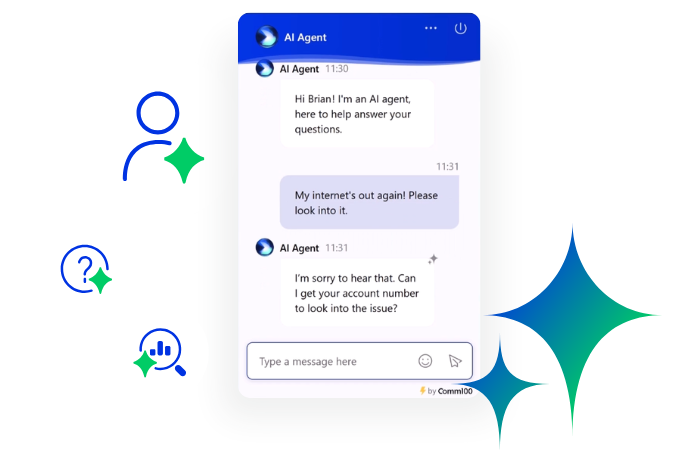
The first thing to do is to deploy AI agents for routine inquiries. Tools like the Comm100 AI Agent can handle 80% or more of routine questions automatically. They understand natural language, access your knowledge base, and resolve common issues without human intervention. This frees your human agents to focus on complex problems that require judgment and empathy.
Then, equip your support agents with AI copilot assistance. When conversations do require human attention, AI copilots provide real-time suggestions, surface relevant knowledge articles, and even draft responses for agent review. This combination of human judgment with AI speed creates faster, more consistent interactions.
The third step is to use proactive chat invitations strategically. Don’t wait for customers to initiate conversations. Trigger chat invitations when behavioral signals indicate confusion or purchase hesitation. A well-timed proactive chat can prevent abandonment and accelerate conversions.
Email: Close the Response Time Gap
Email remains important for customer service, especially for older consumers and complex issues that require documentation.
The challenge with email is managing volume efficiently while maintaining quality. Unlike chat, email doesn’t demand immediate responses, but that flexibility can become a liability when tickets pile up and response times balloon. The solution lies in intelligent automation and prioritization.
How to Improve Email Support
Not all emails deserve equal urgency. Use AI to analyze incoming messages, identify VIP customers, detect urgent issues, and automatically route tickets to the right specialists. This ensures high-priority items get immediate attention while routine requests flow through standard processes.
More importantly, establish clear SLAs based on priority levels. For example: urgent issues within 1-hour, standard requests within 4 hours, low-priority inquiries within 24 hours. Use automated escalation rules to ensure nothing falls through the cracks as deadlines approach.
AI copilot tools can analyze incoming emails, pull relevant information from your knowledge base, and draft responses for agent review. This dramatically reduces handling time while maintaining personalization and accuracy.
SMS offers unmatched reach and engagement rates. Industry research consistently shows SMS open rates around 98%, with 95% of messages read within three minutes of delivery. These numbers dwarf email engagement metrics.
The power of SMS lies in its immediacy and intimacy. Text messages land in the same inbox where customers receive messages from friends and family. This personal context drives attention, but it also demands respect. SMS works best for time-sensitive, high-value communications rather than promotional noise.
How to Use SMS Effectively
Focus on transactional and time-sensitive messages. Appointment reminders, shipping updates, order confirmations, and security alerts are ideal SMS use cases. Industry research shows that 64% of consumers appreciate SMS reminders for appointments. These messages provide genuine value rather than marketing noise.
You can use tools like Comm100 Outreach to enable two-way SMS conversations. One-third of messages sent to businesses never receive a reply due to lack of two-way messaging capability. When customers can respond to your texts and receive quick answers, SMS becomes a powerful support channel. Integrate SMS with your ticketing system to capture these conversations.
Finally, unify SMS with your omnichannel strategy. SMS shouldn’t exist in isolation. Connect it to your broader customer messaging platform so agents can see SMS conversations alongside chat, email, and social interactions. This unified view prevents fragmented experiences and enables seamless handoffs.
Phone Support: Optimize for Complex and High-Stakes Issues
Despite the rise of digital channels, phone support remains crucial. McKinsey’s 2024 consumer survey found that live phone conversations remain among the most preferred support methods across all age groups, including Gen Z. In fact, one financial services company reported that Gen Z customers are 30 to 40 percent more likely to call than millennials.
Phone calls excel for complex issues requiring real-time dialogue, emotionally charged situations, and premium service expectations. The challenge is managing phone support costs while maintaining quality.
How to Optimize Phone Support
Make sure to implement callback functionality during peak periods. Nothing frustrates customers more than being placed on hold. Queue management systems let customers hold their place in line without sitting on the phone. When an agent becomes available, the system calls them back automatically.
Route calls to agents based on the specific expertise required, not just availability. When customers reach someone who can solve their problem on the first call, satisfaction soars and handle times drop.
Provide agents with complete customer context. Screen pops showing customer history, recent interactions, and relevant account information enable personalized service from the first moment. Agents shouldn’t waste time asking customers to repeat information they’ve already provided through other channels.
Bringing It All Together: Omnichannel Integration
Optimizing individual channels isn’t enough. McKinsey research confirms that customers of all generations want the flexibility to use different channels according to their needs. They might start on chat, switch to email for documentation, and call when the issue escalates. Each transition is an opportunity to either delight or frustrate.
The challenge is that most organizations still struggle with integration. This fragmentation creates disconnected experiences, forces customers to repeat themselves, and prevents agents from delivering personalized service.
How to Achieve True Omnichannel Integration
Consolidate on a unified platform. The most effective approach is bringing all channels onto a single platform with a unified customer database. When agents can see the complete interaction history across every channel, they can provide seamless service regardless of how customers choose to connect.
Enable intelligent cross-channel routing. Customers shouldn’t have to restart when switching channels. Intelligent routing should carry context forward, matching customers with agents who can see their complete history and pick up where the last interaction left off.
Use analytics to understand channel preferences. AI Insights can analyze interaction patterns to reveal which channels customers prefer for different issue types. Use these insights to guide customers toward the channels most likely to resolve their specific needs quickly.
Conclusion: Continuous Optimization as a Mindset
Channel optimization isn’t a project with an end date. It’s an ongoing discipline that requires continuous measurement, testing, and refinement.
Start with the quick wins we talked about. Then tackle the larger strategic initiatives: deploying AI agents, implementing AI copilot assistance, and consolidating onto a unified omnichannel platform. Each improvement compounds on the last.
The organizations that will thrive are those that treat customer communication not as a cost center to minimize, but as a strategic function that drives loyalty, retention, and revenue.
With the right channels optimized and integrated, every customer interaction becomes an opportunity to strengthen relationships and differentiate from competitors still struggling with fragmented, frustrating experiences.
Frequently Asked Questions
Q: What is the biggest problem with self-service today?
Most self-service portals fail because customers can’t find relevant content. The fix isn’t adding more articles but organizing them around the language customers actually use. Monthly ticket audits reveal the exact phrases people search for, and AI-powered search can match natural language queries to relevant articles even when the wording doesn’t match perfectly. Structure your knowledge base around customer questions rather than internal categories.
Q: Why is phone support still important when digital channels are growing?
Phone support remains critical because customers across all generations still prefer live conversations for complex or high-stakes issues. Phone excels when problems require real-time dialogue, emotional sensitivity, or premium service expectations. The key is optimizing phone for these complex interactions while steering simpler issues toward more cost-effective channels like chat and self-service.
Q: How can AI improve live chat without losing the human touch?
AI works best as an assistant rather than a replacement. AI agents can handle routine inquiries automatically, freeing human agents for complex issues. For those tougher conversations, AI copilots provide real-time suggestions and draft responses for agents to review and personalize. This combination lets human agents focus on interactions requiring judgment and empathy while AI handles repetitive tasks.
Q: What makes SMS different from other customer communication channels?
SMS offers unmatched immediacy and engagement. Messages land in the same inbox where customers receive texts from friends and family, creating attention that email can’t match. However, SMS works best for time-sensitive, high-value messages like appointment reminders, shipping updates, and security alerts. Enable two-way conversations so customers can reply and receive support and integrate SMS with your ticketing system to maintain conversation history.
Q: What’s the first step toward true omnichannel integration?
Start by consolidating channels onto a unified platform like Comm100 with shared customer data. Without integration, customers repeat themselves when switching channels and agents lack context for personalized service. Begin with an audit of your current channel coverage to identify gaps, then prioritize connecting your highest-volume channels to a single customer database. This foundation enables seamless handoffs regardless of how customers choose to connect.
Explore Comm100’s Omnichannel Customer Engagement Platform
See how Comm100 unifies live chat, email, SMS, self-service, and phone support on one AI-powered platform to deliver faster, more personalized experiences at scale.
Request a demo
Request Demo