Higher education institutions face a convergence of pressures in 2026 that will fundamentally reshape how they operate. Federal funding faces unprecedented cuts. Enrollment challenges persist across most institutional types. Mental health demands overwhelm campus resources. Political scrutiny intensifies with each news cycle.
The institutions that thrive in 2026 won’t always be the richest, and they’ll be the smartest about technology deployment.
They’ll be those that deploy technology strategically, implement AI with proper governance frameworks, and prove their value through concrete, measurable outcomes. Here are the seven trends that will define success or struggle in the year ahead.
The number: $6.9-$8.2 billion in federal funding awards have been terminated and another $3.3-$3.7 billion is targeted for cuts.
More than 4,000 grants have been affected at over 600 institutions. Public institutions have had nearly twice the amount of funding targeted as compared to private institutions.
That translates to roughly $206 in cuts per enrolled student.
The Response from Major Institutions
- Stanford: 363 positions eliminated
- University of Nebraska: Faculty buyouts
- Dozens more: Hiring freezes
In 2026, these numbers are only going to go higher as institutions scale down. Budget constraints hit hardest during peak demand seasons:
- Admissions during application windows
- Advising during registration
- IT help desks at semester start
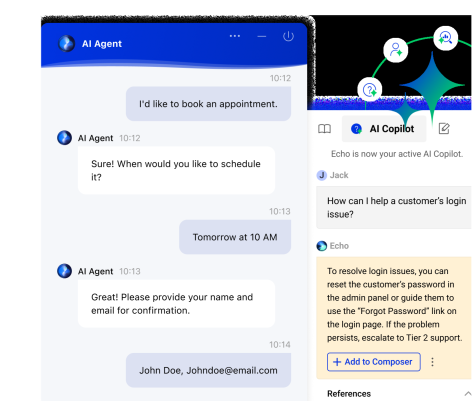
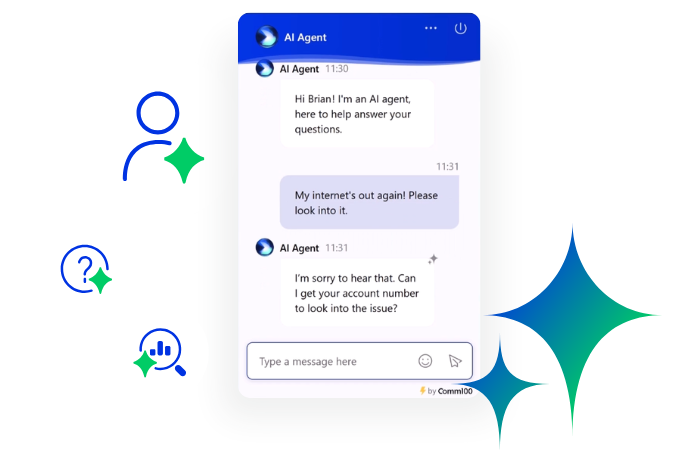
This has forced many universities to focus on operational transformation: making staff more efficient with AI. For starters, institutions like San Jose State University have already managed to automate up to 55% of all incoming chats with the Comm100 AI Agent.
Apply this to mid-sized university admissions:
- 500 daily inquiries during peak season
- 70% to AI = 350 inquiries
- 68% resolved = 238 automated daily
- Six-week peak = 10,000 inquiries handled by automation
Other tools like the AI Copilot are already being deployed, helping amplify the capabilities of their support staff.
Instead of typing from scratch, support staff get AI suggestions based on inquiry context.
- Generative answer suggestions
- Text enhancement ensures professional tone
- Smart summaries eliminate reading entire histories
- Smart wrap-up speeds ticket closure
2. AI Without Governance Is a Liability
The AI adoption debate is over.
The 2026 EDUCAUSE Top 10 is a pretty good indicator of what higher education leaders will focus on in 2026.
It’s becoming increasingly clear that technology leaders now focus on accountability frameworks.
The conversation is more about how to govern the use of AI.
What are the latest AI and data governance frameworks today?
Several frameworks guide institutional AI governance:
For Higher Education
Most institutions start with NIST RMF for risk-based foundation.
- EU-serving institutions prepare for AI Act compliance.
- ISO/IEC 42001 provides a certification pathway demonstrating proper governance to accreditors and regulators.
Practical application: These frameworks translate into concrete controls like requiring AI responses cite verified sources, implementing review processes for every AI interaction, and maintaining audit trails showing proper oversight.
International Standards
- OECD AI Principles: Adopted by 47 nations. Emphasizes transparency, accountability, human-centered values.
- EU AI Act: Binding regulation effective August 2024. Classifies AI by risk level (unacceptable, high-risk, limited, minimal).
- NIST AI Risk Management Framework: U.S. standard. Four functions: Govern, Map, Measure, Manage.
Certification & Technical Standards
- ISO/IEC 42001: First AI management system standard (2023). Addresses data quality, bias, lifecycle processes.
- IEEE 7000 Series: Focuses on transparency and algorithmic bias in system design.
The institutions succeeding with AI governance don’t just adopt principles. They implement technical controls enforcing those principles automatically.
Sophisticated institutions are building three-layer governance approaches:
- Clear policies defining which AI use cases are acceptable and which require additional review
- Technical controls that prevent AI systems from hallucinating information not grounded in verified institutional knowledge.
- Continuous review mechanisms that evaluate AI performance against established quality standards.
AI systems, like higher ed chatbots, learn from your content.
Outdated policy documents, contradictory FAQs and missing answers all lead to hallucinations and incorrect information for students. With institutions managing larger and larger support volumes, tools like AI Knowledge help in auditing and updating knowledge base content.
3. Mental Health Needs Exceeding Available Support
By 2026, the United States will need approximately 900,000 mental health workers, representing a 10% increase over current staffing levels. Roughly half of the states will experience total shortfalls of 55,000 workers. Needless to say, this will impact higher education too.
The current mental health workforce is reaching retirement age while new entrants fail to replace those exiting the field quickly enough.
This creates an impossible situation where higher education institutions face exponentially growing student mental health needs while the available pool of mental health professionals remains severely constrained, all occurring against the same budgetary pressures limiting their ability to expand counseling services.
Technology can’t replace student counselors, but it can reduce operational stress.
When students can’t get answers about financial aid, registration, degree requirements; uncertainty creates anxiety.
When simple inquiries take days for response, stress compounds.
Organizations are already looking at AI to offer better student counseling, and we fully expect this trend to continue in 2026.
4. Unified Systems to Replace Point Solutions in Academia
As purse strings become tighter and budgets shrink, organizations are taking measured approaches to technology investment.
Translation: Stop adding more vendors.
A great example of this is student support and communications technology infrastructure, with institutions using separate platforms:
- One vendor for live chat
- Another for chatbot
- Third for email ticketing
- Fourth for social media
- Fifth for SMS
That means:
- Five contracts to manage
- Five integrations to maintain
- Five training programs for staff
- Five dashboards to monitor
Analytics stay siloed.
Not only does it affect student support, but it also leads to substantial operational costs.
Student context doesn’t flow seamlessly between systems, forcing agents to manually piece together interaction histories from multiple platforms.
Organizations are increasingly looking at omnichannel solutions that they can use to manage everything through one platform. We are seeing an uptick in the number of universities and institutions that are looking for solutions beyond just live chat.
The best live chat vendors all offer comprehensive support solutions, including AI chatbots, email ticketing, and more. At Comm100, we enable institutions to offer student support across different channels, from SMS, email, messaging apps like WhatsApp, to social media tools like Facebook or Instagram.
With specialized tools for higher education like Comm100 Booking for making appointments and Comm100 Queue Management for managing wait times and longer queues, Comm100’s unified platform is the ultimate choice for institutions.
Plus, one comprehensive analytics dashboard reveals complete student journeys across all touchpoints. Administrators see which students started inquiries on social media, continued through live chat, and ultimately resolved their questions via email, understanding the full context rather than fragmentary snapshots from disconnected systems.
5. A Deeper Focus on Personalization
Generic mass communications don’t work anymore.
Students expect experiences that recognize who they are, what they need, and where they are in their journey.
When a returning student asks about fall registration, they shouldn’t get the same canned response as a first-time applicant.
When a transfer student inquires about credit evaluation, the system should already know they submitted transcripts last month.
When a graduate student emails financial aid, the response shouldn’t assume they’re an undergrad.
Real personalization leads to a smooth flow of context across every touchpoint:
- Student messages via social media about housing
- Follows up through live chat about meal plans
- Emails about financial aid deadline
Each agent sees complete history. No repetition. No starting over.
The AI Agent can recognize returning students, reference past conversations, and provide specific answers instead of offering generic responses.
Not “here’s general information about deadlines.”
Instead: “Your spring registration opens November 4th at 9 AM based on your current credit hours.”
Students grew up with Netflix recommendations, Amazon personalization, Spotify playlists tailored to their taste.
They expect institutions to operate the same way.
Generic communication feels broken.
Given how much research students put into institutions before deciding where to apply, expect hyper personalization to become a critical focus in 2026 for academic institutions.
6. Alternative Credentials Gain Federal Backing
The four-year degree faces real competition.
Dual enrollment programs increased more than 10% year-over-year according to the 2025 Landscape of Higher Education Report, adding 100,000 students and accounting for 28.1% of undergraduate enrollment increases.
The One Big Beautiful Bill Act opens Pell Grant eligibility to programs as short as eight weeks, fundamentally changing the economics of certificate programs and intensive boot camps.
These shorter pathways become accessible to students who previously couldn’t afford them without taking on substantial private loan debt.
“Degree in three” programs gain momentum as students recognize opportunities to enter the workforce sooner while avoiding the escalating costs of a fourth year.
Many universities that built their business models around four-year degree programs must now compete with faster, cheaper alternatives promising immediate career relevance.
The institutions adapting successfully aren’t abandoning bachelor’s degrees. They’re building portfolio approaches that include traditional four-year programs alongside shorter credentials serving different student populations with different needs and timelines.
7. A Sharp Decline in International Enrollment
These past few years saw some of the highest international enrollment numbers in both Canada and the US. However, that’s trending downward sharply.
In Canada, international enrollment fell almost 60% in 2025, as compared to the previous year. Next year, the country’s reducing it by another 49% compared to the cap in 2025.
In the US, international enrollment is down 17% and is expected to go down even more.
That’s the largest single-year decline in 11 years outside the pandemic, according to the Institute of International Education’s Open Doors report.
Graduate programs took the hardest hit:
- Graduate enrollment down 12%
- Master’s programs down 20.5%
The pipeline of global talent is breaking.
Experts warn 2026 will be worse.
Students making enrollment decisions in 2025 had an entire year to reconsider U.S./Canadian options.
Institutions that built budgets assuming international tuition revenue are already facing severe shortfalls.
This leads to a new situation: universities must make themselves more competitive if they want to attract foreign talent.
One way to do that is to deliver flawless support experiences to students navigating:
- Complex visa processes
- Time zone differences
- Language barriers
- Cultural adjustment
24/7 availability becomes essential, not optional.
Is Your Institution Ready for the Future?
Given the changing political climate, the increased scrutiny on international applicants, and the changing macroeconomic conditions, institutions need to start preparing yesterday.
The choice facing higher education leadership isn’t whether to address these trends. It’s whether to address them strategically and comprehensively or reactively and fragmentarily.
The institutions that thrive in 2026 won’t manage these trends separately. They’ll build integrated systems where AI governance, operational efficiency, AI-powered analytics, and outcome tracking work together.
See Comm100 in Action
See how Comm100 is helping universities improve customer support.
View demo
View Demo