

Your shortlist looked strong in the demo. Then security asked which certifications actually cover the product you’re buying, compliance asked where conversation data + Read More about selecting a financial services chatbot: security, compliance, and integration checklist
What Is a Good AI Resolution Rate for Player Support? The Honest Distribution
Across the 220 million-plus live chat interactions analyzed in the Comm100 2026 AI Live Chat Benchmark Report, AI chatbots resolved 44.8% of the chats they handled. That single figure hides a spread running from 89.0% down to 41.2% by team size, and from 97.7% down to 38.1% by sector. iGaming sits at the bottom of both.
If you’re an operator looking to adopt an AI solution, having a solid understanding of AI resolution rates is the first place to start. Here’s our full guide.
What Is a Good AI Resolution Rate?
A good AI resolution rate is from 65% to 80%, depending on how finely tuned the AI chatbot is to your company’s internal documents. The all-industry average of 44.8% applies only to chats the bot actually handled, not to total incoming volume.
The variation by team size is the more useful cut:
- 1 to 5 agents: 89.0%
- 6 to 10 agents: 69.6%
- 11 to 25 agents: 47.8%
- 26 or more agents: 41.2%
By sector, the same metric ranges from 97.7% in Non-Profit through Education at 75.9% and Banking & Finance at 75.2%, down to Health & Pharma at 45.8% and iGaming at 38.1%.
Using a spread that wide might not be the most useful choice for iGaming companies. An operator benchmarking against 44.8% is comparing itself to a blend that includes deployments a fraction of its size.
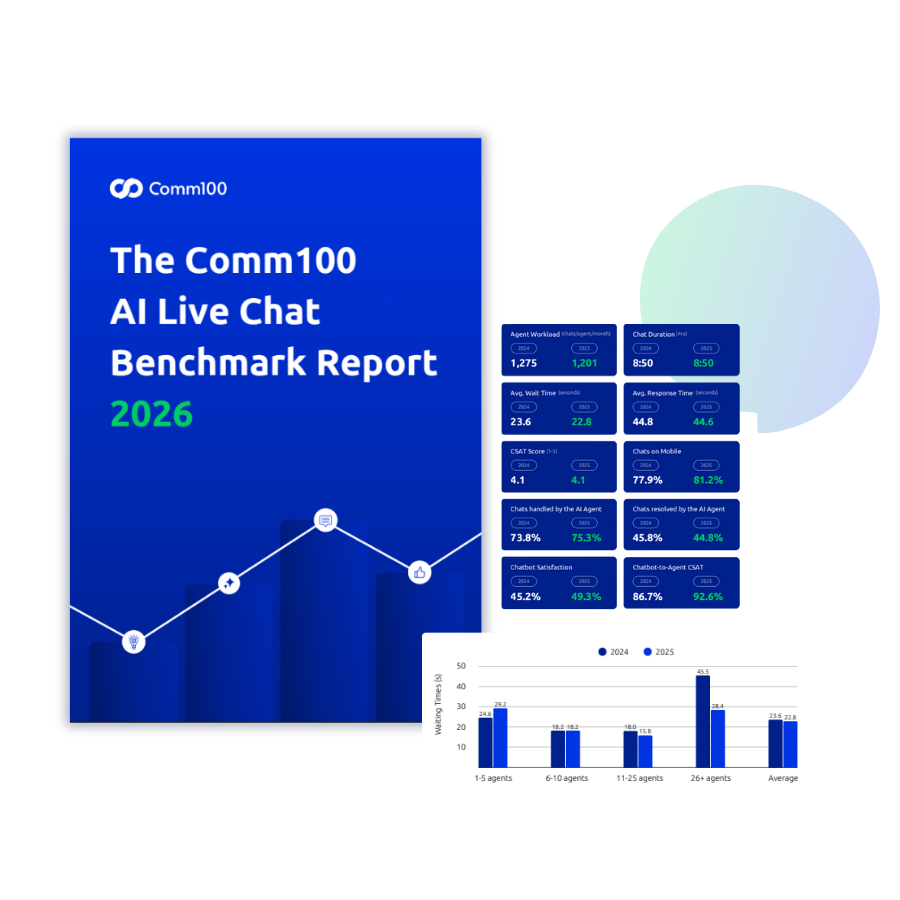
The Comm100 AI Live Chat Benchmark Report 2026
Go beyond the 44.8% average. See AI resolution rates by team size and industry, plus handling, satisfaction, wait time, and agent workload benchmarks drawn from more than 220 million chats.
Download reportReport
Why Does Resolution Rate Fall as AI Handles More Chats?
Coverage and resolution move in opposite directions, and the team-size data shows it cleanly. Teams of one to five agents route 54.3% of chats to the bot and resolve 89.0% of them, while teams of 11 to 25 route 92.5% and resolve 47.8%. The larger deployment looks worse on the headline metric while doing considerably more work.
Questions do not arrive in random order of difficulty, which is what drives the pattern. The first slice of coverage is documented FAQ material where the answer either exists or it does not.
Push coverage towards 90% and you have pulled in account-specific queries, multi-step requests and judgment calls. The report puts it plainly: as AI chatbots handle a larger share of incoming chats, they encounter more edge cases and complex queries that require human escalation.
Importantly, volume matters more than the percentage suggests. A 41.2% resolution rate applied to millions of conversations removes far more work from agents than 89.0% applied to a few thousand.
Teams of six to ten agents break the pattern, with handling dropping from 65.3% to 45.3% and resolution from 75.9% to 69.6%. The report attributes both declines to organizations re-evaluating their AI strategies after early experiments, which is a reminder that the curve describes most deployments rather than all of them.
Why Is iGaming’s AI Resolution Rate So Low?
Two things put operators at the bottom of the range, and neither is a configuration problem.
Scale accounts for the first. iGaming agents handle 1,540 chats per agent per month, the highest figure among the sectors published in the report, and the average site fields 25,647 chats per month.
That is enterprise-scale contact volume, so the enterprise-scale resolution band is the right comparison, and iGaming’s 38.1% sits close to the 41.2% recorded for teams of 26 or more agents. The sector figure corroborates the team-size finding rather than contradicting it.
The shape of the contact mix does the rest of the work. Player queries divide into two groups, and the first of them is large, well documented and straightforward to automate: bonus terms, wagering requirements, deposit methods, account access, missing free spins and explanations of responsible gambling tools all have a correct answer written down somewhere. A well-fed knowledge base handles them.
The second group cannot be automated at any level of model quality. It covers withdrawal delays tied to a compliance review, where the reason for the hold cannot always be disclosed in full.
It covers KYC document disputes, where a player is contesting a verification decision, and source of funds queries carrying AML obligations. It covers self-exclusion requests, which trigger regulated processes with fixed timelines. Above all, it covers any contact carrying a problem gambling signal, where the interaction itself becomes evidence of how the operator responded.
None of these are difficult questions. They are regulated decisions, and a regulated decision needs a named human accountable for it. An operator’s licensing footprint and verification friction therefore set a ceiling on automatable share before anyone writes a single intent, which is why two operators running identical software in different markets will land in different places.
Two figures are worth reading alongside the resolution rate. iGaming records the shortest average chat duration in the dataset at 6 minutes 12 seconds, and a CSAT of 4.1, equal to the all-industry average. The sector is not resolving less because it serves players worse.
What Does a Realistic Resolution Rate Translate to Agent Capacity?
On an average site, 75.6% of 25,647 monthly chats reach the AI Agent, giving roughly 19,400 AI-handled conversations, and 38.1% of those are resolved without a person: about 7,400 chats per month. Set against a workload of 1,540 chats per agent per month, that deflection is worth close to five agents per site, which is the conclusion the report reaches from the same figures.
A low-resolution rate applied to a large base is worth more than a high one applied to a small base, and the same arithmetic shows where improvement pays. Moving resolution from 38% to 45% within the automatable band adds roughly another agent’s worth of capacity per site, without touching a single contact that needs human accountability.
What Should Operators Measure Instead?
The most useful substitute for a blended resolution figure is resolution measured only within the automatable band. Classify intents into automatable and escalate-by-design, then score the bot against the first group alone. A bot resolving 85% of documented-policy queries while escalating 100% of compliance-touching ones is performing well, even though the blended figure still reads below 45%.
Escalation quality deserves equal weight and almost nobody reports it. Track the share of transfers arriving with intent, account context and conversation history attached, then use bot-to-agent satisfaction as the outcome measure. This is what separates intake-and-classification architecture from a bot that gives up.
Containment error rate is the third, and it asks how often the bot resolved something it should have escalated. It is the only one of the three where the target is zero, and the one most operators have not yet instrumented.
A ceiling you can name is a ceiling you can plan around. Staffing models, market expansion and surge cover for a major fixture all depend on knowing what share of player contact will always land with a person. The operator working from an 80% assumption discovers the real number during a peak, when there is no time to hire.

Build a Smarter AI Resolution Strategy
See how Comm100 AI Agent resolves documented player questions, escalates regulated cases with full context, and gives your team the data to measure performance accurately.
Request a demoRequest Demo