

Your shortlist looked strong in the demo. Then security asked which certifications actually cover the product you’re buying, compliance asked where conversation data + Read More about selecting a financial services chatbot: security, compliance, and integration checklist

Insurance AI Chatbots and Compliance: Regulations, Data Privacy, and Risk Controls
A policyholder opens a chat window at 9pm and asks whether last week’s water damage is covered. Whatever answers that question has made a statement about a regulated insurance product, and a state examiner can ask you to account for it.
That’s the part most insurance AI chatbot projects underestimate. Requirements arrive from three directions: the NAIC model bulletin and its state-level adoptions, individual insurance department rules that go further, and unfair discrimination law that predates AI entirely. None of them mentions chatbots by name, but all three apply.
Licensing the technology instead of building it doesn’t change who is accountable. The carrier is still the party a regulator examines, and a vendor’s certifications don’t transfer that responsibility. This article covers policyholder-facing conversational systems used for service questions, billing, claims intake, and status checks. Underwriting and pricing models fall under separate rules.
Comm100 has been building customer service technology since 2009 for insurance, banking, healthcare, and government teams operating under these constraints.
What the NAIC AI Model Bulletin Requires of Insurance AI Chatbots
The NAIC AI model bulletin, formally the Model Bulletin on the Use of Artificial Intelligence Systems by Insurers, was adopted on December 4, 2023. Its central requirement is a written AI Systems (AIS) Program for the responsible use of AI systems that make or support decisions related to regulated insurance practices.
That program should cover governance, risk management controls, and internal audit functions, with responsibility vested in senior management accountable to the board. It should span the system’s full life cycle, from design through retirement, and apply whether you built the system or bought it. The bulletin also asks for processes that give affected consumers notice that AI systems are in use. These expectations build on the NAIC Principles of Artificial Intelligence, adopted in 2020: fairness, accountability, compliance with state law, transparency, and safe and secure systems.
Applied to a chat widget, those expectations translate into concrete work. Your insurance chatbot needs a documented owner, a validation record, a monitoring cadence, and a version history you can produce on request. The AIS Program can sit inside your existing enterprise risk management program, which is usually faster than building a standalone program.
Keep in mind that the bulletin is guidance, not model law, and it isn’t self-executing.
Why Your Compliance Obligations Change State by State
Because the bulletin is not self-executing, it reaches you only where a state insurance department has issued it. As of April 1, 2026, the NAIC’s own implementation tracker listed 25 jurisdictions that had adopted the model bulletin, while California, Colorado, New York, and Texas had their own insurance-specific AI regulations or guidance.
For single-state carriers, identifying the requirements is straightforward. For carriers writing multi-state business, it’s harder, because an insurance AI chatbot is held to the strictest jurisdiction in your footprint, not the average.
The states with their own rules are worth reading closely. New York’s Insurance Circular Letter No. 7 was issued in July 2024 and covers AI systems in underwriting and pricing, setting expectations for discrimination analysis, actuarial validity, governance, and internal controls. Using a chatbot for insurance service work doesn’t bring you within the letter’s scope, but the letter shows what New York’s examiners are already trained to look for.
Adoption is still expanding, so treat any list as a snapshot and refresh your jurisdiction matrix quarterly. Include your deployment model in that matrix as well, because where conversation data is physically stored can determine whether a state’s residency expectations are met.
Unfair Discrimination and AI Governance: The First Thing Examiners Look For
In insurance, unfair discrimination is a defined legal standard. It comes from the Unfair Trade Practices Model Act and the Unfair Claims Settlement Practices Model Act: decisions must not be inaccurate, arbitrary, capricious, or unfairly discriminatory. The standard applies regardless of the method used to reach the decision.
An insurance AI chatbot can breach that standard without ever touching a rate. Most of the risk comes from three areas: routing, when some policyholders reach a licensed human faster than others; answer quality, when accuracy drops for less common policy types; and escalation, when a complaint is logged if phrased one way but not another.
The bulletin describes the controls that address these risks: test for errors and bias before deployment, monitor after launch, document the validation, and keep a person involved in any interaction that carries a meaningful risk of harm to the consumer.
Comm100’s AI Copilot works alongside a licensed agent, suggesting responses and surfacing policy context while the agent remains accountable for what is said. For high-risk interactions, an assistive model is easier to defend than a fully autonomous one.
The bulletin also addresses third-party accountability directly, asking your program to cover vendor due diligence, audit rights in contracts, and vendor cooperation with regulatory inquiries. Request those terms during procurement, because adding them later means renegotiating the contract.
Data Privacy and Policyholder Information Inside AI Conversations
A transcript from an insurance AI chatbot is more than a support log. It can contain a policy number, a loss description, sometimes a date of birth, and, in health or disability lines, protected health information. That makes the transcript a regulated record, subject to the same privacy obligations as the policy system that feeds it.
Four control areas cover most of the exposure:
- Retention: a defined period with automatic deletion, not indefinite storage by default.
- Encryption: in transit and at rest, including any analytics copy.
- Access: role-based, so an agent sees only the conversations their role requires.
- Residency: knowing which country’s data center holds the record, because several states, and PIPEDA in Canada, attach consequences to where it is stored.
Notice matters here as well. Policyholders should be able to tell when an automated system is responding and how to reach a person, which the NAIC bulletin asks for directly.
Comm100 supports both cloud and on-premises deployment, with data centers in the US, Canada, Europe, and APAC, and holds SOC 2 Type II, ISO 27001, PCI DSS, GDPR, PIPEDA, HIPAA, WCAG, TX-RAMP, and FIPPA certifications. Current details are in the Comm100 Trust Center. Confirm the scope that applies to your deployment model, because platform certification supports your compliance program but doesn’t replace it.
Risk Controls That Hold Up Under a Market Conduct Examination
Examiners work from documentation, so each control needs an owner, an artifact you can produce, and a review cadence. The six controls below cover a conversational deployment.
| Control | What Regulators Look For | Where It Lives |
|---|---|---|
| Automation notice | Policyholder can tell a system is answering | Widget copy and greeting |
| Escalation to a person | Documented path and response time | Routing rules |
| Logging and retention | Full transcripts, defined retention period | Platform configuration |
| Accuracy review | Sampled review of coverage and status answers | QA program |
| Bias and error testing | Pre-launch results plus monitoring cadence | AIS Program record |
| Vendor oversight | Due diligence file and audit rights in contract | Procurement and legal |
Most carriers already run five of these six controls somewhere in their contact center. The task is extending their scope to cover the insurance AI chatbot rather than standing up a parallel program.
On the platform side, Comm100’s AI Agent resolves routine policyholder questions in the same console your human agents use, with transcripts, routing rules, and escalation paths configured centrally. Comm100 for insurance customer service covers carrier-specific setup in more detail. Bias testing and vendor oversight remain your team’s responsibility, because no platform can produce that documentation for you.
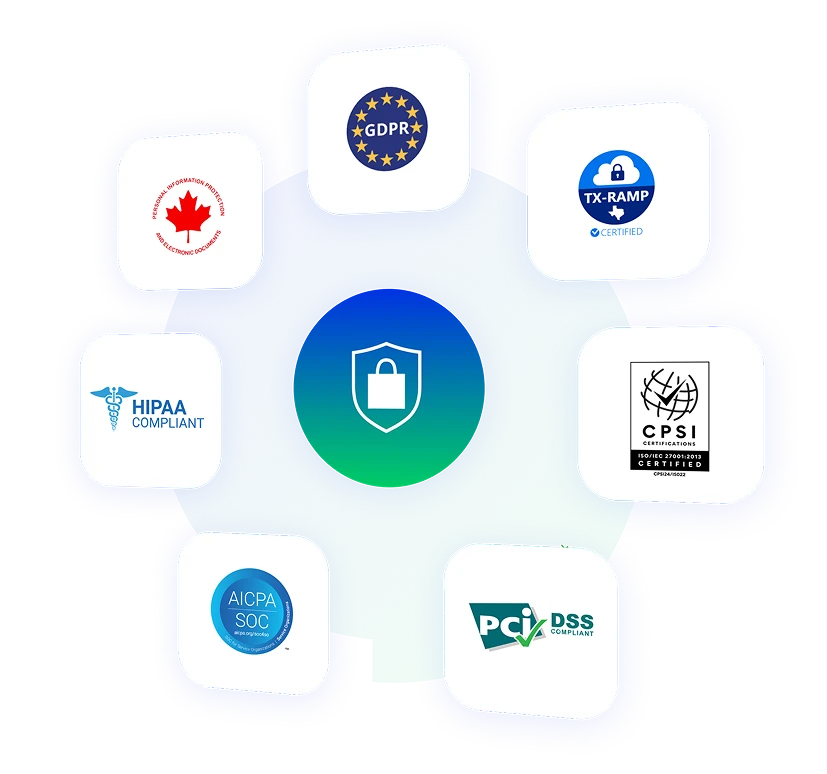
Explore the Comm100 Trust Center
Review security controls, compliance information, and deployment options as you evaluate Comm100 for insurance.
Visit Trust CenterTrust Center
Insurance AI Chatbot Compliance Questions Answered
Is the NAIC AI Model Bulletin Legally Binding?
Not by itself. It’s principles-based guidance the NAIC adopted on December 4, 2023, and it takes effect in a state only after that state’s insurance department issues it. As of April 1, 2026, 25 jurisdictions had done so. Where it applies, the department can request your AIS Program documentation during a market conduct action.
Do a Vendor’s Certifications Satisfy My Insurance AI Compliance Obligations?
No. Certifications such as SOC 2 Type II and HIPAA describe the controls the platform operates and give you evidence to cite. The obligation to maintain governance, testing, and documentation stays with the carrier, and the bulletin asks insurers to address third-party AI systems inside their own program.
Must Policyholders Be Told They Are Talking to an Automated System?
In adopting states, yes. The NAIC bulletin asks insurers to give notice that AI systems are in use, with information appropriate to the stage of the insurance life cycle. In practice, that means insurance chatbot copy that names the automated system and offers a visible route to a human agent.
How Long Should Insurance Chat Transcripts Be Retained?
There’s no single national answer. Retention is set by your state’s record-retention rules, applicable privacy law, and your line of business, with health-related conversations often carrying stricter requirements. Set a defined period per line, automate deletion at that point, and document the reasoning.
Who Is Responsible When a Chatbot for Insurance Gives a Wrong Answer?
The carrier. Regulatory standards attach to the decision regardless of the tool used to reach it, so an incorrect coverage statement from an insurance chatbot is the insurer’s to answer for. That’s why accuracy review, escalation paths, and vendor audit rights belong in the control set.
Building Compliant Policyholder Support With Comm100
Insurance AI compliance comes down to four things you can show a regulator: who owns the insurance AI chatbot, what you tested, what you logged, and where the data sits.
Comm100 provides a people-first, AI-powered omnichannel customer service platform for insurance, banking, government, and healthcare teams. AI Agent resolves up to 80% of inquiries automatically, AI Copilot keeps a licensed person accountable for the interactions that need one, and cloud or on-premises deployment lets conversation data stay where your jurisdiction matrix requires. These are platform capabilities, not guaranteed results for your book of business.

Explore AI Support for Insurance
See how organizations like yours are using Comm100 to deliver better customer service.
Request a demoRequest Demo