

A policyholder opens a chat window at 9pm and asks whether last week’s water damage is covered. Whatever answers that question has made + Read More about insurance ai chatbots and compliance: regulations, data privacy, and risk controls

Selecting a Financial Services Chatbot: Security, Compliance, and Integration Checklist
Your shortlist looked strong in the demo. Then security asked which certifications actually cover the product you’re buying, compliance asked where conversation data is stored, and IT asked how it connects to your core banking platform. Three weeks later, you’re running the evaluation again.
Choosing a financial services chatbot is a risk decision before it’s a feature decision. Conversations may touch account details, payment information, or personal data, so the platform has to satisfy your risk committee as much as your support team. Feature lists rarely separate vendors at this level. What does separate them comes down to three things: the security controls protecting customer data, the certifications each vendor holds and what they cover, and how cleanly the platform connects to the systems you already run. Work through those three areas and the right choice becomes much clearer.
Why Chatbot Selection Is Harder in Financial Services
Conversational automation is already standard in banking. The Consumer Financial Protection Bureau found that all ten of the largest U.S. commercial banks use chatbots of varying complexity to engage customers. The real question is which platform will clear your internal review.
That review is where financial services differs from other industries. A chatbot that underperforms in retail might cost you a future sale, but a chatbot that mishandles cardholder data produces an audit finding, and whoever approved it gets to explain why.
Security Controls to Verify Before You Book a Demo
Chatbot security comes down to specific controls you can check. Any financial services chatbot vendor worth a demo slot should be able to confirm each control below and name the mechanism behind it. “We take security seriously” doesn’t do that; “TLS 1.2 or higher in transit, AES-256 at rest, and card numbers masked at capture” does.
| Control | What to verify | Why it matters in banking |
|---|---|---|
| Encryption | TLS in transit and encryption at rest, with the standard named | Transcripts hold account data long after the chat ends |
| Sensitive data masking | Card numbers masked before an agent or the AI sees them | Keeps cardholder data out of transcripts and logs |
| Single sign-on | SAML or OIDC against your identity provider | Removes a separate credential store and centralizes offboarding |
| Two-factor authentication | Enforceable at account level, not per agent | The agent console is a privileged view of customer records |
| Agent permission tiers | Granular roles, so tier-one agents see less than supervisors | Limits risk when one account is compromised |
| Audit logging | Immutable logs of who viewed or exported what, and when | Auditors ask for this, and you can’t reconstruct it later |
Compliance: What Each Certification Actually Covers
Certifications prove less than most buying committees assume, because scope varies by product line, region, and deployment model. A vendor certified at the company level may not hold the same certification for the specific product you’re evaluating. So rather than asking whether a vendor is certified, ask what each certification covers, who audited it, and when.
| Certification | What it covers | Question to ask the vendor |
|---|---|---|
| PCI DSS | Handling of cardholder data by anyone who stores, processes, or transmits it | Which product lines and deployment models are in scope, and can you share the attestation? |
| SOC 2 Type II | Operating effectiveness of controls over a defined observation period | What was the window, and were there exceptions in the report? |
| ISO 27001 | The information security management system as a whole | Which entities and locations does the certificate cover? |
| GDPR | Processing of personal data of EU and UK residents | What is your lawful basis, and where are sub-processors listed? |
| PIPEDA | Handling of personal information in Canada | Is Canadian data hosted in Canada, and under whose control? |
| WCAG | Accessibility of the customer-facing chat interface | At what conformance level, and is there a current conformance report? |
SOC 2 Type I describes controls at a point in time, while Type II tests whether they operated effectively over several months. For a chatbot for financial services handling live conversations, Type II is the report that matters.
The PCI Security Standards Council is explicit that PCI DSS applies to every entity that stores, processes, or transmits cardholder data, including service providers. A chatbot vendor is a service provider, so if cardholder data can enter a chat window, that vendor falls inside your PCI scope. For a closer look at the mechanics, see Comm100’s PCI DSS compliance information.
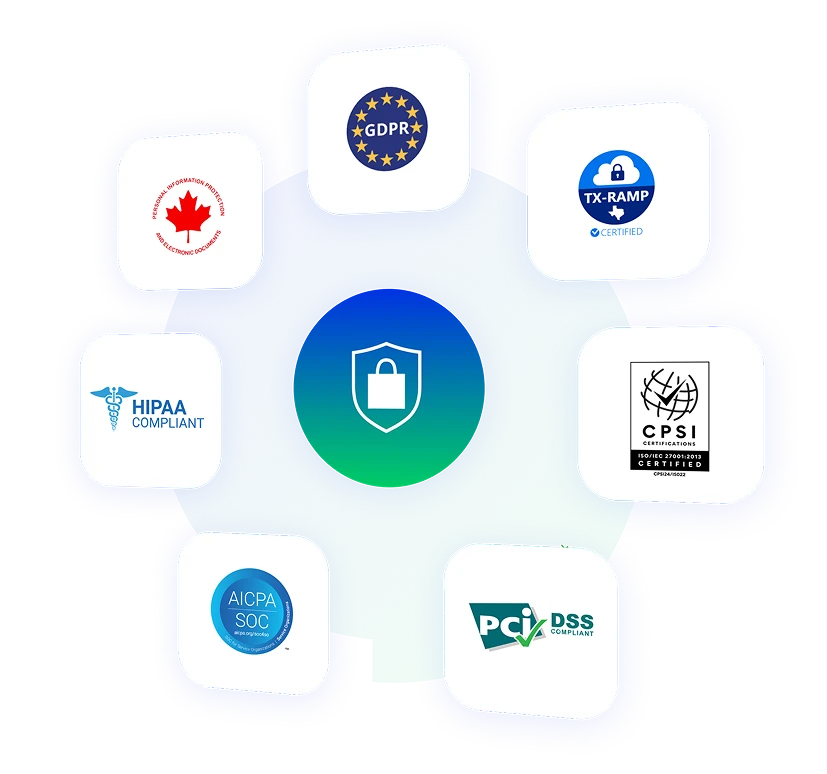
Explore the Comm100 Trust Center
Review security controls and compliance information as you evaluate Comm100 for financial services.
Visit Trust CenterTrust Center
Integration: How the Platform Fits Your Existing Stack
Integration is where many of these projects stall. Core banking systems, CRMs, and ticketing tools weren’t built with conversational automation in mind. A financial services chatbot that can’t read customer context gives generic answers, then hands the customer to an agent who asks for information you already have.
Evaluate integration on five things:
- Pre-built connectors: Does the vendor already integrate with your CRM, ticketing tool, and identity provider, or is every connection custom?
- Open API and webhook access: Can your team move conversation data programmatically without paying for professional services?
- Single sign-on: Does agent authentication run through your existing identity provider?
- Unified agent console: Do chat, email, messaging, and voice land in one place, or do agents keep switching tabs?
- Handover with context: When the AI escalates, does the agent get the full conversation history, or does the customer start over?
Handover is what separates conversational AI that customers tolerate from conversational AI they trust, so ask each vendor to demonstrate a live escalation.
Deployment and Data Residency: Cloud, On-Premises, or Both
For a financial services chatbot, where conversation data is stored is usually dictated by compliance requirements. Data residency refers to where that data physically sits. Data sovereignty refers to which country’s laws govern it. The two don’t always line up: data held domestically can still fall under a foreign jurisdiction, depending on who operates the infrastructure.
Institutions generally land in one of three positions:
- Cloud: Lowest resourcing requirements and fastest upgrades. Acceptable to most institutions, provided data stays in a named jurisdiction. Confirm the region in writing.
- On-premises: Full control of data and infrastructure. Some internal policies and regulators require it, though it takes more resources to run and upgrades arrive more slowly.
- Hybrid: Sensitive workloads stay internal and the rest run in the cloud. Check that the vendor genuinely supports this and isn’t just relabeling a private cloud instance.
One trap to flag for your risk team: certifications don’t always carry across deployment models. A platform assessed for its cloud offering hasn’t necessarily been assessed on-premises, so confirm coverage in writing for each certification and each model. If you need on-premises deployment, filter for it first. Most vendors in this space are cloud-only, and ruling them out early saves weeks.
The Vendor Questions That Separate Answers From Marketing
Ask every potential vendor the same questions in writing, then compare replies side by side. Written answers expose what a polished demo can hide, and they give your risk and procurement teams something to review without scheduling another meeting.
Security
- What encryption standards do you use in transit and at rest?
- How is sensitive customer data masked, and at what point in the conversation flow?
- Can you provide sample audit logs showing agent access and export events?
Compliance
- Which certifications do you hold, and which product lines and deployment models does each one cover?
- Can you share your current SOC 2 Type II report and PCI DSS attestation under NDA?
- Where is our data physically stored, and which jurisdiction governs it?
Integration
- Which of our systems have pre-built connectors, and which need custom work?
- What do comparable customers spend on integration, and over what timeline?
- What information transfers to a human agent at escalation?
Implementation and Support
- What is a realistic implementation timeline for an institution of our size?
- What resolution accuracy do your financial services customers see, and how is it measured?
- After launch, do we get a named contact or a support queue?
Financial Services Chatbot FAQs
What can a financial services chatbot safely handle?
Publicly available information and guided self-service: branch hours, fee schedules, product explanations, application status, card activation, and routing. Anything touching a specific account belongs behind authentication, and anything needing judgment or empathy belongs with a human agent. Drawing that line clearly makes the deployment much easier to defend.
Which certifications should a financial institution require?
Require SOC 2 Type II from any chatbot for financial services, along with ISO 27001 for broader security management and PCI DSS if cardholder data can enter a chat. Add GDPR or PIPEDA depending on where your customers are, and WCAG for the customer-facing interface. Ask for the scope of each in writing rather than taking the badge at face value.
How does a chatbot for banks integrate with core banking systems?
Most integrations run through APIs, pre-built connectors, or middleware rather than touching the core directly. The practical questions are whether the vendor already supports your systems, how much custom development is involved, and whether context carries into the agent console at handover.
How long does implementation typically take?
It depends on integration complexity. A deployment built on published knowledge base content moves faster than one needing custom core banking work. Ask for a timeline tied to your actual system list.
Does automating support reduce service quality?
Not if the split between automated and human-handled conversations is drawn correctly. Automation handles volume and repetition, freeing agents for conversations where expertise and empathy matter. Quality suffers when institutions automate conversations that need a human.
Turning the Checklist Into a Shortlist
Apply the three criteria as an ordered filter. Start with chatbot security, because a vendor who can’t answer control questions in writing won’t clear review. Check certification scope second, since that’s where the gap between the badge and the substance shows up. Assess integration depth last, because it decides whether the platform works on day one or only after six months of custom work.
Comm100 is an AI-powered omnichannel customer service platform founded in 2009, headquartered in Vancouver, BC, serving banking, credit union, and financial services institutions across North America, Europe, and APAC.
Comm100 holds SOC 2 Type II, ISO 27001, PCI DSS, GDPR, PIPEDA, HIPAA, WCAG, TX-RAMP, and FIPPA certifications, with data centers in the US, Canada, Europe, and APAC, and offers both cloud and on-premises deployment. Our Trust Center outlines our certification details and records, and our platform security controls documentation describes specific mechanisms rather than general assurances.

Evaluate Comm100 for Financial Services
See how Comm100 meets financial services chatbot security, compliance, and integration requirements across live chat and AI Agent.
Request your personalized demoRequest Demo