The best support ticket is the one that never gets created. That principle drives the growing adoption of customer self-service across industries. Rather than routing every question through live agents, forward-thinking organizations empower customers to find their own answers through knowledge bases, AI chatbots, customer portals, and community forums.
The business case is compelling. Salesforce research shows that 61% of customers prefer self-service for simple issues, and organizations using self-service effectively resolve an estimated 54% of customer inquiries without agent intervention.
This guide breaks down what customer self-service actually means, the channels available, realistic cost expectations, and the ROI you can expect when implementation is done right.
What is Customer Self-Service?
Customer self-service refers to the tools, resources, and systems that help customers resolve issues, find information, or complete tasks independently without interacting with a company representative. These solutions range from dynamic FAQ pages to sophisticated AI agents capable of handling complex, multi-step inquiries.
The evolution has been dramatic. Early self-service consisted primarily of one-way communications like knowledge bases and FAQ documents. Today’s implementations leverage artificial intelligence, natural language processing, and deep integrations with backend systems to deliver personalized, context-aware support at any hour.
Self-service functions as a subset of your broader help desk and customer experience strategy. When designed well, it handles the high-volume, repetitive inquiries that would otherwise consume agent time while creating a seamless escalation path for issues requiring human expertise.
What Are the Different Types of Customer Self-Service Channels?
Modern self-service encompasses multiple channels, each serving distinct purposes within your customer support ecosystem.
Knowledge Bases and Help Centers
A knowledge base serves as a centralized repository housing articles, how-to guides, troubleshooting documentation, video tutorials, and FAQs. It’s often the first destination for customers seeking answers.
Knowledge bases can be public (unauthenticated) for general product information or private (authenticated) for personalized content based on customer accounts and purchase history.
The most effective knowledge bases go beyond static content. AI-powered systems can flag outdated articles, identify content gaps based on search queries, and even generate new help articles from bullet points. Comm100’s AI Knowledge solution integrates directly with live chat and AI agents, ensuring customers receive accurate, consistent answers across all touchpoints.
AI Agents and Chatbots
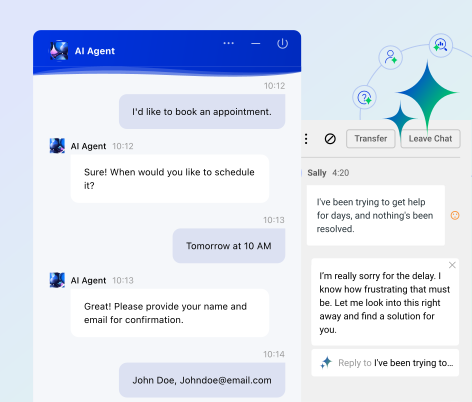
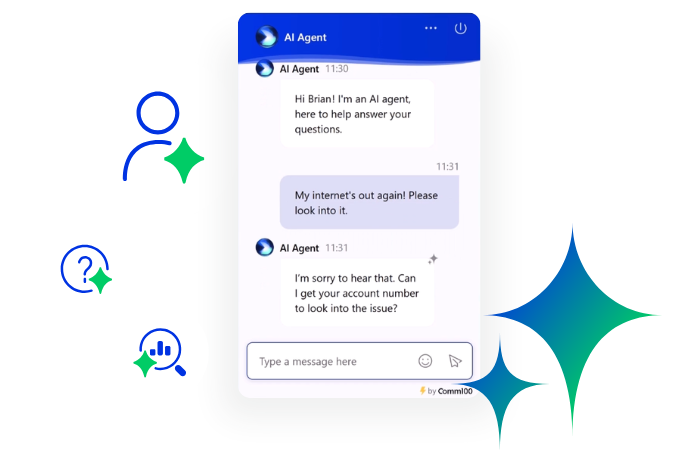
AI agents represent the most sophisticated tier of self-service technology. Unlike rules-based chatbots that follow predetermined scripts, modern AI agents use natural language processing to understand intent, sentiment, and context. They can handle complex, multi-turn conversations while pulling relevant information from integrated systems.
These systems excel at automating common requests like order status checks, account updates, appointment scheduling, and basic troubleshooting. When configured properly, AI agents can resolve issues entirely or collect qualifying information before escalating to human agents with full conversation context intact.
The Comm100 AI Agent can automate up to 80% of customer queries with context-aware responses, deploying across live chat, SMS, and messaging apps while learning from your existing knowledge base and website content.
Customer Portals
A customer portal is a dedicated online hub where authenticated users manage their relationship with your business. Features typically:
- Submitting support requests
- Order tracking
- Account management
- Document access
- Communication history
Banks use portals for account management and card services. Retailers enable order modifications and return initiation. Educational institutions provide student services from registration to financial aid.
The key differentiator from public-facing help centers is personalization. Portals leverage customer data to surface relevant information, pre-populate forms, and provide tailored recommendations based on account history and preferences.
Interactive Voice Response (IVR) Systems
Interactive Voice Response systems enable phone-based self-service through automated menus and voice recognition. Customers navigate options by speaking or pressing phone keys, accessing account information, checking order status, or completing routine transactions without agent involvement.
Modern IVR systems integrate with AI to provide more natural conversational experiences. Tools like the Comm100 Voice Bot extend self-service to the voice channel, understanding and responding to hundreds of topics while escalating complex issues to live agents when needed.
Community forums facilitate peer-to-peer support where customers help each other solve problems, share workarounds, and discuss best practices. This model proves particularly valuable for complex products where users develop expertise through hands-on experience.
The benefits extend beyond cost deflection. Forums build customer loyalty, surface product feedback, and create searchable archives of solutions.
Salesforce’s Trailblazer Community exemplifies this approach, with top-performing service teams being nearly 11x more likely to maintain active online communities than underperformers.
How Much Does Customer Self-Service Cost?
Understanding the true cost of self-service requires examining both implementation expenses and per-interaction economics. The comparison to traditional support channels reveals why organizations are investing heavily in these solutions.
Cost Per Interaction: Self-Service vs. Live Support
The economics of customer service vary dramatically by channel. Industry benchmarks from multiple research sources paint a clear picture:
| | |
Self-service (knowledge base) | | |
| | |
| | |
| | |
Phone support (live agent) | | |
Sources: IBM and McKinsey research on customer service economics
The math is straightforward. At the low end, self-service interactions cost roughly 2-4% of what a phone call costs. Organizations handling thousands of monthly inquiries can realize substantial savings by shifting even a modest percentage to self-service channels.
Beyond Direct Cost Savings
Self-service ROI extends beyond the line items on a budget spreadsheet:
- Reduced agent burnout: Deflecting repetitive inquiries allows agents to focus on complex, meaningful work that utilizes their skills
- 24/7 availability: Self-service operates around the clock without overtime or shift coverage costs
- Consistent quality: AI agents deliver the same accurate answers regardless of time, volume, or individual variability
- Scalability: Handle volume spikes during peak periods or promotional events without proportional staffing increases
What are the Key Benefits of Customer Self-Service?
For Customers
Self-service meets customers where they already want to be. The preference for independent problem-solving is well-documented. Beyond avoiding hold times, customers gain control over when and how they interact with your business.
Speed matters enormously. According to Forrester research, 71% of customers say that valuing their time is the most important thing a business can do to provide good service. Self-service delivers immediate answers rather than queue-dependent responses.
For Support Teams
Agents benefit when self-service handles the routine questions they’ve answered hundreds of times. Rather than cycling through password resets and shipping inquiries, teams can focus on issues requiring empathy, judgment, and creative problem-solving.
For the Business
The business case combines cost efficiency with strategic advantage. Salesforce research shows that 80% of high-performing service organizations provide self-service solutions, compared to just 56% of low performers. The correlation between self-service capability and overall service excellence is clear.
Plus, self-service also generates valuable data. Search queries reveal what customers struggle with. Content engagement patterns highlight which documentation works and what needs improvement. This intelligence feeds product development, marketing strategy, and service optimization.
Best Practices for Customer Self-Service Implementation
Build Your Knowledge Foundation First
Self-service is only as good as the content behind it. Start by auditing existing agent knowledge articles and customer-facing documentation. Identify the top 20 questions your support team answers repeatedly. These become priority content for your knowledge base and AI training.
Structure content for both human readers and AI consumption. Use clear headings, consistent formatting, and explicit categorization. Modern AI systems can pull from well-organized knowledge bases to generate accurate, contextual responses.
Optimize for Search and Discovery
Customers can’t use resources they can’t find. Invest in search functionality within your help center. Tag content thoroughly. Optimize articles for the terms customers actually use, not internal jargon. Analyze search queries to identify content gaps where customers look but don’t find answers.
Design Clear Escalation Paths
Self-service should never feel like a dead end. When customers can’t find answers or when issues require human judgment, the path to live support must be obvious and friction-free. The best implementations preserve context when escalating, so agents see the customer’s self-service journey and can pick up without requiring repetition.
Measure and Iterate
You must establish baseline metrics before implementation: current ticket volume by category, average handle time, cost per interaction, and customer satisfaction scores. Track self-service deflection rate, resolution rate, and feedback ratings. Use analytics to identify underperforming content and opportunities for automation.
Self-service isn’t a one-time project. The most effective programs include regular content reviews, AI model refinement, and ongoing optimization based on customer behavior data.
Common Self-Service Mistakes to Avoid
There are some common implementation pitfalls that you should be wary of:
- Forcing self-service without alternatives: Making it difficult to reach human support frustrates customers and damages brand perception
- Launching with incomplete content: A half-built knowledge base creates more frustration than no self-service at all
- Neglecting mobile experience: Many customers access support from phones; clunky mobile interfaces drive them to call instead
- Ignoring performance data: Failing to track metrics means missing opportunities to improve and not knowing if the investment is paying off
- Letting content go stale: Outdated articles erode trust and generate unnecessary support contacts
- Over-automating complex issues: Some situations require human empathy and judgment; automation should know its limits
Give Your Customers Greater Choice with Self-Service Options
Customer self-service has evolved from a cost-cutting tactic to a strategic imperative. The economics are compelling: per-interaction costs a fraction of live support, scalability without proportional headcount growth, and 24/7 availability that meets customer expectations for instant access.
For organizations evaluating their options, the path forward is clear: audit current support patterns, identify high-volume routine inquiries suitable for automation, select a platform like Comm100 that integrates across channels, and build from a solid content foundation. The ROI will follow.
See Comm100 in Action
See why Comm100 is the best choice if you’re looking to improve customer self-service.
View demo
View Demo