When a patient sends your team a message asking about test results, medication refills, or insurance claims, that interaction contains protected health information (PHI) the moment it leaves their keyboard.
The ticketing system that receives, routes, and stores that message must meet federal security standards or your organization faces penalties that can cripple operations. OCR (Office for Civil Rights) enforcement actions in recent years have resulted in settlements exceeding $144 million (according to the HHS), with individual fines reaching into eight figures for organizations that failed to secure patient communications.
Healthcare support teams operate in a fundamentally different environment than their counterparts in retail or technology. Every ticket, chat transcript, and email thread potentially contains diagnosis codes, treatment plans, billing records, or personal identifiers that fall under HIPAA’s protection requirements.
Standard customer support software designed for general communication often lacks the encryption protocols, access controls, and audit capabilities that healthcare organizations need to remain compliant during regulatory audits.
The challenge intensifies as patients increasingly expect digital convenience. They want to message their healthcare providers through web portals, receive appointment reminders via text, and resolve billing questions without sitting on hold.
Meeting these expectations while maintaining airtight data security requires ticketing platforms specifically engineered for regulated industries. Here are seven of the best HIPAA-compliant ticketing systems in 2026.
Best HIPAA-Compliant Ticketing Systems in 2026
1. Comm100
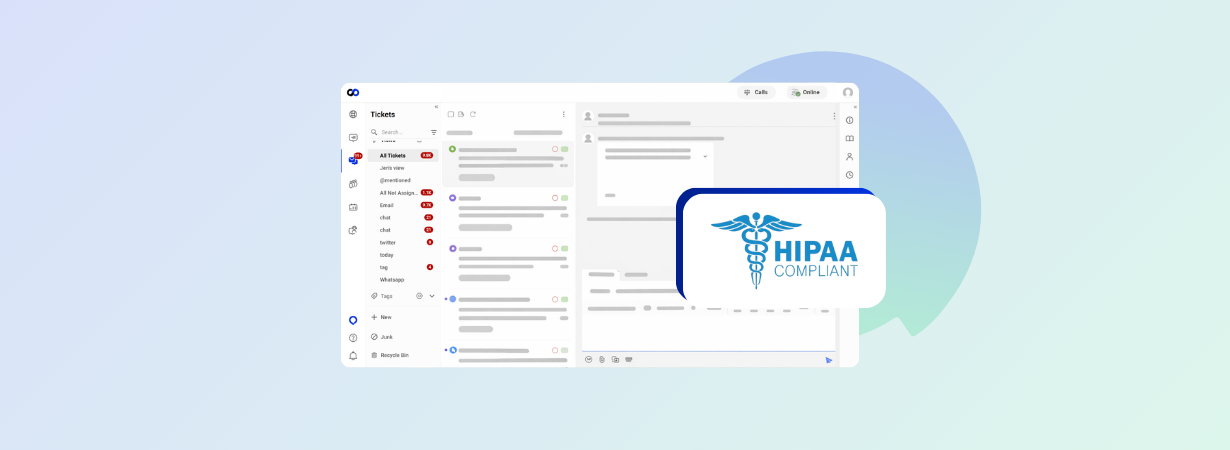
Comm100 is the best HIPAA-compliant ticketing system with a proven track record in the healthcare space. The AI-powered Ticketing & Messaging system consolidates patient inquiries from email, web forms, social channels, and SMS into a centralized workspace where agents can track every interaction from submission through resolution.
Healthcare organizations particularly value HIPAA-compliance controls that extend uniformly across all channels rather than requiring separate security configurations for each communication method.
The platform’s strength lies in how it combines multiple communication tools under a single compliance umbrella. Agents can transition seamlessly between live chat conversations and ticket-based support without switching systems or worrying about different security protocols.
This integration matters because patient conversations rarely stay in one channel. Someone who starts with a chat question about billing often needs follow-up documentation sent via email, and both interactions must maintain identical protection standards.
For organizations with strict data sovereignty requirements, Comm100 provides the option to deploy on-premises, entirely within your own infrastructure.
This on-premises deployment capability means patient data never leaves the servers you physically control. Large health systems with existing data centers, organizations bound by state privacy laws stricter than federal requirements, and healthcare entities serving government contracts often require this level of data residency control.
Comm100’s AI capabilities address one of healthcare’s persistent operational challenges: high volumes of routine inquiries that consume agent time but don’t require clinical expertise.
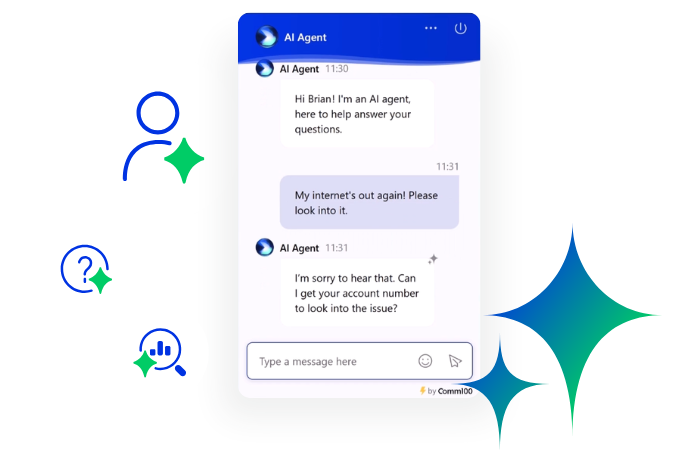
The Comm100 AI Agent handles appointment scheduling requests, facility directions, insurance verification questions, and other repetitive tasks automatically.
The critical difference from consumer-grade AI assistants is that responses come exclusively from your organization’s approved knowledge base rather than general internet training data, eliminating the risk of patients receiving inaccurate medical or administrative information.
When inquiries require human judgment, AI Copilot assists agents by suggesting responses, pulling relevant knowledge articles, summarizing lengthy tickets with AI, and flagging compliance-sensitive content.
Supervisors maintain oversight through AI Quality Assurance, which automatically reviews interactions against organizational standards without requiring manual audits of every conversation.
Monitoring and sentiment analysis tools like AI Insights then aggregate patterns across all patient interactions, revealing systemic issues, training opportunities, and workflow bottlenecks that manual reporting would miss.
Healthcare organizations including Canadian Blood Services and Toronto Public Health already rely on Comm100’s HIPAA-compliant messaging infrastructure to handle sensitive patient communications at scale.
The platform’s track record in regulated environments provides assurance that security controls have been tested under real operational conditions, not just laboratory certifications.
Key Features
- 256-bit AES encryption with TLS 1.2 and above: All patient data encrypted both at rest and during transmission across every communication channel.
- Independent, annual HIPAA assessments: Annual third-party evaluations covering technical systems, administrative policies, and physical security controls.
- SOC 2 Type II, ISO 27001, PCI DSS certifications: Independent verification of security controls extending beyond baseline HIPAA requirements.
- Intelligent ticket routing: Automatically assign incoming requests based on channel source, patient identity, subject keywords, or department rules to ensure PHI reaches only appropriate staff.
- SLA enforcement with escalation triggers: Define response and resolution timeframes by ticket priority, with automatic alerts when deadlines approach and escalation workflows when they pass.
- AI-powered ticket summarization: Generate concise resolution summaries documenting the issue, actions taken, and outcome for compliance records without manual note-taking.
Why It Is the Best Choice for Healthcare Organizations
- Unified compliance across channels: Identical encryption and access protocols protect Live Chat, ticketing, SMS, email, and social interactions without gaps between communication methods.
- On-premises deployment option: Full data residency control for organizations requiring patient information to remain within their own infrastructure boundaries.
- Healthcare-proven AI suite: AI Agent, AI Copilot, AI Insights, and AI Quality Assurance all operate under the same HIPAA-compliant framework with responses sourced exclusively from approved organizational knowledge.
- Ticket lifecycle tracking: Every patient inquiry moves through defined stages with status updates, assignee changes, and resolution timestamps recorded for regulatory documentation.
- Scalable without security fragmentation: Organizations can add channels, AI capabilities, and agent seats while maintaining consistent compliance posture across the entire platform.
Build Secure, HIPAA-Compliant Patient Support
Learn how Comm100 helps healthcare organizations manage patient tickets securely with HIPAA-compliant workflows, enterprise-grade encryption, and signed BAAs.
Request a demo today
Request Demo
2. Help Scout
Help Scout brings a conversational approach to healthcare support, presenting patient interactions as ongoing threads rather than impersonal ticket numbers. The platform routes incoming messages from email, live chat, and in-app messaging into a shared inbox where teams collaborate on responses.
Healthcare organizations appreciate that patient communications feel personal while still maintaining the tracking and accountability that regulated environments require.
HIPAA compliance on Help Scout requires the Pro plan, which unlocks the security features necessary for handling PHI. Like Comm100, the company signs Business Associate Agreements upon request and hosts infrastructure on AWS, which maintains its own HIPAA compliance certification.
Help Scout employees receive annual HIPAA training, and the company offers customers the option to prevent any employee access to their accounts. Standard security controls include 256-bit SSL encryption and two-factor authentication.
Key Features
- AWS hosting: Infrastructure runs on Amazon Web Services with HIPAA-eligible configurations.
- 256-bit SSL encryption: All data transmissions secured with industry-standard encryption.
- Two-factor authentication: Additional login security available for all accounts.
- SOC 2 Type II certified: Independent verification of security controls and procedures.
- Annual employee HIPAA training: All staff complete compliance education with option to restrict account access entirely.
3. Hiver
Hiver transforms Gmail and Outlook into collaborative help desk systems, allowing healthcare teams to manage patient inquiries without leaving their familiar email environment.
The platform adds ticketing capabilities, assignment workflows, and performance analytics directly within Google Workspace or Microsoft 365. For organizations already invested in these ecosystems, Hiver eliminates the learning curve of an entirely new support platform.
HIPAA compliance requires Hiver’s Elite plan, which adds the security controls necessary for handling protected health information. The platform’s architecture offers an interesting compliance advantage: Hiver doesn’t store email content on its own servers.
Patient messages remain within Google or Microsoft’s HIPAA-eligible infrastructure, reducing the number of third parties with access to PHI. Hiver maintains SOC 2 Type II certification, ISO 27001 compliance, and meets GDPR and CCPA requirements.
Healthcare organizations can configure permissions so billing staff only see financial inquiries while clinical support teams handle medical questions. This segregation helps satisfy the HIPAA minimum necessary standard, which requires limiting PHI access to what’s required for each job function.
Key Features
- No email storage: Patient messages remain in Google or Microsoft infrastructure rather than Hiver servers.
- Okta SSO integration: Centralized identity management with enterprise authentication.
- Role-based access controls: Granular permissions supporting HIPAA’s minimum necessary requirements.
4. HappyFox
HappyFox provides a full-featured help desk platform with multi-channel ticket management, automation workflows, and a knowledge base. Healthcare organizations can receive patient inquiries through email, web forms, phone integration, and chat, then route them to appropriate teams based on category, urgency, or department.
The platform’s automation capabilities help reduce manual ticket sorting and ensure consistent handling of common request types.
HIPAA compliance on HappyFox requires the Enterprise plan, which adds the security features and BAA availability that healthcare organizations need.
The platform implements two-factor authentication, session-based security controls, comprehensive audit logs, IP restrictions, and single sign-on integration. SOC 2 Type II certification and CCPA compliance provide additional assurance of organizational security practices.
Key Features
- SOC 2 Type II certification: Independent audit of security controls.
- Comprehensive audit logs: Detailed activity tracking for compliance reporting.
- IP restrictions and SSO: Network-level access controls and centralized authentication.
- Session security controls: Automatic timeouts and session management policies.
5. MedChat
MedChat focuses exclusively on healthcare, providing patient messaging and engagement tools designed specifically for medical environments. Unlike general-purpose help desk platforms adapted for healthcare use, MedChat’s entire product development centers on clinical workflows, patient access requirements, and healthcare compliance.
The platform handles appointment scheduling, prescription refill requests, billing inquiries, and patient intake through conversational interfaces.
The platform’s compliance posture reflects its healthcare-only focus. MedChat maintains HIPAA, SOC, ISO, and HITECH certifications, with SOC 2 Type II audits conducted regularly.
End-to-end encryption protects all patient communications, and the company undergoes third-party security testing to identify vulnerabilities before they become problems. The narrow industry focus means compliance controls are tuned specifically for healthcare scenarios rather than adapted from general business requirements.
Key Features
- HIPAA and HITECH compliance: Built specifically for healthcare regulatory requirements.
- SOC 2 Type II and ISO certifications: Independent verification of security controls.
- End-to-end encryption: Patient messages protected throughout entire transmission path.
- Third-party security testing: Regular external vulnerability assessments.
6. Giva
Giva provides cloud-based IT ticketing and customer service software designed for organizations in highly regulated industries. The platform includes ticketing, knowledge base, reporting dashboards, self-service portals, and satisfaction surveys.
Healthcare organizations appreciate that Giva built compliance into its standard offering rather than reserving security features for premium tiers.
HIPAA-level security applies to all Giva editions, and Business Associate Agreements come standard rather than requiring negotiation.
Implementation speed sets Giva apart from enterprise competitors. Where platforms like ServiceNow can require months of configuration and extensive training, Giva typically deploys in days with agents reaching proficiency within an hour.
Key Features
- HIPAA compliance on all editions: Security features included standard, not limited to premium tiers.
- 256-bit encryption: All data protected with strong encryption standards.
- Azure-based AI Copilot: Agent assistance running on HIPAA-eligible Microsoft infrastructure.
7. Freshdesk
Freshdesk offers a widely adopted help desk platform with omnichannel support capabilities spanning email, phone, chat, and social media. The platform’s automation features help route tickets, assign priorities, and trigger workflows based on ticket content or customer attributes.
Healthcare organizations considering Freshdesk should understand that HIPAA compliance requires careful configuration and specific plan selection rather than coming enabled by default.
Freshworks limits HIPAA coverage to specific products: Freshdesk, Freshchat, Freshcaller, and Freshdesk Omnichannel. Other products in the Freshworks ecosystem are not eligible for BAAs.
Comm100 vs. Freshworks: See what sets Comm100 apart →
Within these covered products, organizations must configure settings precisely to maintain compliance. The Freshconnect feature used for internal discussions must be disabled because it cannot protect PHI adequately.
Protected health information can only be stored in encrypted custom fields, not in standard ticket fields, which requires training and oversight to ensure agents use the system correctly.
Healthcare teams using email-based support must configure a custom mail server to ensure message handling remains HIPAA-compliant. SAML single sign-on and role-based access controls help manage who can view patient information, but the configuration-dependent nature of Freshdesk’s compliance means ongoing vigilance is required.
Key Features
- SAML single sign-on: Centralized authentication for access management.
- Role-based access controls: Permission settings to limit PHI visibility by role.
- Encrypted custom fields: PHI storage in protected fields (standard fields not encrypted).
- Audit logging: Activity tracking for compliance documentation.
Build Secure, HIPAA-Compliant Patient Support
Learn how Comm100 helps healthcare organizations manage patient tickets securely with HIPAA-compliant workflows, enterprise-grade encryption, and signed BAAs.
Request a demo today
Request Demo
What Is HIPAA?
The Health Insurance Portability and Accountability Act establishes federal standards for protecting sensitive patient health information. Enacted in 1996 and expanded through subsequent rules, HIPAA governs how covered entities and their business associates handle protected health information (PHI). Understanding HIPAA’s structure helps organizations evaluate whether a ticketing system meets their compliance obligations.
The Privacy Rule defines what constitutes PHI and establishes patient rights over their health information. PHI includes any individually identifiable health information transmitted or maintained in any form, including electronic records, paper documents, and verbal communications.
This encompasses obvious data like diagnoses and treatment plans, but also extends to billing records, appointment histories, insurance information, and any communication that could identify a patient and relates to their health status.
The Security Rule specifies technical, physical, and administrative safeguards required to protect electronic PHI (ePHI). Technical safeguards include encryption, access controls, audit logging, and transmission security.
Physical safeguards cover facility access, workstation security, and device controls. Administrative safeguards address workforce training, risk assessments, security policies, and incident response procedures. A HIPAA-compliant ticketing system must implement controls across all three categories.
Covered entities under HIPAA include healthcare providers, health plans, and healthcare clearinghouses. When these organizations engage vendors to handle PHI on their behalf, those vendors become business associates subject to HIPAA requirements through Business Associate Agreements.
Ticketing system vendors handling patient communications fall into this category, which is why BAAs are fundamental to healthcare support software selection.
How Does a Ticketing System Ensure HIPAA Compliance?
A HIPAA-compliant ticketing system implements specific technical and administrative controls that satisfy federal requirements for protecting patient information. Understanding these controls helps healthcare organizations evaluate vendor claims and verify that platforms actually deliver the security they advertise.
Business Associate Agreements establish the legal foundation for compliance. When a healthcare organization uses a ticketing vendor to handle patient communications, that vendor becomes a business associate with direct HIPAA obligations.
The BAA specifies how the vendor will protect PHI, what happens in case of a breach, and how the relationship can be terminated. Without a signed BAA, using any ticketing system with patient data violates HIPAA regardless of the platform’s technical security.
Encryption protects patient data both at rest and in transit. Data at rest includes stored tickets, chat transcripts, and attachments sitting on servers. Data in transit includes messages traveling between patients, agents, and systems.
HIPAA does not mandate specific encryption standards, but 256-bit AES encryption and TLS 1.2 or higher for transmission represent current industry expectations. Platforms should encrypt all PHI by default rather than requiring administrators to enable protection for specific fields.
Access controls ensure only authorized individuals can view patient information. Role-based permissions should limit staff access to PHI necessary for their job functions, satisfying HIPAA’s minimum necessary standard.
Multi-factor authentication prevents unauthorized access even when credentials are compromised. Automatic session timeouts reduce exposure from unattended workstations. SSO integration allows centralized identity management and rapid deprovisioning when employees leave.
Why Is HIPAA Compliance Necessary for Patient Support Software?
Healthcare organizations cannot legally handle patient communications through non-compliant software, but the reasons for HIPAA compliance extend beyond regulatory obligation. Understanding why these requirements exist helps organizations approach compliance as patient protection rather than bureaucratic burden.
Financial penalties for HIPAA violations escalate based on the level of negligence involved. The lowest tier, where organizations were unaware of violations despite reasonable diligence, carries penalties of $100 to $50,000 per incident.
Reasonable cause violations without willful neglect range from $1,000 to $50,000 per incident. Willful neglect that gets corrected within 30 days carries $10,000 to $50,000 per incident.
Willful neglect without timely correction brings mandatory minimum penalties of $50,000 per incident up to $1.5 million per violation category per year. These amounts represent per-incident calculations, and a single breach can involve thousands of patient records.
Beyond direct penalties, HIPAA violations trigger mandatory breach notification requirements that damage organizational reputation:
- HIPAA violations require organizations to notify affected individuals within 60 days of discovery.
- Breaches affecting more than 500 people trigger media notification requirements and public posting on the HHS breach portal.
- Public breach disclosure often causes more lasting harm than direct financial penalties, especially in healthcare where patient trust underpins the care relationship.
Consumer AI tools and general-purpose software present particular risks that healthcare organizations sometimes underestimate. When support staff use ChatGPT, personal email accounts, or non-compliant messaging apps to handle patient inquiries, they create HIPAA violations regardless of their intentions.
These tools lack the access controls, audit logging, and data protection that regulations require. Patient data entered into consumer AI systems may be retained for training purposes, creating ongoing exposure even after the conversation ends.
HIPAA-compliant ticketing systems exist specifically to prevent well-meaning staff from inadvertently creating compliance violations.
Choosing the Right HIPAA-Compliant Ticketing System
Selecting a ticketing system for healthcare support requires balancing compliance requirements against operational needs. Every platform reviewed here offers some path to HIPAA compliance, but they differ significantly in how that compliance is achieved, what limitations apply, and how much configuration burden falls on the customer organization.
Comm100 provides the most comprehensive solution for healthcare organizations that need omnichannel patient communication with consistent security across all channels.
The platform’s integrated AI suite operates under the same HIPAA framework as its core messaging tools, eliminating the compliance fragmentation that occurs when organizations cobble together separate solutions.
The on-premises deployment option addresses data residency requirements that cloud-only competitors cannot satisfy. For organizations seeking a single platform that scales from basic ticketing through advanced AI automation while maintaining verified compliance, Comm100 represents the strongest available choice.
Whatever platform you select, verify compliance claims before deployment. Request current certification documentation, review BAA terms carefully, and confirm that the specific features you need are covered under the vendor’s HIPAA compliance.