Healthcare institutions face a difficult balancing act: patients expect instant, 24/7 digital support, but federal regulations demand airtight protection of their most sensitive information. The consequences of getting this balance wrong are severe. In 2024 alone, healthcare data breaches exposed over 275 million patient records across 725 reported incidents, according to the HIPAA Journal.
AI chatbots offer a compelling solution to the operational pressures facing healthcare support teams. They can handle appointment scheduling, insurance verification, medication reminders, and routine patient inquiries around the clock without adding headcount.
But deploying a standard chatbot in a healthcare environment can be risky, or worse, illegal. Any AI system that touches protected health information (PHI) must meet the stringent requirements of the Health Insurance Portability and Accountability Act (HIPAA).
Whether you are a compliance officer evaluating vendors, an IT leader planning implementation, or a VP of Patient Experience seeking to modernize support operations, here’s our list of the best HIPAA compliant AI chatbots for healthcare in 2026.
Best HIPAA-Compliant AI Chatbots for Healthcare in 2026
1. Comm100
Comm100 was built from the ground up to serve regulated industries, making HIPAA compliance a core architectural feature. The platform’s highly modular, making it easy for healthcare institutions to just choose the Comm100 AI Agent, or combine it with other tools like live chat, ticketing, knowledge base, and a dedicated AI suite.
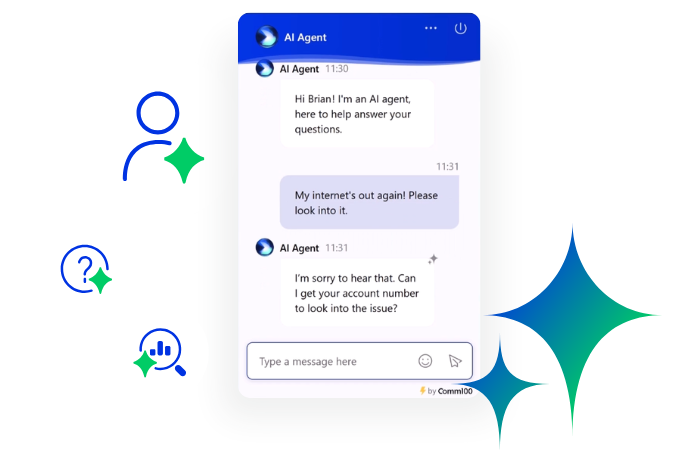
The Comm100 AI Agent uses generative AI to handle patient inquiries across multiple channels while maintaining strict data protection protocols.
Agents can securely access ePHI during conversations while the system maintains strict access controls and end-to-end encryption throughout.
Comm100 also offers flexible deployment options that many competitors lack. Organizations requiring maximum control over data residency can deploy the platform on-premises, keeping all patient data within their own infrastructure boundaries.
This option is particularly valuable for large health systems with strict data governance policies or organizations operating under state-level privacy requirements that exceed federal HIPAA standards.
Comm100’s AI Agent also enables organizations to manage volume spikes without having to scale up support operations, automating up to 80% of all incoming chats.
For instance, Open Enrollment periods, Medicare Annual Enrollment Period (AEP), and the January onboarding surge can overwhelm traditional support teams, leading to long wait times, frustrated members, and missed enrollment deadlines.
With the AI Agent, organizations no longer experience a decline in customer service, and patients still feel heard.
The platform’s AI strictly follows organizational knowledge and policies rather than generating responses from general training data, reducing the risk of inaccurate information reaching patients.
Support teams can review past interactions and provide feedback, adjusting tone, adding context, or correcting responses. These improvements are automatically incorporated into future conversations, creating a continuous improvement loop.
Key Compliance Features
- AES 256-bit encryption protects all data at rest, while TLS 1.2 secures data during transmission.
- Annual third-party HIPAA assessments by SecurityMetrics include on-site evaluations of systems, policies, and physical security.
- SOC 2 Type II, ISO 27001, and PCI DSS certifications provide independently verified compliance assurance.
- Business Associate Agreements are signed with customers and maintained with AWS infrastructure providers, subject to terms and conditions.
- Least-access principle ensures staff only access information required for their specific job functions.
- Multi-factor authentication protects every login to reduce unauthorized access risk.
- Every employee and contractor completes HIPAA training at hire and annually thereafter.
- Detailed access logs and system activity records are always maintained and audit-ready.
Why It Is the Best Choice for Healthcare Organizations
- Omnichannel HIPAA Coverage: The same encryption and access controls apply across Live Chat, AI Agent, Ticketing, SMS, and social channels, eliminating compliance gaps between communication methods.
- Audit-Ready Documentation: Comprehensive logs are maintained from day one, so OCR investigators or internal auditors have immediate access to required evidence.
- On-Premises Deployment: Organizations requiring maximum data control can deploy within their own infrastructure, satisfying strict governance policies and state-level requirements.
- Proven Healthcare Track Record: Comm100 is already used by healthcare organizations like Canadian Blood Services and Toronto Public Health.
- Integrated AI Suite: AI Agent, AI Copilot, AI Insights, and other AI tools like AI Knowledge, AI Quality Assurance, and AI Training all work within the same compliant framework, enabling AI expansion without new compliance risks.
- Healthcare System Integrations: Pre-built integrations for EHR, CRM, and scheduling systems give agents complete patient context without compromising privacy.
Build Secure, HIPAA-Compliant Patient Conversations
Learn how Comm100’s HIPAA-compliant AI chatbots help healthcare organizations automate patient conversations securely while meeting strict regulatory requirements.
Request a demo today
Request Demo
2. Ada
Ada positions itself as an AI-first customer service platform, with particular strength in health insurance and healthcare payer applications.
The platform uses generative AI to power automated resolution of customer inquiries across chat, voice, email, and SMS channels. Ada has built a substantial presence in the insurance sector, where complex benefits questions and high inquiry volumes create significant operational challenges that traditional support models struggle to address cost-effectively.
Ada’s AI Agent is also HIPAA compliant, even though healthcare isn’t their primary market. And, just like Comm100, the platform provides complete control over when and how conversations transfer to human agents, ensuring that clinical questions or emotionally sensitive situations receive appropriate human attention.
Ada also provides complete visibility into AI performance through detailed analytics showing resolution rates, deflection rates, escalation patterns, and conversation outcomes.
Key Compliance Features
- HIPAA, SOC 2, GDPR, and AIUC-1 certifications provide comprehensive regulatory coverage for healthcare deployments.
- Zero data retention policies with LLM providers ensure patient information is never stored or used for model training.
- Built-in safeguards minimize AI hallucinations through continuous monitoring for accuracy and response safety.
- Annual penetration testing specifically targets LLM components to identify AI-specific vulnerabilities.
3. Fini
Fini differentiates itself from traditional chatbots by focusing on action-taking automation rather than simple question-and-answer interactions.
Just like creating flows for tasks in Comm100, you can also train Fini to execute step-wise workflows: updating patient records, processing refunds, verifying identity across multiple databases, and completing account changes without human intervention.
The platform integrates bidirectionally with major helpdesk and CRM platforms including Salesforce, Zendesk, and Intercom.
When Fini resolves a ticket, it automatically updates records in all connected systems while maintaining complete audit trails. This bidirectional capability eliminates the data synchronization issues that plague organizations using chatbots with read-only integrations.
Key Compliance Features
- Business Associate Agreements are provided as standard with enterprise healthcare deployments.
- SOC 2 certification validates security controls for handling sensitive healthcare data.
- Audit-ready logging captures every AI decision with full traceability for compliance reviews.
- Reasoning-first architecture ensures all actions are verifiable with explainable decision logs.
4. Kore.ai
Kore.ai is an enterprise-focused conversational AI platform with deep healthcare industry expertise developed over years of serving major health systems. The company’s HealthAssist solution is specifically designed for patient access, revenue cycle management, and clinical workflow automation.
The platform powers voice, SMS, and chat interactions across the healthcare continuum, from initial patient contact through billing and follow-up care coordination.
The platform’s healthcare integration capabilities set it apart from general-purpose chatbot solutions. Kore.ai offers pre-built connectors for over 80 EHR and practice management systems, including Epic (through App Orchard), Oracle Cerner, and athenahealth.
FHIR API support enables standardized data exchange with modern health information systems, while HL7 compatibility addresses legacy system requirements. Additional integrations cover Cisco and Genesys contact center platforms, enabling healthcare organizations to modernize their IVR systems with conversational AI while maintaining existing telephony infrastructure.
Key Compliance Features
- HIPAA-compliant infrastructure with enterprise BAA support is standard for healthcare deployments.
- SOC 2 Type II attestation provides independent verification of security controls over time.
- Configurable PHI retention windows and automatic redaction capabilities meet specific requirements.
- Pre-built connectors for 80+ EHR/PM systems maintain compliance across integrated workflows.
5. Fin by Intercom
Intercom is a widely-adopted customer service platform that has expanded its compliance capabilities to serve healthcare organizations requiring HIPAA-compliant patient communications. The Fin AI Agent from Intercom can combine with live chat, email management, ticketing, and help center functionality within a unified workspace.
Intercom has invested significantly in AI data privacy infrastructure to meet healthcare requirements. The platform maintains Business Associate Agreements with all third-party LLM providers used for HIPAA-compliant customers, requiring these providers to implement technical and organizational measures meeting applicable data protection standards.
Comprehensive logging captures all AI interactions, with prompts stored in access-controlled repositories and subject to the same security controls as other customer data. For European healthcare customers or organizations with EU patient populations, Intercom now processes AI interactions within Europe through regional hosting infrastructure.
One important limitation healthcare organizations must consider: HIPAA compliance features are only available on Intercom’s “Expert” plan, the highest pricing tier in their product lineup.
Organizations on Essential or Advanced plans cannot access the security controls, audit logging, and administrative features required for HIPAA-compliant operation. The Expert plan includes customizable user roles, SSO authentication with major identity providers, advanced collaboration tools for support teams, and the granular access management features required for healthcare deployments.
Organizations must also ensure that any third-party integrations receiving ePHI (such as CRM connections to Salesforce or marketing platforms) have their own BAAs in place.
Key Compliance Features
- Annual HIPAA attestation examination validates data storage and processing against HIPAA standards.
- Comprehensive logging tracks all data access and AI interactions in access-controlled repositories.
- Regional data processing infrastructure supports European data residency requirements.
- LLM providers undergo periodic access reviews and annual security audits as key sub-processors.
How to Choose the Right Healthcare AI Chatbot
Selecting a HIPAA-compliant chatbot requires evaluation across multiple dimensions. Compliance certification is necessary but not sufficient; the platform must also fit your operational requirements, integrate with existing systems, and deliver the patient experience your organization needs.
What compliance documentation should you request?
Start by requesting the vendor’s SOC 2 Type II report, which provides independent verification of security controls over time rather than a point-in-time snapshot. Ask for their most recent HIPAA risk assessment or attestation report.
Request a copy of their standard Business Associate Agreement and review it with your legal team before signing. Verify that the BAA explicitly covers all products and features you plan to use, as some platforms limit HIPAA coverage to specific components or pricing tiers.
Confirm whether the vendor maintains BAAs with their subprocessors, particularly cloud hosting providers and any LLM providers used for AI functionality.
How should you evaluate integration requirements?
Map your existing systems and identify which integrations are essential for your workflows. If you use Epic, Cerner, or another major EHR, verify that the chatbot platform has tested, production-ready connectors rather than generic API capabilities.
Check whether integrations support bidirectional data flow or only read access, as this affects what workflows the chatbot can automate.
For organizations with complex workflows spanning multiple systems, evaluate the platform’s ability to orchestrate multi-step processes while maintaining HIPAA compliance at each handoff point.
What questions should you ask about AI safety?
Generative AI introduces unique risks in healthcare contexts that traditional software evaluation frameworks do not address.
- Ask vendors specifically how they prevent hallucination, where the AI generates plausible but incorrect information.
- Understand whether patient data is used to train underlying AI models, either by the vendor or by third-party LLM providers.
- Confirm that the platform provides audit trails showing exactly what knowledge sources the AI used to generate each response.
- For platforms using third-party LLMs, verify that zero-retention agreements prevent patient data from being stored or used beyond the immediate interaction.
Why Is HIPAA Compliance Necessary When Using AI Chatbots?
HIPAA compliance is not optional for any technology that handles protected health information on behalf of a covered entity. When a healthcare organization deploys a chatbot that collects, stores, transmits, or processes PHI, the AI chatbot vendor becomes a business associate under HIPAA regulations. This legal relationship carries specific obligations that both parties must fulfill to avoid penalties.
The HIPAA Security Rule mandates specific administrative, physical, and technical safeguards to protect electronic PHI. For chatbot platforms, this translates to requirements including:
- Access controls
- Encryption
- Audit logging
- Incident response procedures
Why Can’t You Use a Standard AI Chatbot in Healthcare?
Consumer AI chatbots like the free versions of ChatGPT, Claude, or Gemini are explicitly unsuitable for healthcare use involving PHI. OpenAI does not sign Business Associate Agreements for ChatGPT Free or Plus plans (They’ve launched ChatGPT for Health, which is a separate product). More importantly, these are not designed primarily for customer service, and may hallucinate.
Anthropic’s free Claude web interface is not HIPAA compliant. Google’s consumer Gemini products fall outside their HIPAA coverage. These platforms store conversation history, may use interactions to improve their models, and lack the security infrastructure required for healthcare data protection.
The distinction between consumer and enterprise AI products is critical and frequently misunderstood. While ChatGPT Enterprise and the OpenAI API can support HIPAA compliance with proper configuration and a signed BAA, the consumer products that most people encounter cannot.
Similarly, Anthropic’s enterprise API offerings can meet HIPAA requirements under appropriate agreements, but the free web interface cannot. Healthcare organizations must carefully verify that any AI platform they deploy is the specific version that supports HIPAA compliance, not a consumer variant with a similar name.
Even platforms marketed to healthcare may not be fully compliant upon closer examination. Marketing claims of “HIPAA-ready” or “healthcare-friendly” do not equal compliance and should not be accepted without verification.
Conclusion
Healthcare AI chatbots offer substantial benefits: 24/7 patient support, reduced administrative burden on clinical staff, consistent information delivery, and improved access to care for patients who prefer digital communication channels. But these benefits are only accessible to organizations that implement AI within a rigorous compliance framework that protects patient privacy and organizational reputation.
Among the platforms evaluated, Comm100 stands out for its comprehensive approach to healthcare compliance. The combination of end-to-end encryption, omnichannel HIPAA coverage, annual third-party assessments, on-premises deployment options, and proven healthcare deployments provides the confidence that compliance officers and IT leaders require.
If you’re looking for a viable solution for your healthcare customer support needs, Comm100 is the best choice.
Build Secure, HIPAA-Compliant Patient Conversations
Learn how Comm100’s HIPAA-compliant AI chatbots help healthcare organizations automate patient conversations securely while meeting strict regulatory requirements.
Request a demo today
Request Demo
Frequently Asked Questions
What makes a chatbot HIPAA compliant?
A HIPAA-compliant chatbot must meet three categories of requirements. First, the vendor must sign a Business Associate Agreement with your organization, legally obligating them to protect PHI according to HIPAA standards.
Second, the platform must implement technical safeguards including encryption (both in transit and at rest), access controls, audit logging, and automatic session timeouts.
Third, the vendor must maintain administrative safeguards including workforce training, security policies, incident response procedures, and regular risk assessments. All three categories are mandatory; meeting two out of three does not constitute compliance.
Can I use ChatGPT or similar AI tools with patient information?
Consumer versions of ChatGPT, Claude, Gemini, and similar AI tools cannot be used with PHI. These platforms do not sign BAAs, may use your data for model training, and lack required security controls.
What happens if our chatbot experiences a data breach?
Under the HIPAA Breach Notification Rule, your organization must notify affected individuals within 60 days of discovering a breach involving unsecured PHI. If the breach affects more than 500 individuals, you must also notify HHS and prominent media outlets serving the affected area.
Your Business Associate Agreement should specify the chatbot vendor’s obligations to detect breaches, notify you promptly (typically within 24-48 hours of discovery), and cooperate with your incident response.
Review breach notification clauses carefully during vendor evaluation, as vague language like “prompt notification” provides less protection than specific timelines.
How do I evaluate whether a chatbot vendor is truly HIPAA compliant?
Start with documentation requests: SOC 2 Type II report, HIPAA risk assessment or attestation report, sample Business Associate Agreement, and security policies. Verify that the BAA covers all products you plan to use, as some vendors limit HIPAA coverage to specific tiers or features.
Ask about third-party audits and assessment frequency. Request references from current healthcare customers. Test the platform in a sandbox environment before introducing any PHI. Involve your compliance officer and legal counsel in the evaluation process.
Be wary of vendors who cannot readily produce documentation or who deflect questions about specific security controls.
What is the difference between HIPAA eligible and HIPAA compliant?
“HIPAA eligible” means a platform has the capability to support HIPAA compliance when properly configured. “HIPAA compliant” means the platform has been configured to meet HIPAA requirements for a specific deployment.
Major cloud providers like AWS, Azure, and Google Cloud describe their services as HIPAA eligible because compliance ultimately depends on how you configure and use those services.
A platform can be HIPAA eligible but deployed in a non-compliant configuration. Your organization bears responsibility for configuring any HIPAA-eligible platform to achieve actual compliance, documenting that configuration, and maintaining compliance over time through ongoing monitoring and periodic assessments.