The market for AI customer engagement software has matured considerably since the early chatbot experiments of the 2010s. Today’s platforms combine natural language understanding, generative AI, omnichannel orchestration, and sophisticated analytics into unified solutions.
Yet with maturity comes complexity. Pricing models vary wildly, from per-seat subscriptions to conversation-based fees to opaque enterprise quotes. Feature sets overlap in confusing ways. And vendor claims often outpace actual capabilities.
The days of siloed communication channels and reactive support are fading fast, replaced by AI-powered platforms that anticipate needs, unify conversations, and deliver personalized experiences at scale. Organizations that master this transition aren’t just improving satisfaction scores; they’re building competitive moats that rivals struggle to cross.
This guide cuts through the noise. We’ve analyzed ten leading platforms across verified user reviews, published pricing data, and documented capabilities. Each entry includes what real users appreciate, where they’ve encountered friction, and how much you can expect to pay.
Whether you’re a credit union evaluating secure messaging options, a university modernizing student support, or an enterprise seeking to consolidate fragmented tools, this comparison provides the foundation for an informed decision.
What is Customer Engagement Software and Why Is It Important?
Customer engagement software refers to platforms that help organizations manage, automate, and analyze interactions with customers across multiple communication channels. These systems consolidate conversations from email, live chat, social media, messaging apps, SMS, and voice into unified workspaces where agents can respond efficiently and AI can assist with routine inquiries.
The importance of these platforms stems from three converging pressures. First, customer expectations have risen dramatically. People now expect instant responses, personalized service, and seamless transitions between channels. A customer who starts a conversation on WhatsApp expects to continue it via email without repeating their issue.
Second, organizations face intense pressure to reduce operational costs while maintaining service quality. AI automation offers a path to handle higher volumes without proportionally increasing headcount.
Third, the data generated by customer interactions has become a strategic asset. Platforms that can surface insights from millions of conversations help organizations identify product issues, spot emerging trends, and understand customer sentiment at scale.
Modern AI customer engagement platforms typically include several core capabilities:
- Omnichannel inbox management
- AI agents and chatbots
- Knowledge base integration
- Workflow automation
- Analytics and reporting
- Integrations with CRM and business systems.
The most advanced platforms also add generative AI features like response suggestions, conversation summaries, and automated quality assurance.
For regulated industries like financial services, healthcare, and government, security and compliance features become equally critical. Organizations in these sectors require platforms that offer data encryption, access controls, audit trails, and certifications like SOC 2, HIPAA, PCI DSS, or FedRAMP authorization.
Now, let’s talk about our list.
1. Comm100
Comm100 is an AI-first, omnichannel customer engagement platform designed for organizations that need to balance automation with human connection. It works across 12+ support channels, including SMS, email, WhatsApp, LINE, Telegram, and more.
The platform serves all industries but dominates where there are elevated compliance requirements, including higher education, credit unions, government agencies, and gaming operators.
Comm100’s core products include AI agents, live chat, ticketing & messaging, AI Copilot, AI Insights, and an extensive suite of supporting AI products.
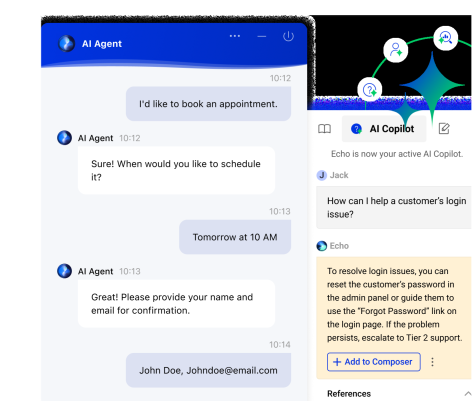
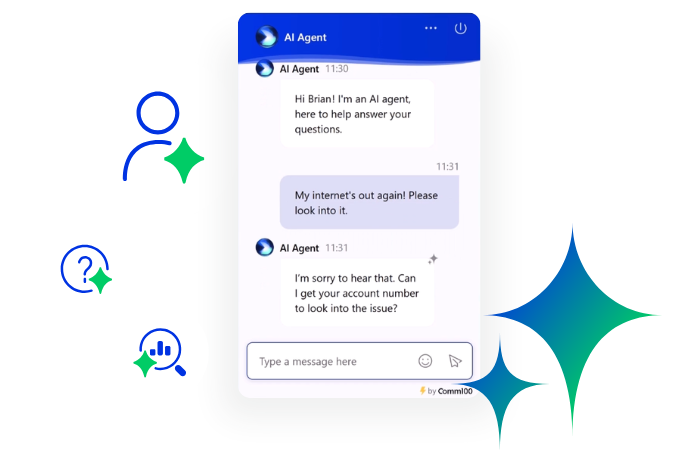
Comm100’s AI Agent handles routine inquiries autonomously while AI Copilot assists human agents with response suggestions, knowledge retrieval, and real-time guidance. AI Insights surfaces patterns across conversations to inform operational decisions, while other tools like AI Quality Assurance automates the review process that traditionally consumed supervisor time.
What distinguishes Comm100 from larger competitors is its focus on personalized implementation support, a range of innovative AI products, and more competitive pricing than you’ll see with other providers. Organizations evaluating enterprise platforms like Zendesk or Salesforce often find Comm100 delivers comparable functionality at significantly lower total cost of ownership.
The platform also offers on-premises deployment options for organizations with strict data residency requirements, a capability that cloud-only competitors cannot match.
What Users Say About Comm100
- Smart routing: “We were able to use Comm100 to flip the students via the chat to the appropriate area that they need to speak to,” said George Bijelic of McMaster University.
- Complex integration requirements: “We have a highly customized chat implementation for our websites and products with specific security requirements. The system screens customer information and passes it through query strings to an intermediate website that handles the redirect process.” – Tom Seelbach of ITSM.
- On-premises deployment: “Comm100 was the one that came out with the best score, including, of course, the fact that they were providing us with an option of having our system on-premises.” – said a product manager on moving to Comm100.
- Intelligent AI agent: “With the bot, we were able to offer instantaneous answers to people, regardless of the day or time.” – Travis Sweet, AACSB.
- Reliable support, long-lasting relationships: “The team is extremely professional, helpful, and effective. Throughout our 6 years together, they have always been supportive and gone the extra mile to understand our needs.” – Burak Dogu, Ultrabet.
- Omnichannel support: “Comm100 does exactly what we needed it to do – integrate multiple channels of communication into a single platform so we don’t have to monitor multiple devices and accounts.” – Global Affairs Canada.
Best For
Comm100 is great for organizations in regulated industries like higher education, iGaming, credit unions, government, and financial institutions that need enterprise-grade AI capabilities without enterprise-level complexity or cost. Ideal for teams seeking on-premises deployment options, personalized implementation support, and a vendor that treats mid-market customers like priority accounts.
Watch Comm100’s AI Customer Engagement Platform in Action
Watch a quick demo to see how Comm100 uses AI agents, omnichannel messaging, and built-in compliance to deliver smarter customer engagement across channels.
View demo
View Demo
2. Salesforce Service Cloud
Salesforce Service Cloud is a cloud-based customer service platform that operates within the broader Salesforce ecosystem. The platform combines case management, omnichannel routing, knowledge management, and AI capabilities through its Einstein and Agentforce technologies.
Organizations using Salesforce for sales or marketing benefit from native integration, as customer data flows seamlessly across the platform without requiring complex integrations.
The AI features include Einstein Bots for automated conversations, Einstein Case Classification for intelligent routing, Einstein Article Recommendations for surfacing relevant knowledge base content, and the newer Agentforce capabilities for autonomous AI agents.
The platform supports engagement across voice, email, chat, social media, and messaging applications, with a unified agent workspace that provides complete customer context.
Why Users Like It
- Comprehensive automation capabilities powered by Einstein AI reduce manual workload
- Over 1,500 applications available through AppExchange for extending functionality
- Unified customer view from Salesforce CRM foundation provides complete relationship history
What Users Dislike
- High total cost when factoring in add-ons for advanced AI, analytics, and expanded functionality
- Customer support response times from Salesforce can be slow
- Implementation complexity requires significant IT resources or consulting assistance
- Steep learning curve for administrators configuring complex workflows
Best For
Salesforce Service Cloud is suitable for organizations already invested in the Salesforce ecosystem who want native CRM integration without third-party connectors. Less suitable for teams without dedicated Salesforce administrators or those seeking quick, low-cost deployment.
3. Genesys Cloud CX
Description and Main Products
Genesys Cloud CX is an all-in-one cloud contact center solution built for organizations that need sophisticated voice capabilities alongside digital channels. The platform excels in workforce engagement management, predictive routing, and real-time analytics.
Unlike competitors that bolted voice onto chat-first platforms, Genesys developed Cloud CX with native telephony integration from the ground up.
The platform includes omnichannel routing across voice, email, chat, SMS, and social media, with AI-powered bots for customer self-service. Workforce management tools help supervisors optimize scheduling and monitor performance.
The predictive engagement feature uses AI to identify website visitors most likely to need assistance and proactively offer help at optimal moments.
Why Users Like It
- Reliability receives frequent praise, critical for contact centers where downtime impacts revenue
- Responsive community forums and extensive training materials
What Users Dislike
- Some legacy features from older systems haven’t fully carried over to Cloud CX
- Reporting capabilities can be complex with occasional gaps compared to specialized analytics tools
- Pricing places Genesys at the higher end of the market
Best For
Viable for large contact centers where voice remains the primary channel and workforce management is a core operational need. Less suited for digital-first teams or organizations without dedicated IT resources for configuration.
4. Zendesk
Zendesk provides customer service software built around a ticketing system that has evolved into a comprehensive omnichannel platform.
The company positions its AI capabilities as trained on billions of customer service interactions, providing a foundation of intent understanding that newer competitors lack. Core products include Support for ticketing, Chat for live conversations, Guide for knowledge management, and Talk for voice.
The platform’s AI agents can resolve customer inquiries autonomously, with Zendesk claiming resolution rates exceeding 80% for certain use cases. Zendesk charges $0.99 per successful resolution rather than per conversation, aligning vendor incentives with customer outcomes. However, this could cause prices to rise sharply too.
Why Users Like It
- Integrated feature set eliminates need to stitch together multiple point solutions
- Quick response times when automation works as intended
- Extensive marketplace of integrations for hundreds of use cases
- Platform maturity means extensive documentation, community resources, and third-party expertise available
What Users Dislike
- Pricing complexity with add-ons for advanced AI, QA, and workforce management substantially increasing costs
- Customer support from Zendesk sometimes falls short of expectations
- Feature gaps compared to specialized competitors for complex workflow requirements
Best For
Mid-market organizations seeking a mature, well-documented platform with extensive third-party integrations. Less ideal for budget-conscious teams, as advanced AI, QA, and workforce management features require costly add-ons.
5. Intercom
Intercom positions itself as an AI-first customer service platform, with its Fin AI Agent serving as the centerpiece of automation capabilities. The platform combines live chat, a shared team inbox, proactive messaging, and product tours into an integrated experience. Intercom’s visual workflow builder enables non-technical teams to create sophisticated automation without coding.
The platform supports messaging across website chat, email, WhatsApp, SMS, and social channels. Fin AI Agent handles front-line inquiries and claims an average resolution rate of 67% across customer deployments. For conversations requiring human attention, AI Copilot assists agents with suggested responses and relevant information retrieval.
Why Users Like It
- Real-time chat capabilities and powerful automation receive consistent praise
- Strong integrations with e-commerce platforms like Shopify
- Multichannel support maintains conversation context across channels
- Visual workflow builder enables marketing and support teams to create sequences without engineering
What Users Dislike
- Pricing escalation as conversation volumes grow and organizations add seats
- Complex pricing structure with separate charges for AI resolutions, proactive messaging, and advanced features
- Some reviews show that AI accuracy falls short of marketing claims with unhelpful responses requiring human intervention
Best For
Product-led SaaS companies and e-commerce brands that prioritize proactive messaging and in-app engagement. Less suited for organizations with complex compliance requirements or those sensitive to usage-based pricing escalation.
6. Tidio
Tidio offers live chat and AI chatbot software designed primarily for small to medium-sized businesses, with particular strength in e-commerce. The platform’s Lyro AI chatbot handles routine customer inquiries, powered by Claude AI technology, enabling sophisticated natural language understanding at accessible price points.
The multichannel inbox consolidates conversations from email, Instagram, Facebook Messenger, and WhatsApp alongside website chat. A visual flow builder enables teams to create automated sequences without coding. The FAQ Wizard helps organizations quickly populate chatbot knowledge from existing support documentation.
Why Users Like It
- Affordable pricing and quick setup with many organizations deploying chatbots within hours
- Conversation-based pricing model rather than per-seat charges makes costs more predictable
- Strong integrations with Shopify and WooCommerce for e-commerce businesses
- Multilingual support enables serving diverse customer bases
What Users Dislike
- Advanced features require higher-tier plans that increase costs beyond entry pricing
- Mobile app performance issues compared to desktop experience
- Customization options more limited than enterprise platforms
- AI capabilities optimized primarily for e-commerce, less effective for complex B2B scenarios
Best For
Small e-commerce businesses on Shopify or WooCommerce that need affordable automation deployed quickly. Less appropriate for B2B organizations with complex support workflows or enterprise security requirements.
7. HappyFox
HappyFox provides help desk and customer support software with strength in ticketing, knowledge management, and multi-channel communication. The platform serves organizations seeking robust ticket management without the complexity of enterprise behemoths. Support for over 20 languages enables global deployment.
Core features include omnichannel ticketing across email, chat, phone, and social media, smart rules automation for routing and escalation, SLA management with automated tracking, and built-in knowledge base capabilities. The Assist AI add-on provides intelligent suggestions and automation to improve agent productivity.
Why Users Like It
- Customization flexibility and responsive support team receive particular praise
- Robust ticketing capabilities at accessible price points
- Clean interface reduces training time for new agents
- Built-in knowledge base eliminates need for separate content management
What Users Dislike
- Advanced features restricted to higher pricing tiers
- Steep learning curve for complex configurations despite clean daily interface
- Mobile application functionality trails desktop experience
- Reporting capabilities may not satisfy organizations with sophisticated analytics requirements
Best For
Mid-sized support teams seeking robust ticketing and knowledge management without the overhead of enterprise platforms. Not as ideal for organizations requiring advanced AI automation or sophisticated real-time analytics.
8. HubSpot Service Hub
HubSpot Service Hub is the customer service component of HubSpot’s integrated platform, which also includes marketing, sales, and CMS capabilities. For organizations already using HubSpot’s CRM, Service Hub provides a natural extension that maintains a unified customer record across all interactions.
The platform includes the Breeze AI customer agent for automated responses, an omnichannel help desk, conversation intelligence for quality monitoring, customer health scores for proactive outreach, and SLA tracking. Native integration with HubSpot’s marketing and sales tools enables service teams to understand the complete customer journey.
Why Users Like It
- Seamless integration with other HubSpot products eliminates data silos
- Unified customer view showing marketing, sales, and service history in single timeline
- Easy to navigate even for users without technical backgrounds
- AI-powered tools and automation help teams work efficiently
What Users Dislike
- Required onboarding fees for Professional and Enterprise tiers add significant first-year cost
- Organizations using only Service Hub without other HubSpot products may find less value
- Email automation features require purchasing Marketing Hub separately
- Channel silos in help desk interface can create friction for agents
- Bundled seat requirements at higher tiers force purchasing more licenses than needed
Best For
Organizations already using HubSpot’s CRM, marketing, or sales tools who want a unified customer timeline across departments. Less valuable as a standalone solution for teams not invested in the broader HubSpot ecosystem.
9. Kustomer
Kustomer is a customer service CRM platform that organizes support around conversations rather than tickets. The unified customer timeline provides agents with a complete view of every interaction, order, and data point associated with a customer, reducing the back-and-forth that slows resolution.
The platform is quite popular with SMBs, with automation and intelligence built into the core architecture. AI Voice provides native voice capabilities without requiring third-party telephony providers.
Omnichannel support spans social, chat, email, SMS, and voice through a single interface. Strong integrations with e-commerce platforms like Shopify and Magento make Kustomer popular among retail brands.
Why Users Like It
- Comprehensive customer view eliminates toggling between systems
- Omnichannel support maintains conversation context across channels
- Customizable workflows enable modeling specific processes without forced standardization
What Users Dislike
- Steep learning curve requiring more training investment than simpler alternatives
- Interface complexity can overwhelm new users
- AI add-on pricing is expensive at $0.60 per engaged conversation and $40 per user for agent assist
- No free trial available, requiring commitment before hands-on evaluation
- Annual contracts only with 8-seat minimums create barriers for smaller organizations
Best For
Retail and e-commerce brands that want conversation-based support rather than traditional ticketing, with strong Shopify and Magento integrations. Less accessible for smaller teams due to annual contracts, 8-seat minimums, and no free trial.
10. LivePerson
LivePerson is a conversational AI platform designed for large enterprises seeking to transform customer engagement through messaging and automation. The platform powers over a billion conversations monthly across industries including telecommunications, financial services, retail, and automotive.
The Conversational Cloud connects customers across web, mobile app, SMS, WhatsApp, Apple Messages for Business, Facebook Messenger, Instagram, and numerous other channels.
The platform includes AI-powered chatbots, intent recognition, knowledge management, proactive messaging, and analytics capabilities. LivePerson emphasizes its ability to deflect voice calls to messaging channels, reducing contact center costs while improving customer satisfaction. Advanced features include conversation simulation for training, analytics studio for insights, and bring-your-own-LLM capabilities for enterprises requiring control over AI models.
Why Users Like It
- Multi-channel integration consolidates conversations from diverse sources into unified agent workspace
- Easy to use once workflows are configured, with AI chatbots reducing response times
- CRM integration, particularly with Salesforce, keeps conversations and data synchronized
What Users Dislike
- User interface feels dated and sometimes confusing to navigate
- Steep learning curve requiring substantial training investment
- Reporting capabilities limited compared to specialized analytics tools
- Implementation takes longer than expected, especially for complex AI bot training
- No public pricing available, requiring sales conversations to understand costs
Best For
Large enterprises with high conversation volumes and large budgets seeking to shift customers from voice to messaging channels at scale. Less appropriate for mid-market organizations or those requiring transparent pricing and fast implementation timelines.
Which is the Best AI Software for Customer Engagement Across Channels?
For organizations prioritizing value and personalized support, Comm100 offers enterprise-grade capabilities at competitive price points with implementation assistance that other vendors rarely match.
Selecting AI customer engagement software requires balancing capability against complexity, features against cost, and vendor promises against verified user experiences. The ten platforms examined here represent different philosophies about how customer service should operate in an AI-augmented world.
Talk to Comm100 Sales About Your AI Customer Engagement Strategy
Speak with Comm100’s sales team to see how our AI-first, omnichannel platform supports regulated industries, complex workflows, and predictable enterprise pricing.
Contact sales
Request Demo
Frequently Asked Questions
What is the difference between AI chatbots and AI agents in customer engagement software?
AI chatbots typically follow predefined conversational flows and respond based on recognized intents or keywords. AI agents represent a more advanced capability where the AI can take autonomous actions, access multiple systems, reason through complex problems, and complete multi-step tasks without human intervention. Many platforms now offer both, with chatbots handling structured inquiries and agents managing more sophisticated interactions that previously required human agents.
How should organizations calculate the total cost of ownership for customer engagement platforms?
Total cost extends well beyond license fees. Organizations should factor in implementation costs (internal resources and external consultants), training expenses for agents and administrators, integration development with existing systems, add-on features like advanced AI or workforce management, usage-based charges for AI resolutions or conversations, and ongoing support or professional services. Request detailed pricing breakdowns for all applicable scenarios rather than relying on base tier pricing.
What security certifications matter most for customer engagement software?
Required certifications depend on industry and geography. SOC 2 Type II demonstrates ongoing security controls and applies broadly across industries. HIPAA compliance is mandatory for healthcare organizations handling protected health information. PCI DSS matters for any organization processing payment card data. FedRAMP authorization is required for federal government agencies and often preferred by state and local government. GDPR compliance is essential for organizations serving European customers. ISO 27001 provides internationally recognized information security management certification.
How long does implementation typically take for AI customer engagement platforms?
Implementation timelines vary dramatically based on complexity. Simple deployments with minimal customization may go live within weeks. Enterprise implementations with custom integrations, complex workflows, AI training, and organizational change management frequently extend to three to six months or longer. Factors affecting timeline include number of channels, integration requirements, data migration needs, customization scope, and internal resource availability. Request realistic timelines from vendors based on comparable deployments.
What questions should organizations ask during vendor demonstrations?
Move beyond feature tours to evaluate real-world fit. Ask vendors to demonstrate specific workflows matching your use cases rather than generic scenarios. Request details on implementation methodology, timeline, and resources required from your team. Ask for customer references in your industry with similar scale and requirements. Inquire about the product roadmap and how customer feedback influences development priorities. Clarify all pricing components including add-ons, usage charges, and what requires upgrade to access. Understand the support model, response time commitments, and escalation paths.
How does AI automation affect the need for human agents?
AI automation changes rather than eliminates human roles. Organizations typically see AI handle routine inquiries, allowing human agents to focus on complex issues requiring judgment, empathy, and creative problem-solving. Agent productivity often increases as AI assists with information retrieval, suggested responses, and automated summarization. Many organizations maintain similar headcount while handling higher volumes, rather than reducing staff. The most effective implementations position AI as augmenting human capability rather than replacing it entirely.