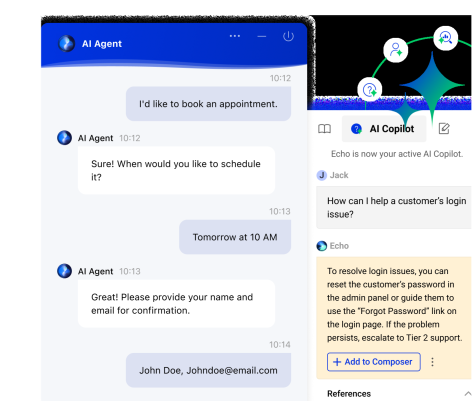
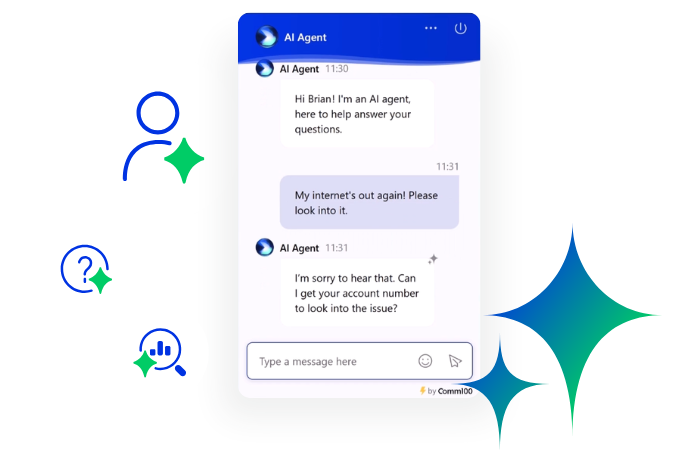
Customer support has long been treated as a cost center, absorbing budgets without generating direct revenue. But that perception is shifting rapidly. AI-powered tools are transforming support operations from expense lines into strategic assets that deliver measurable returns.
Companies implementing AI for customer service routinely report cost reductions of 15-40% in the first year alone, with savings increasing as AI models improve with more data.
The trajectory is clear. Agentic AI will soon resolve most common customer service issues without human intervention, driving significant reductions in operational costs.
This guide breaks down 9 practical strategies for leveraging AI to cut support costs while improving service quality. Each approach targets specific cost drivers and includes implementation guidance based on real-world deployments.
1. Automate Routine Inquiries with Intelligent Agents
The most immediate cost savings come from automating high-volume, repetitive queries. Password resets, order status checks, account balance inquiries, and FAQ responses consume enormous agent bandwidth despite being straightforward to resolve.
AI agents handle these interactions at a fraction of the cost, freeing human agents for complex issues that require judgment and empathy.
Intelligent AI agents go beyond keyword matching. They understand context, maintain conversation history, and resolve multi-step issues without human intervention.
When a customer asks about a delayed shipment, the AI can access order data, check carrier status, and offer solutions like refunds or expedited replacements, all within seconds.
The key is connecting AI systems directly to your operational data, so responses are accurate and actionable:
- Deploy an AI agent for password resets, order tracking, and account updates first since these represent quick wins with measurable impact
- Connect AI systems directly to order management, CRM, and knowledge bases to enable real-time data access for accurate responses
- Design seamless handoff protocols that transfer full conversation context when escalation to human agents becomes necessary
2. Accelerate Agent Productivity with Real-Time AI Assistance
Even when human agents handle complex issues, AI can dramatically improve their efficiency. An AI Copilot can surface relevant knowledge articles, suggest responses, and auto-populate case summaries as conversations unfold.
Your support agents can even converse with the AI Copilot before sending information forward to a customer. Agents spend less time searching for information and more time solving problems. The productivity gains translate directly into reduced staffing requirements for the same ticket volume.
The benefits compound across the entire resolution cycle. AI drafts email responses, compiles after-call summaries, and translates conversations in real-time for multilingual support.
Agents who previously spent 10-15 minutes on post-call documentation can complete wrap-ups in under two minutes. When you multiply those time savings across thousands of daily interactions, the cost impact becomes substantial.
3. Prevent Escalations Through Predictive Intelligence
Escalations represent one of the most expensive outcomes in support operations. When a routine issue escalates to senior agents or supervisors, handling costs multiply.
AI-powered sentiment analysis and intent detection can identify at-risk interactions before they spiral into escalations, enabling proactive intervention that keeps resolution costs low while protecting customer relationships.
Predictive and analytical systems like Comm100 AI Insights analyze conversation patterns, customer history, and real-time language cues to flag potential problems.
A customer’s frustration level, repeated contact attempts, or specific keyword combinations can trigger automated routing to specialized teams before the situation deteriorates. This proactive approach reduces repeat contacts while improving resolution quality.
See How AI Reduces Support Costs in Real Time
See how Comm100’s AI agents, copilots, and analytics help teams cut support costs by up to 40% while improving service quality.
View demo
View Demo
4. Reduce Training Costs with AI-Powered Onboarding
Agent training represents a significant hidden cost in support operations. New hires typically require weeks of instruction before handling live interactions, and turnover means repeating that investment constantly.
AI-driven training platforms like Comm100 AI Training compress onboarding timelines by providing personalized learning paths, realistic simulations, and real-time performance feedback.
Simulation-based training using AI allows new agents to practice with realistic customer scenarios in a controlled environment. The AI adapts difficulty based on performance, focuses on individual knowledge gaps, and provides immediate coaching feedback. Agents become productive faster while making fewer costly errors during their initial weeks. Organizations using this approach often cut onboarding time in half while improving new hire retention. With the right AI support staff training software, you can:
- Generate training scenarios automatically from real (anonymized) customer interactions to ensure relevance
- Use AI scoring to identify specific skill gaps and recommend targeted training modules rather than generic courses
- Provide AI-generated quizzes and assessments that adapt to each agent’s learning pace and retention patterns
5. Keep Knowledge Bases Current Through Automated Maintenance
Outdated knowledge bases create a cascade of costs: agents waste time searching for information, customers receive incorrect answers, and repeat contacts increase. AI-powered knowledge management systems like AI Knowledge continuously audit content accuracy, identify coverage gaps, and even draft new articles based on recurring customer questions.
The most advanced systems analyze support conversations to detect when existing articles fail to resolve issues, automatically flagging content for review. When new product features launch or policies change, AI can identify all affected knowledge articles and suggest updates, ensuring consistency across documentation.
This continuous maintenance prevents the knowledge decay that quietly inflates support costs over time.
6. Scale Quality Assurance with Automated Evaluation
Traditional quality assurance programs sample only a tiny fraction of customer interactions. Manual QA processes typically cover 2-5% of conversations, making it difficult to identify trends or catch systemic problems.
This sampling approach misses issues and creates inconsistent quality standards. AI-powered QA evaluates every interaction against predefined criteria, providing complete coverage without proportional increases in QA staffing.
Tools like Comm100 AI Onboarding score conversations on compliance, accuracy, tone, and resolution effectiveness in real-time. They identify coaching opportunities for individual agents, detect emerging issues across the entire support operation, and ensure consistent service standards.
The shift from sampling to comprehensive coverage transforms QA from a spot-check function into a continuous improvement engine, resulting in significant cost savings over time.
7. Slash Response Times with Intelligent Triage
Speed matters in customer support. Long response times frustrate customers, increase handling costs as issues compound, and drive churn. AI-powered triage systems analyze incoming requests instantly, categorizing by urgency, complexity, and required expertise, then route to the optimal resolution path. What once took hours can happen in minutes or even seconds.
Smart routing ensures urgent issues reach agents immediately while routine queries flow to self-service channels. Priority assignment considers customer value, issue severity, and SLA commitments.
The AI pre-populates ticket fields and suggests solutions before agents even open the case, reducing handle time from the first moment of engagement.
8. Improve Self-Service Resolution Rates
Every issue customers resolve themselves represents a ticket that never enters the support queue. AI-enhanced self-service portals guide users through troubleshooting flows, surface relevant knowledge articles, and complete transactions without agent involvement.
Modern self-service goes far beyond static FAQ pages. Conversational AI interfaces understand natural language queries, personalize responses based on customer history, and handle complex multi-step processes.
When self-service cannot resolve an issue, the system creates a support ticket pre-populated with diagnostic information, accelerating human resolution.
9. Lower Cost Per Resolution with AI-Powered Analytics
You cannot optimize what you do not measure. AI-driven analytics platforms provide granular visibility into support operations, identifying cost drivers, efficiency bottlenecks, and improvement opportunities that traditional reporting misses. The insights go beyond surface metrics to reveal root causes and guide strategic decisions.
Advanced analytics reveal which issue types consume disproportionate agent time, where knowledge gaps exist, and how individual process changes affect overall efficiency.
Machine learning models predict volume patterns, enabling precise staffing optimization. The insights translate directly into operational improvements and cost reductions across every support function.
- Track cost-per-resolution by channel, issue type, and customer segment to identify optimization priorities
- Use predictive models to forecast volume patterns and align staffing with expected demand
- Correlate operational metrics with customer outcomes to understand which efficiency gains actually improve satisfaction
Common Pitfalls and How to Avoid Them
Despite the clear benefits, many AI implementations fail to deliver expected returns. Only about a quarter of contact centers have successfully integrated AI automation into their daily operations, indicating significant challenges in full adoption. Understanding common failure modes helps avoid costly missteps.
Over-Automating Complex Interactions
The temptation to automate everything backfires when AI handles issues beyond its capabilities. Most customers still prefer human agents for complex issues. Forcing customers through inadequate automation frustrates them, increases escalations, and damages brand perception. Start with simple, high-volume queries where success rates exceed 90% before expanding scope.
Neglecting Knowledge Base Quality
AI systems are only as good as the information they access. Many organizations deploy sophisticated AI tools on top of outdated, incomplete, or inconsistent knowledge bases. The AI confidently delivers wrong answers, eroding customer trust. Before implementing AI, audit and remediate knowledge content. Establish ongoing maintenance processes that keep content current.
Ignoring Agent Adoption and Training
A common disconnect exists between what leaders think they’ve provided in AI training and what agents actually receive. Many agents report receiving no training at all on new AI tools. This gap means expensive technology goes underutilized while agents resist changes they do not understand. Invest in comprehensive training programs that demonstrate clear benefits to agents, not just management.
Measuring the Wrong Metrics
Optimizing purely for cost metrics like average handle time can degrade service quality and increase long-term costs through repeat contacts and customer churn. Balance efficiency metrics with quality indicators like first-contact resolution, customer satisfaction, and Net Promoter Score. The goal is reducing cost per successful resolution, not just cost per contact.
Underestimating Implementation Timelines
AI deployments require significant integration work, training data preparation, and iterative refinement. The breakeven point typically occurs within 9-15 months for mid-sized companies.
Organizations expecting immediate results often abandon implementations before realizing returns. Plan for phased rollouts with realistic milestones and communicate expectations clearly to stakeholders.
- Start with narrow, well-defined use cases before expanding to broader automation
- Audit knowledge base accuracy and completeness before deploying AI that depends on it
- Develop comprehensive agent training programs with ongoing reinforcement
- Track both efficiency and quality metrics to ensure optimization does not sacrifice service excellence
- Plan 12-18 month timelines with incremental milestones rather than expecting immediate transformation
Making AI Work for Your Support Operation
AI delivers cost reductions across every dimension of customer support, from frontline automation to back-office analytics. But the technology works best as an integrated ecosystem rather than a collection of point solutions. Each capability reinforces the others: better knowledge bases improve AI agent accuracy, automated QA identifies training needs, and analytics reveal optimization opportunities.
Organizations seeing the greatest returns start with clear cost baselines and specific improvement targets. They invest in change management alongside technology deployment.
And they maintain a customer-first perspective, recognizing that the ultimate measure of success is not just reduced costs but better service delivered more efficiently.
The companies that master this balance will gain sustainable competitive advantage in customer experience while operating leaner support functions than their competitors.
Build a Leaner, Smarter Support Operation with AI
Talk to Comm100 experts about deploying AI agents, automated QA, and intelligent routing to lower cost per resolution—without sacrificing customer experience.
Talk to an expert
Request Demo
Frequently Asked Questions
How quickly can you expect ROI from AI customer service investments?
Most organizations see measurable results within 3-6 months for initial deployments, with full ROI typically realized in 9-15 months. Quick wins come from automating high-volume, simple interactions like password resets and order status inquiries, often showing returns within weeks.
More complex implementations involving analytics, quality assurance, and multi-channel integration take longer to mature but deliver larger cumulative benefits. The majority of total ROI materializes in years 2-3, once AI systems mature and agent-AI collaboration improves. Plan for phased benefits rather than immediate transformation.
Will AI replace your human support agents?
AI transforms agent roles rather than eliminating them entirely. While automation handles routine queries, human agents focus on complex problem-solving, relationship building, and high-value interactions.
Some organizations reduce headcount through attrition as AI absorbs volume, but successful implementations also create new roles around AI management and optimization.
The most effective approach uses AI to augment agent capabilities, making each agent more productive and effective. Companies using AI-augmented support often report improved agent satisfaction and reduced turnover, as agents handle more meaningful work with better tools.
What metrics should we track to measure AI effectiveness?
Balance efficiency metrics with quality indicators for a complete picture. Track cost per resolution (not just cost per contact), first-contact resolution rate, AI deflection rate, escalation percentage, customer satisfaction scores, and Net Promoter Score trends.
Monitor AI-specific metrics like containment rate, intent recognition accuracy, and handoff quality. Avoid optimizing solely for speed or cost, as this often increases long-term expenses through repeat contacts. The goal is reducing cost per successful resolution while maintaining or improving customer satisfaction and first-contact resolution rates.
How do we prevent AI from giving wrong or harmful answers?
Implement multiple safeguards. Ground AI responses in verified knowledge bases rather than allowing open-ended generation. Configure confidence thresholds that trigger human review when AI certainty drops below acceptable levels. Use approved response templates for sensitive topics.
Establish clear escalation paths for issues AI should never handle autonomously. Inaccuracy remains the most commonly reported AI risk, so continuous monitoring and rapid correction of errors is essential. Monitor AI responses continuously and correct errors immediately to prevent pattern reinforcement.
What’s the best starting point for AI implementation?
Begin with high-volume, low-complexity interactions where success is easily measurable. Password resets, order status checks, and account balance inquiries make ideal starting points because they have clear resolution criteria and high volumes that generate quick ROI.
Ensure your knowledge base is accurate and comprehensive before deployment since AI performance depends heavily on underlying content quality. Run pilot programs with defined success criteria before broad rollout. Gather agent feedback early since they identify practical issues that analytics might miss. Once initial use cases prove successful, expand systematically to more complex scenarios.