An AI-first customer service strategy isn’t about replacing your agents with chatbots. It’s a fundamental rethinking of how support operations work, placing artificial intelligence at the center of every customer interaction while reserving human expertise for the moments that truly require it.
Today, the gap between what customers want and what support teams can deliver has never been wider, with service leaders facing mounting pressure to do more (and better) with less.
This guide walks through the essential steps for building an AI-first strategy that works, from laying the groundwork with vision and data to deploying AI across your support channels, training your team, and measuring what matters.
What is an Effective AI-First Customer Service Strategy?
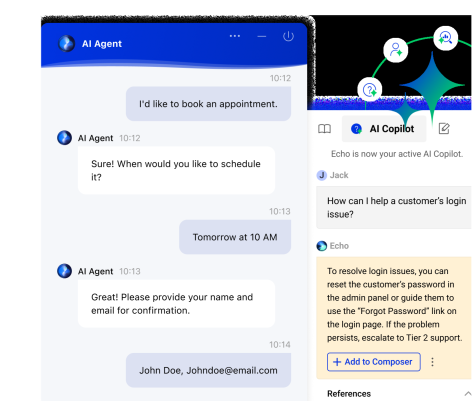
An AI-first customer service strategy treats artificial intelligence as the primary engine of your support operations rather than an add-on feature. Every customer inquiry flows through an AI layer first, whether that’s an AI Agent handling the entire conversation, an AI Copilot assisting human agents in real-time, or intelligent routing that gets customers to the right resource immediately.
This approach differs from traditional support models that treat AI as supplementary. In those older models, chatbots handle overflow or after-hours inquiries while humans do the “real work.”
An AI-first strategy inverts that assumption. AI handles the bulk of customer interactions, and human agents step in for complex cases that require judgment, empathy, or specialized expertise.
The distinction matters because it changes how you:
- Design workflows and customer journeys
- Hire and train support staff
- Invest in technology infrastructure
- Measure success and ROI
An effective AI-first strategy includes several key components: a centralized knowledge base that feeds AI with accurate information; omnichannel deployment so customers get consistent AI-powered support wherever they reach out; clear escalation paths to human agents; quality assurance systems that monitor AI performance; and analytics that reveal what’s working and what needs improvement.
9 Tips for Building Your AI-First Customer Service Strategy
1. Define Your Vision and Strategic Objectives
Every successful AI implementation starts with clarity about what you’re trying to achieve. Before evaluating vendors or building chatbots, answer these questions: What specific customer experience problems are you solving? What does success look like in 12 months? How does AI support your broader business objectives?
Vague goals like “improve customer service with AI” lead to scattered implementations and disappointing results. Strong objectives are specific:
- Reduce average response time from 4 hours to under 5 minutes
- Automate 60% of routine inquiries within six months
- Improve CSAT scores by 15 points while reducing cost per interaction
Your vision should also reflect your brand values:
- An iGaming operator would optimize for speed and accuracy above all else
- A financial institution might emphasize security and compliance at every step
- A university might focus on accessibility and 24/7 availability for students across time zones
Consider both short-term wins and long-term transformation. Many organizations start with a focused use case, such as automating password resets or order status inquiries, to build confidence before expanding. That’s reasonable, but the vision should encompass where you want to end up, not just where you’re starting.
2. Build a Robust Knowledge Foundation
AI is only as good as the information it can access. Commitment to a robust and comprehensive knowledge foundation is table stakes when it comes to AI-first customer service. Generative AI chatbots and virtual agents work through retrieval-augmented generation (RAG), which means they search your knowledge base, retrieve relevant information, and generate responses based on what they find. If your knowledge base is outdated, incomplete, or poorly organized, your AI will give bad answers and most likely fail to achieve your goals.
Most organizations underestimate this requirement. Gartner research notes that service and support leaders deploying conversational GenAI struggle because they rely on a well-maintained knowledge library that doesn’t exist. They launch AI without the foundational content it needs to succeed.
Auditing your existing documentation should come before any investment in AI deployment:
- Review help articles for accuracy and completeness
- Identify the 50-100 most common customer questions and ensure clear answers exist
- Remove conflicting or outdated information
- Structure content in formats that AI can easily parse
Tools like Comm100 Knowledge Base help centralize and organize this information, making it accessible across all AI-powered channels. The goal is a single source of truth that feeds every customer-facing AI interaction, whether through live chat, email ticketing, or social messaging.
Beyond documentation, consider what customer data your AI needs access to. Can it retrieve order status from your e-commerce platform? Can it pull account details from your CRM? AI that can answer “Where’s my order?” is far more useful than AI that can only provide generic shipping policies.
3. Choose the Right AI Channels and Technologies
AI-first doesn’t mean AI-only. The goal is deploying the right type of AI on the right channel for the right type of inquiry. That requires understanding what each technology does well.
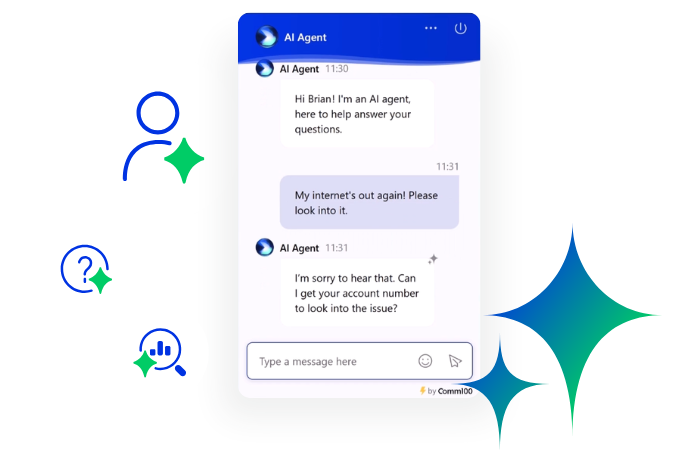
AI Agents (sometimes called AI chatbots or virtual agents) handle customer conversations autonomously. Modern AI Agents go far beyond scripted decision trees. They understand natural language, maintain context across multi-turn conversations, and can complete tasks like processing returns or updating account information.
AI Copilots work alongside human agents rather than replacing them. When a customer issue requires human judgment, AI Copilot suggests responses, surfaces relevant knowledge articles, and summarizes conversation history so agents can resolve issues faster.
Research from the National Bureau of Economic Research (NBER) found that customer support agents using a generative AI assistant increased productivity by 14% on average, with novice and low-skilled workers seeing improvements of up to 34%.
According to data from ZipRecruiter, the average annual pay for a Customer Support Agent in the United States is $45,024. A 14% productivity gain means your team of 10 agents now delivers the output of 11.4 agents. Instead of hiring 1.4 additional agents at $45,000 each, you’ve unlocked $63,000 in capacity through AI.
For a 10-agent team, that translates to roughly $63,000–$153,000 in annual capacity gains without adding headcount.
The right channel mix depends on your customers. A younger demographic comfortable with chat might engage primarily through messaging. Customers with complex technical issues might prefer email or phone. Your AI strategy should meet customers where they are, with consistent quality across every channel.
See Comm100’s AI-First Customer Service Platform in Action
See how Comm100’s AI Agents, AI Copilot, and unified knowledge base work together to automate high-volume support while ensuring seamless human escalation.
View demo
View Demo
4. Prioritize Your Use Cases
Not every customer inquiry is equally suited for AI automation. The best AI-first strategies start with high-impact, low-risk use cases and expand from there.
High-impact use cases share a few characteristics:
- They happen frequently (high volume)
- They have clear and consistent answers
- They don’t require human judgment or emotional sensitivity
Examples include order status inquiries, password resets, return and refund policy questions, store hours and locations, and basic troubleshooting steps. These use cases often represent 60-80% of total support volume.
When prioritizing, consider both automation potential and customer impact:
- A use case representing 15% of volume but causing significant frustration might be more valuable to automate than one at 25% volume that customers don’t mind waiting for
- Industry context matters: higher education AI might prioritize financial aid and registration; banking AI focuses on balance inquiries and transaction disputes; government AI handles permit applications and benefits administration
5. Design Seamless Human Escalation Paths
Every AI implementation needs clear, frictionless paths to human agents when situations require them. Getting this wrong creates more frustration than having no AI at all, and can quickly undermine your overall AI-first strategy making it appear as though it is unsuccessful.
The organizations getting results from implementing AI in customer service aren’t trying to eliminate humans; they’re redefining what humans do.
Escalation should happen under several circumstances:
- Customers explicitly request a human agent
- AI confidence drops below a defined threshold
- The inquiry involves sensitive topics (billing disputes, complaints, emotional distress)
- The conversation exceeds a complexity threshold (too many turns, repeated clarification requests)
- Sentiment analysis detects significant frustration
The handoff itself must be smooth. Nothing frustrates customers more than repeating everything they’ve already told the AI. The human agent should receive full conversation history, the AI’s understanding of the issue, any relevant customer data, and suggested next steps. Comm100 Live Chat enables this kind of context-rich handoff between AI and human agents.
For organizations with in-person service (university advising offices, bank branches, government service centers), AI can support queue management by triaging requests, setting expectations about wait times, and directing customers to the right service point.
6. Invest in Agent Training and Change Management
AI changes what agents do, not whether they’re needed. But that shift requires intentional training and change management. Agents who feel threatened by AI become obstacles. Agents who understand how AI makes them more effective become advocates.
The NBER research on AI-assisted customer service found something striking: AI assistance improved customer sentiment, increased employee retention, and helped newer workers move along the experience curve faster. An agent using the AI tool with just two months’ tenure performed as well as an agent with six months’ tenure working without the tool.
Effective training covers several areas:
- How to work alongside different AI tools
- When and how to intervene in AI-handled conversations
- How to handle escalations that AI couldn’t resolve
- How to provide feedback that improves AI performance over time
Comm100 AI Training can accelerate agent ramp-up by providing interactive guidance and reducing time-to-proficiency.
Change management goes beyond training. Agents need to understand why the organization is adopting AI-first strategies and how their roles are evolving. In many cases, AI enables agents to spend less time on repetitive tasks and more time on meaningful, complex customer interactions. That’s often more satisfying work, but the narrative needs to be communicated clearly.
7. Implement Quality Assurance and Focus on Incremental Improvement
AI performance degrades if you don’t monitor and refine it continuously. The organizations seeing the best results treat AI quality assurance as an ongoing discipline, not a one-time setup task.
Quality assurance for AI customer service includes several dimensions:
- Accuracy: Are answers correct?
- Completeness: Does the response address the full question?
- Tone: Does it match brand voice?
- Resolution: Did the customer’s issue get resolved?
- Escalation appropriateness: Are the right cases going to humans?
Reviewing AI conversations manually is essential, especially early in deployment. Sample a percentage of AI-handled interactions and score them against your quality criteria. Look for patterns: common questions the AI struggles with, topics where customers frequently escalate or abandon, phrasing that confuses the AI, and areas where the knowledge base needs improvement.
Instead of having humans sample just a handful of conversations, using AI is a great way to evaluate how support is performing at scale. Comm100 AI Quality Assurance can be used to analyze all conversations, provide targeted feedback, and enable your agents to better understand key areas for improvement.
8. Establish Clear Guardrails and Governance
AI that operates without guardrails creates risk. An AI-first strategy needs clear boundaries on what AI can and cannot do, how it handles sensitive information, and how it escalates appropriately.
Gartner notes that 75% of customer service and support leaders feel pressure from executive leadership to implement GenAI. That pressure can lead to rushed deployments without proper governance. Taking time to establish guardrails protects both customers and your organization.
Start with topic-level guardrails. What subjects should AI never address?
- Providing specific legal or medical advice
- Discussing executive compensation or internal company matters
- Making promises about outcomes (especially in regulated industries)
- Handling certain complaint categories that always need human judgment
Additional governance considerations:
- Regulatory requirements for your industry (financial disclosures, HIPAA, accessibility mandates, responsible gaming)
- Tone and brand voice consistency
- Data handling policies (what can AI access, store, and retain?)
- Ownership of ongoing governance reviews
When evaluating any AI platform, look at their security and compliance capabilities. Ensure that they adhere to the regulatory requirements within your industry.
9. Measure What Matters and Iterate
AI-first strategies succeed or fail based on measurement. Without clear metrics and regular review, you can’t know whether AI is delivering value or creating problems.
Before you implement any AI changes to your support infrastructure, always benchmark current performance. Then, you can more accurately demonstrate progress after AI implementation.
Core metrics to track:
- Containment rate: Percentage of inquiries AI resolves without human involvement
- First response time: How quickly AI responds to initial customer outreach (should be nearly instant)
- Resolution time: How quickly customer issues are fully resolved, including escalations
- Customer satisfaction (CSAT): Satisfaction specifically with AI-handled interactions
- Escalation rate: Percentage of AI conversations that escalate to humans
- Cost per interaction: Fully loaded cost segmented by channel and AI vs. human resolution
Moving Forward
The path forward isn’t about deploying AI for its own sake. It’s about using AI strategically to deliver faster, more consistent, more personalized customer experiences while enabling human agents to focus on work that truly requires their skills.
When AI handles the predictable volume, agents can spend their time on conversations that benefit from human empathy, creativity, and judgment.
Consider where you stand today:
- Do you have the knowledge foundation AI needs to succeed?
- Are you measuring the right metrics to understand AI performance?
- Have you designed escalation paths that work for customers and agents alike?
- Are your teams prepared for the shift in how they’ll work?
Start with clear objectives, build the knowledge foundation AI needs to succeed, choose use cases where AI delivers immediate value, and establish the measurement and improvement practices that drive ongoing optimization. That’s the framework for an AI-first customer service strategy that works.
Your customers are ready for AI-first service. The question is whether you’re ready to deliver it.
Build Your AI-First Customer Service Strategy with Comm100
Speak with Comm100 experts to design and deploy an AI-first customer service strategy that improves CSAT, reduces cost per interaction, and scales securely across channels.
Talk to sales
Request Demo