The online gambling industry has reached a decision point. Facing higher regulatory costs, increased taxation, and tightening margins, operators are searching for technologies that can simultaneously reduce expenses and improve player experiences. AI-powered customer support has emerged as a leading candidate.
Our latest research report with SBC Media surveyed compliance and support leaders across the iGaming sector to understand where the industry stands on AI adoption, what excites operators about the technology, and what concerns still hold them back.
The findings reveal an industry that has moved past asking whether to adopt AI and is now focused on how to deploy it without disrupting what already works.
Industry Confidence in AI: High for Volume, Cautious for Value
Survey respondents demonstrated nuanced thinking about where AI agents belong in their support operations. The confidence levels tell a clear story about how operators view different use cases:
- 65.2% trust AI agents for proactive engagement tasks like onboarding, explaining game rules, and delivering promotional messages
- 60.9% would assign moderate reactive tasks such as deposit and withdrawal queries to AI
- 56.5% feel comfortable with simple reactive help including password resets, limit setting, and technical troubleshooting
- Only 21.7% would trust AI with complex queries involving responsible gaming or bonus disputes
The sharpest drop-off comes with VIP interactions. Just 17.4% of respondents would let AI handle their highest-value players. Operators clearly believe that premium customer service should remain human-centric when relationships carry significant monetary value or regulatory sensitivity.
This pattern reflects what might be called the “value-volume divide.” AI agents get deployed where interaction volume threatens to overwhelm human capacity. Humans retain control where relationship value justifies premium service costs.
The Emerging Role of AI Agents in Player Support
Explore exclusive SBC Media research revealing how iGaming operators are adopting AI agents, where they see the biggest ROI, and what’s holding them back.
Download report
Report
Perhaps the most striking finding: zero respondents said they are not considering AI for support. Not a single operator wants to be left behind.
The adoption timeline is compressed. Over half of operators (54.6%) have already deployed AI agents or are actively piloting the technology, while 40.9% are evaluating available solutions. Within two years, AI-powered support will likely shift from competitive differentiator to table stakes across the industry.
What’s driving this acceleration? Two statistics stand out:
- 82.6% cite 24/7 availability as their primary motivation for AI adoption
- 73.9% point to reduced operational costs as a key benefit
Operators face dual pressure from player expectations demanding round-the-clock support across time zones and languages, combined with margin compression from rising regulatory costs and tax burdens. AI-powered live chat solves both problems simultaneously.
The Hybrid Model Will Dominate Near-Term
Most operators recognize that wholesale replacement of human agents isn’t realistic in the short term. The survey revealed clear expectations for how the human-AI balance will evolve:
- 45.5% envision AI handling simple tasks while humans take the lead on complex issues
- 36.4% expect AI to handle most inquiries with occasional human intervention
- 18.1% see AI primarily assisting human agents through suggestions and response drafting
- 0% believe AI will have a minimal role in support operations
The intention appears to be expanding automation for common, simple tasks while retraining human agents from frontline support to specialist roles in complex case management, responsible gambling, and VIP relationship management.
What Operators Want from AI Support
When asked what excites them about AI agents, respondents focused on practical business benefits rather than theoretical capabilities:
- 24/7 availability (82.6%) topped the list, reflecting the global nature of online gambling operations
- Reduced operational costs (73.9%) came second, highlighting the financial pressures facing operators
- Scalability during peak events (47.8%) addresses a critical pain point when first-time depositors surge during major sporting events
- Personalized player journeys (47.8%) shows interest in AI-driven retention strategies
The ultimate aim appears to be using AI agents as tools to drive retention and service quality through around-the-clock availability combined with highly effective personalization.
Where Operators Expect ROI
Respondents view AI primarily as a cost reduction tool rather than a revenue generator at this stage:
- 47.8% expect the biggest ROI from headcount savings, whether through retraining staff, not recruiting against attrition, or direct reductions
- 43.5% anticipate reduced churn through faster support will deliver significant returns
- Only 4.3% point to player reactivation as the primary ROI driver
- 0% selected improved VIP experience as the main return source
These findings suggest operators remain cautious about attributing directly measurable revenue targets to AI deployment. They appear more confident in cost savings than revenue generation, at least initially.
What’s Holding Operators Back from AI Investments?
Despite enthusiasm for AI’s potential, operators expressed legitimate concerns that may limit deployment scope:
- 78.3% worry about errors or misinformation from AI agents, which could trigger compliance issues
- 69.6% cite impersonal or robotic experiences as a significant concern
- 30.4% flag deployment complexity as a barrier
- 21.7% mention cost predictability as a concern
- Only 4.3% identify regulatory risk as a limiting factor
The low percentage concerned about regulatory risk deserves attention. Most gambling regulations focus on player protection, responsible gaming, financial transaction security, and marketing practices. Few explicitly govern customer support technology or AI deployment in support contexts.
However, the 78.3% concerned about errors understand that today’s operational mistake could become tomorrow’s regulatory requirement. An AI agent providing incorrect information about deposit limits, bonus terms, or responsible gambling resources could trigger scrutiny that leads to new technology-specific rules.
Defining Success: What Makes a “Good” AI Experience?
When asked to define a good AI-powered support experience from a player’s perspective, operators coalesced around three interconnected themes:
- Human-like qualities: The experience must be seamless and indistinguishable from human interaction
- Speed and accuracy: AI agents need to deliver fast, correct responses without errors
- Personalization and context: Systems must recognize player behavior, preferred games, and interaction history
One respondent captured the stakes perfectly: AI support should work for “all customers if it’s good, but none if it’s bad.” Players don’t necessarily object to AI handling their queries. They object to bad support that happens to come from AI.
This creates a strategic opportunity. Operators who solve the human-like experience challenge first will enjoy significant competitive advantages during the adoption window. While competitors struggle with robotic interactions and player complaints, early movers with genuinely conversational AI will capture efficiency gains without suffering churn penalties.
Practical Recommendations for Operators
Based on these findings, operators considering AI implementation should focus on several key areas:
Invest in accuracy and guardrails. The biggest concern about AI agents is the potential for errors or misinformation. Implement mandatory human verification loops during piloting, especially for responses involving financial or regulatory advice.
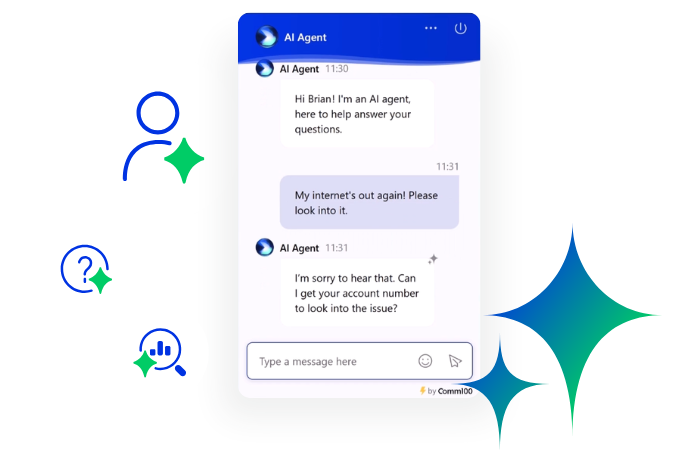
Solutions like Comm100’s AI Agent use knowledge-based responses generated only from verified sources, reducing misinformation risk.
Define and track success metrics. Without clear KPIs, you cannot establish whether AI delivers its promised benefits. Develop a balanced scorecard including efficiency metrics (headcount savings, cost per interaction, resolution time) and quality metrics (churn reduction, first contact resolution rate, CSAT scores). AI Insights can help detect frustrated or disengaged high-value players showing churn indicators.
Start with high-volume, low-risk queries. Prioritize simple frontline reactive help and proactive engagement tasks. This approach leverages AI’s strength in scalability and 24/7 availability while minimizing exposure to regulatory or financial risk.
Focus on contextual personalization. The importance of creating a human-like experience makes personalization essential. Integrate player data and lifecycle management systems with AI agents so the system can recognize whether a player prefers casino games or sports betting and adjust its communication accordingly.
The Bottom Line
The iGaming industry has collectively decided that AI agents represent inevitable infrastructure, not optional enhancement. The question is no longer whether to adopt but how to deploy effectively.
Operators who implement robust verification systems, maintain compliant content libraries, and establish clear escalation rules for sensitive topics can deploy AI agents confidently within existing regulatory frameworks. Those who move first with genuinely human-like AI experiences will capture both the efficiency gains and the competitive advantages while slower-moving competitors struggle to catch up.
The Emerging Role of AI Agents in Player Support
Explore exclusive SBC Media research revealing how iGaming operators are adopting AI agents, where they see the biggest ROI, and what’s holding them back.
Download report
Report