
Telecom support teams handle a heavy load of billing questions, technical issues, and outage updates, often while competitors work hard to win their + Read More about top-rated ai-powered support software for telecommunications
Top Freshdesk Competitors That Are SOC 2 Type II and PCI DSS Ready
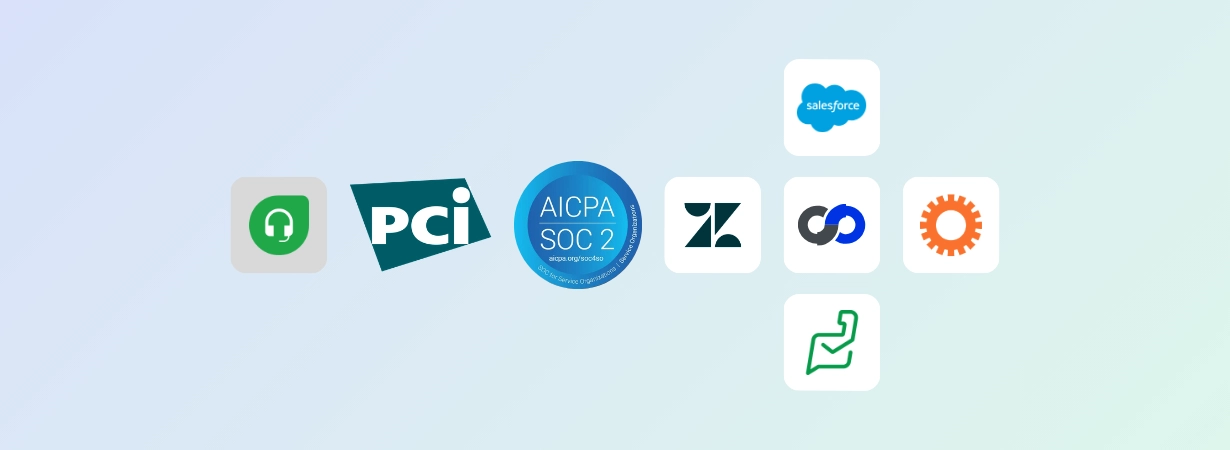
For organizations in regulated industries such as finance, government, healthcare and higher education, choosing a customer support platform is a high-stakes decision. Freshdesk is a popular tool with a solid security baseline: Freshworks states that Freshdesk is audited annually for ISO 27001, ISO 27701 and SOC 2 Type 2, and that it is PCI compliant. For most regulated teams, the harder questions come after the certificates. How is card and health data handled inside chats and tickets? Which plan unlocks those protections? And where does the data actually live?
Those questions are why teams look for the best Freshdesk competitors that meet SOC 2 Type II and PCI DSS security standards out of the box. This guide explains how to choose a Freshdesk alternative with SOC 2 Type II and PCI DSS compliance for regulated industries and compares leading platforms on the criteria that actually separate them. Comm100 has built omnichannel customer engagement software for regulated organizations since 2009, and its platform is included in the comparison.
Why SOC 2 Type II and PCI DSS Matter for Support Platforms
The two standards answer different questions. SOC 2 Type II shows how well a vendor protects data in general, while PCI DSS governs what happens when payment card data enters a conversation.
- SOC 2 Type II: an independent audit, performed under AICPA standards, that reports on a vendor’s controls for security and, where in scope, availability, processing integrity, confidentiality and privacy. A Type I report assesses the design of controls at a single point in time. A SOC 2 Type II audit tests whether those controls operated effectively over an extended period, which is why most enterprise buyers insist on it.
- PCI DSS: the Payment Card Industry Data Security Standard applies to any organization that stores, processes or transmits cardholder data. Non-compliance can lead to fines from card brands, higher transaction fees and, in serious cases, loss of the ability to accept card payments. Support platforms fall into this picture because customers routinely type card numbers into chats and tickets, which can pull the platform into your PCI scope.
For any organization handling personally identifiable information (PII), protected health information (PHI) or financial data, a platform’s adherence to these standards is a direct measure of its ability to protect customers. Because Freshdesk and most of its major competitors already hold both, the real evaluation is about how each vendor applies them.
Key Criteria for Evaluating Secure Freshdesk Alternatives
Certification logos are the starting point of an evaluation, not the end of it. Use the checks below to separate platforms that are compliant on paper from platforms that fit a regulated operation.
Compliance Included in Your Plan
Verify the vendor’s compliance portfolio first, then check which plan each protection applies to. SOC 2 Type II and PCI DSS should cover the core platform, and protections such as HIPAA support shouldn’t require a jump to the most expensive tier or a separately priced add-on. Freshdesk’s HIPAA support, for example, requires its Enterprise plan, because mandatory configurations such as IP allowlisting are only available there. Compliance tied to premium tiers creates budget uncertainty and makes it easy for a lower-tier deployment to fall short of what auditors expect. Mature security programs also show up in additional certifications such as ISO 27001 and in documented support for regulations such as HIPAA, GDPR and PIPEDA.
How Card Data Is Handled in Conversations
Vendor-level PCI DSS compliance doesn’t tell you how card data moves through your support channels. Look for credit card masking that automatically hides card numbers typed into chats, and for secure forms that collect payment details outside the conversation transcript. Then ask how widely those protections apply. In Freshdesk, only one PCI field can be added, which can be limiting for teams that collect payment details in several workflows.
Deployment Flexibility and Data Sovereignty
Data sovereignty, the principle that data is subject to the laws of the country where it’s stored, is a critical concern for many government, healthcare and financial institutions. Regional cloud hosting addresses data location for many organizations. Some, however, operate under policies that require support data to stay on infrastructure they control, and Freshdesk and most of its leading competitors can’t meet that requirement because they don’t offer on-premises deployment. For these organizations, choosing a cloud-only vendor means giving up control over storage location and legal jurisdiction, which can rule a platform out before features are even compared.
Consistent Security Across Every Channel and the AI Layer
Security has to hold across every channel, not just one. A secure platform enforces the same controls across live chat, ticketing, messaging and AI chatbots. When AI comes from a separate vendor bolted onto the help desk, a gap in one component can expose the whole customer journey, so confirm that the vendor’s certifications cover its AI features as well as the core platform. Every interaction needs the same protection from first query to final resolution.
Explore the Comm100 Trust Center
Review Comm100's security, compliance, and privacy information in one place.
Explore Trust CenterTrust Center
Comparison of Top Secure Freshdesk Competitors
The table below compares leading Freshdesk competitors on the standards that matter most to regulated buyers, with Freshdesk included as the baseline. Certifications change over time, so confirm current status in each vendor’s trust center before you shortlist.
Comm100: Purpose-Built for Regulated Industries
Comm100 holds SOC 2 Type II, PCI DSS, HIPAA and ISO 27001, and supports compliance with GDPR and PIPEDA. These controls apply across the unified platform, from live chat and messaging to the AI Agent. For payment data, Comm100 includes credit card masking and PCI DSS-compliant secure forms, covered in detail on its PCI DSS compliant customer service page.
Comm100 is also the only platform in this comparison that offers on-premises deployment alongside its cloud service, giving organizations full control over where their data lives. If you need a platform designed for security and compliance from the start, see why organizations choose Comm100.
Zendesk: The Scalable Cloud Platform
Zendesk is a mature Freshdesk alternative with a broad feature set and a large app marketplace. Its trust center lists SOC 2 Type II, PCI DSS tooling that includes automatic redaction of credit card numbers, and a HIPAA program with a BAA. The tradeoff is cost, since HIPAA eligibility depends on plan and configuration, which can raise total cost of ownership for healthcare teams. As a cloud-only service, Zendesk can’t meet requirements for on-premises hosting.
Salesforce Service Cloud: The Enterprise Ecosystem Play
For enterprises already invested in Salesforce CRM, Service Cloud is a powerful, integrated option with a strong compliance portfolio that includes SOC 2, PCI DSS and HIPAA support. The main tradeoffs are total cost of ownership and implementation complexity, which often make it a harder fit for organizations that aren’t already deep in the Salesforce ecosystem. Like every competitor on this list, it runs in the cloud only.
LivePerson: The Conversational AI Specialist
LivePerson focuses on large-scale, AI-driven conversational messaging. Its security page lists SOC 2 reporting with HIPAA, ISO 27001 and PCI DSS 4.0. The tradeoff is specialization: its focus on large enterprise messaging deployments can make it less flexible or cost-effective for organizations that need a balanced mix of live chat, ticketing and messaging in one console.
Zoho Desk: The Integrated Suite
Zoho Desk is a solid choice for businesses already running the Zoho suite. It holds SOC 2 Type II and supports HIPAA through a BAA, ePHI field marking and field encryption. Zoho doesn’t publicly document PCI DSS compliance for Zoho Desk specifically, so teams that take payments over support channels should confirm it directly. Like the other SaaS-only providers here, it offers no on-premises option. For teams that want a dedicated customer engagement platform outside the Zoho suite, see how Comm100 compares with Zoho Desk.
Why Comm100 Is the Strongest Alternative for Security-Conscious Organizations
When security is the deciding factor, Comm100 brings compliance, deployment flexibility and AI together in one platform.
Compliance Built Into the Core Platform
Comm100 was designed with regulated industries in mind. SOC 2 Type II and PCI DSS apply to the platform itself rather than to a separately sold module, and card data protections such as masking and secure forms are part of the product. Security is part of the foundation you deploy, not an upgrade you negotiate later.
Data Sovereignty with On-Premises Deployment
Comm100 is one of the few enterprise-grade vendors in this space to offer both cloud and on-premises deployment. Freshdesk, Zendesk, Salesforce Service Cloud, LivePerson and Zoho Desk are all cloud-only. On-premises deployment gives government agencies, financial institutions and healthcare providers direct control over where their data is stored and processed, so they can meet the strictest data residency mandates. You can learn more in the Comm100 Trust Center.
A Unified and Secure AI-Powered Platform
You don’t have to choose between AI and security. Comm100’s AI Agent can automate up to 80% of routine inquiries while operating under the same certifications as the rest of the platform. Whether customers reach you through live chat, email or the AI Agent, every conversation is covered by the same security controls. For a wider view of the market, see our guide to the best AI live chat software.
Wrap Up
When choosing a Freshdesk alternative for a regulated industry, your evaluation has to go beyond features and pricing. Freshdesk and most major competitors already hold SOC 2 Type II and PCI DSS, so the differences lie in how those standards are applied: whether card data protections cover every channel you use, whether HIPAA support sits behind a premium plan, and whether you can deploy on infrastructure you control.
On those measures, Comm100 is the strongest fit for security-conscious organizations. It combines a compliance-first platform, the only on-premises option in this comparison, and AI that runs under the same controls as every other channel.
Ready to see a platform built for your regulatory needs? Contact sales to discuss how Comm100 can secure your customer engagement.

Discuss Secure Customer Support with Comm100
Talk with Comm100 about compliance, deployment, and security needs for your support channels.
Contact salesContact Sales