
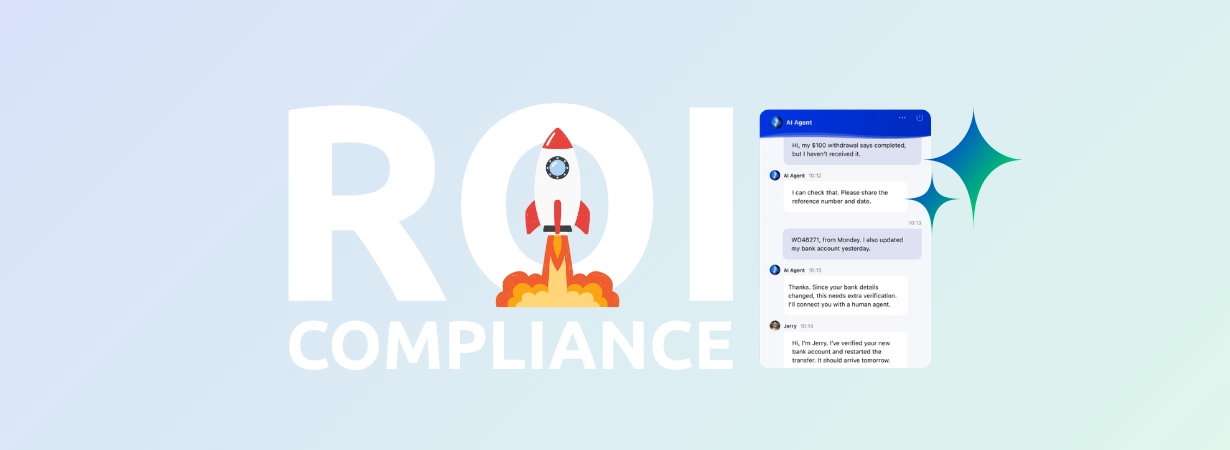
A major football fixture on a Saturday afternoon is a stress test for any operator’s support team. Deposit volumes spike, withdrawal questions flood + Read More about ai-powered support for igaming: maximize roi and compliance

Secure vs Standard Messaging: HIPAA Compliance for Healthcare
Patients want to message their healthcare providers the same way they message everyone else. The Health Insurance Portability and Accountability Act (HIPAA), however, requires that any Protected Health Information (PHI) shared in those conversations stays secure. The consumer chat apps patients already use weren’t built to meet those requirements. This article explains how standard messaging differs from a secure messaging platform, what HIPAA compliance requires, and what to look for in the best HIPAA-compliant messaging platform for patient communication.
Why Standard Messaging Falls Short of HIPAA
Many organizations assume everyday tools like native SMS, WhatsApp, or Facebook Messenger are good enough for patient conversations. That assumption can be expensive. These consumer apps weren’t designed to handle PHI, and using them to send it violates HIPAA.
Here’s where they fall short:
- Lack of End-to-End Encryption: HIPAA-compliant chat has to encrypt data both in transit and at rest. Standard messaging services often leave data unencrypted on provider servers or local devices, where it can be intercepted or accessed without authorization.
- No Access Controls: These apps can’t reliably verify who a user is, enforce role-based permissions, or stop PHI from being screenshotted, copied, or forwarded to people who shouldn’t see it.
- Absence of Audit Trails: HIPAA requires organizations to track who accesses PHI. Consumer apps don’t keep audit trails, so there’s no way to investigate a security incident or show due diligence after a possible breach.
- No Business Associate Agreement (BAA): Any vendor that handles PHI for a healthcare provider is a Business Associate and must sign a BAA, a contract that makes the vendor legally responsible for protecting that data. Consumer tech companies won’t sign one, which leaves the healthcare organization carrying all of the liability.
The penalties are real. Violations can bring fines of up to $50,000 per incident, along with corrective action plans that tie up staff and budget for years. Patients who learn their health information was exposed may also stop trusting the organization. On the question of secure messaging vs standard messaging for HIPAA compliance in healthcare, standard tools don’t meet the requirements.
What a HIPAA-Compliant Messaging Platform Needs
So, what is the best HIPAA-compliant live chat software for healthcare organizations? It’s one built with the technical, administrative, and physical safeguards HIPAA requires to protect PHI. When you evaluate a platform, check for the following.
End-to-End Encryption for PHI Protection
Every HIPAA-compliant live chat solution starts with encryption. A compliant platform keeps PHI unreadable to anyone without authorization, both “in transit” (as it moves across networks) and “at rest” (while stored on servers). Standard protocols like TLS 1.2+ and AES 256-bit encryption handle this, so intercepted data can’t be read.
Strict Access Controls and Identity Verification
A compliant platform needs fine-grained control over who can see sensitive data, which protects against both outside attackers and insider misuse. Look for:
- Unique User Authentication: Every agent, clinician, and administrator must have a unique, traceable login.
- Role-Based Access Control: Administrators can limit what each person sees and does based on their job and need-to-know.
- Two-Factor Authentication (2FA): Requires a second form of verification at login, so a stolen password alone isn’t enough to get in.
- Single Sign-On (SSO): Connects to the organization’s identity provider so staff sign in once and security policies are managed centrally.
Comprehensive Audit Trails and Reporting
HIPAA requires detailed, tamper-proof logs of system activity. These audit trails record who accessed PHI, when, and what they did with it. Security teams rely on them for routine reviews, incident investigations, and proving compliance to regulators.
A Signed Business Associate Agreement (BAA)
The BAA is the legal basis of a compliant vendor relationship. It’s a contract that requires the technology vendor to protect PHI to the same standard as the healthcare organization itself. Using any vendor to store or transmit PHI without a signed BAA is a direct HIPAA violation. Comm100 signs BAAs with all healthcare clients, and you can confirm this in its public Trust Center.
Security Beyond the HIPAA Minimum
Meeting HIPAA’s baseline requirements is only the minimum. Healthcare organizations should also look for a vendor that treats security as an ongoing program and applies it across every part of the patient experience.
Proactive Security and Independent Verification
Ask vendors for evidence of their security practices, not just claims. That means regular vulnerability scans, annual third-party penetration tests, and formal risk assessments. Strong vendors also hold certifications beyond HIPAA, such as SOC 2 Type II and ISO 27001, which require independent audits of their security controls.
Consistent Compliance Across All Patient Channels
Patients now contact providers through more digital channels than ever, and any channel left unprotected becomes a weak point. HIPAA safeguards have to apply wherever a patient reaches out, whether through live chat, an AI Agent, or a secure ticketing system. That requires a unified platform that brings all conversations together and applies one security model to every channel. This is one of the main things that separates the best HIPAA-compliant customer support software solutions from the rest.
Data Sovereignty and Deployment Flexibility
Large health systems and government-funded organizations are often required by law or policy to control where patient data is physically stored. Some platforms meet this need with flexible deployment options. Secure cloud hosting is the most common choice, but an on-premises deployment gives an organization full control over its data and keeps it inside its own network.
Choosing a messaging vendor affects both compliance and patient trust. Standard consumer tools leave PHI exposed. A purpose-built, HIPAA-compliant platform provides encryption, access controls, audit trails, and a signed BAA. When those protections are independently audited and applied across every channel, they protect patients, reduce risk, and let healthcare organizations offer the digital communication patients expect.
See how AI-powered, HIPAA-compliant patient communication works in practice. Contact Comm100 for a personalized demo.

See Comm100 Healthcare Messaging
Explore live chat, AI Agent, and ticketing workflows for patient communication.
Request demoRequest Demo