

Patients want to message their healthcare providers the same way they message everyone else. The Health Insurance Portability and Accountability Act (HIPAA), however, + Read More about secure vs standard messaging: hipaa compliance for healthcare
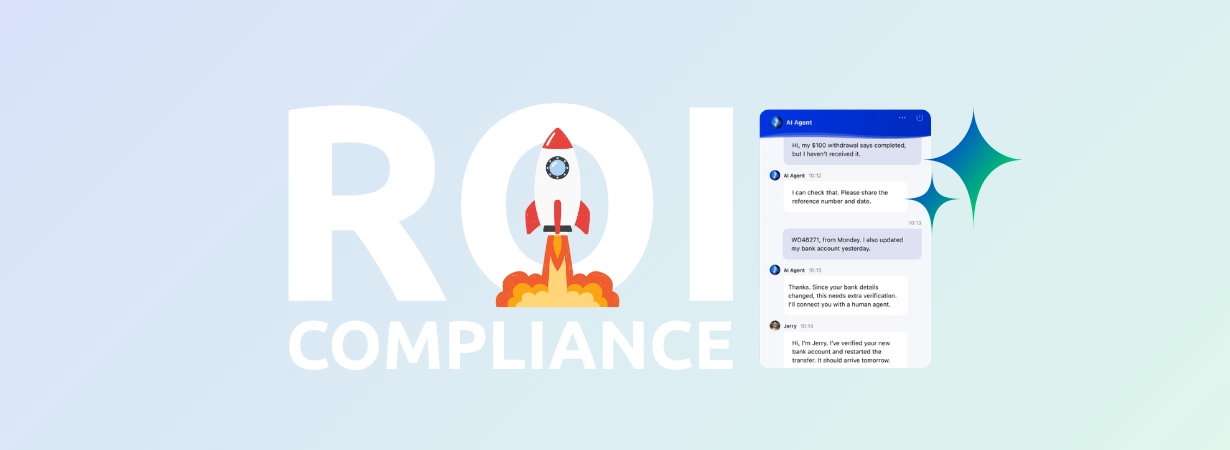
AI-Powered Support for iGaming: Maximize ROI and Compliance
A major football fixture on a Saturday afternoon is a stress test for any operator’s support team. Deposit volumes spike, withdrawal questions flood in, bonus disputes pile up, and the live chat queue climbs faster than agents can clear it. Players expect instant answers at 2 a.m. as readily as at 2 p.m. Responsible gambling obligations don’t pause for the rush either, and regulators still expect you to spot at-risk behavior and respond appropriately.
That tension defines player support in iGaming. Operators know support affects retention, yet it rarely wins the budget. In The Benchmark for AI Player Support, a 2026 survey by SBC Media and Comm100, only 5% of operators ranked customer support as their top budget priority, while 70% said speed of issue resolution drives retention. Players judge a brand by how quickly and accurately it solves their problem, and switching to a competitor takes a few taps.
AI is how many operators are closing that gap. In SBC Media and Comm100’s survey of gambling support and compliance leaders, 54.6% of operators had already deployed or were piloting AI agents in player support, and none said they weren’t considering it. The open question for most operators is no longer whether to adopt AI, but how to deploy it in a way that pays back and stays compliant.
This article covers how AI delivers measurable ROI for iGaming operators, how it supports compliance and responsible gambling obligations, and how to choose a platform built for the demands of the industry.
Why AI Has Become Standard in Player Support
For years, AI in player support was a differentiator. With more than half of operators now deploying or piloting it, it is fast becoming the baseline, and the operators pulling ahead are the ones using it well.
The same survey shows what’s driving adoption. 24/7 availability tops the list, cited by 82.6% of operators. Players bet around the clock and across time zones, so a support model that goes quiet overnight loses players. Always-on demand is a major reason AI adoption in player support is accelerating.
Reducing operational costs follows, cited by 73.9% of operators. Support volume scales with player growth, and hiring to keep pace gets expensive fast when every new agent has to learn game rules, bonus mechanics, withdrawal policies and compliance procedures before taking a chat.
Volume spikes add pressure that no staffing plan solves cleanly. Major sporting events, tournament finals and big promotions can multiply inbound chats within hours. Staffing for the peak wastes money during normal periods, while staffing for the average breaks during the peak. AI absorbs the surge without emergency headcount.
Operators are also clear about where AI belongs, a pattern the SBC Media and Comm100 research calls the value-volume divide. Operators trust AI with volume: 65.2% trust it for proactive engagement and 60.9% for moderate reactive help. They are far more cautious with value, since only 17.4% would trust AI with VIP interactions and 21.7% with complex responsible gambling queries. The operators getting this right send routine, high-volume queries (password resets, deposit confirmations, bonus terms) to AI and keep human agents on high-value players, complex disputes, and conversations where empathy and judgment matter. AI takes the repetitive volume so your people can spend their time where a human makes the difference.
Where the ROI Comes From
The return on AI in player support starts with unit costs, then compounds through agent productivity and player retention.
Lower Cost Per Resolved Query
Gartner benchmarks put the median cost per contact at $13.50 for assisted channels such as phone, chat and email, against $1.84 for self-service, roughly 86% less. Every routine query that AI resolves end to end moves from the first cost line to the second.
The word resolves matters. Comm100 positions the Comm100 AI Agent to automate up to 80% of inbound queries, the repetitive questions that eat agent time: password resets, deposit and withdrawal checks, bonus eligibility, and account verification status. Real-world data sets a more precise expectation. Comm100’s 2026 AI Live Chat Benchmark Report, drawn from more than 220 million interactions, found that on sites with a chatbot deployed, AI handled 75.3% of chats and resolved 44.8% of the chats it handled. In iGaming specifically, the resolution rate was 38.1%. Savings come from resolved queries, not handled ones, so the handoff to a human agent matters as much as the automation rate.
The AI Agent deploys without coding and learns from your website, knowledge base and cloud files, so its answers can keep pace as promotions and rules change.
The broader trend points the same way. Gartner predicts that by 2029, agentic AI will autonomously resolve 80% of common customer service issues without human intervention, leading to a 30% reduction in operational costs. Operators that build their resolution and escalation workflows now will have that groundwork in place as the technology matures.
Help Agents Deliver VIP Service at Scale
Automation handles volume. The bigger win is what AI does for the agents who stay on the front line.
Player support in iGaming is hard to staff, and onboarding an agent who needs to learn game rules, bonus mechanics, withdrawal policies and compliance prompts takes time. Comm100 AI Copilot shortens that ramp by surfacing suggested replies and relevant knowledge to agents in real time, inside the console they already use.
When a player asks about a wagering requirement or a specific bonus’s terms, AI Copilot suggests an accurate, brand-consistent response the agent can send or adapt in seconds. New hires reach competence faster, and experienced agents stop hunting through documentation and spend more time helping players.
Every player gets the same accurate answer regardless of which agent they reach, which supports first-contact resolution and satisfaction. For the VIP and complex conversations operators want to keep human, AI Copilot makes those humans faster and more consistent.
Increase Player Lifetime Value and Reduce Churn
Churn in iGaming rarely comes down to one dramatic failure. It builds from friction: a slow reply on a withdrawal question, a confusing bonus dispute, silence at midnight. Each one gives a player a reason to try a competitor’s app. With 70% of operators in the SBC Media and Comm100 benchmark linking resolution speed to retention, speed is the retention lever support controls most directly.
Instant, 24/7 support removes much of that friction, and the value of keeping players adds up quickly. Take an illustrative operator with 10,000 active players, each worth $500 a year. Cutting annual churn by 1.5 percentage points keeps 150 more players, worth $75,000 in annual player value that would otherwise go to a competitor.
AI also turns support into a growth channel. Comm100’s integrations with Optimove and RealTime Gaming bring player segments, lifecycle information, engagement history and gaming-platform data into support workflows, so agents see the context behind each inquiry. With that context, teams can deliver proactive support to high-value players, reaching out before a problem escalates or before a VIP drifts away. The support center stops being a pure cost line and becomes a place where loyalty is built.
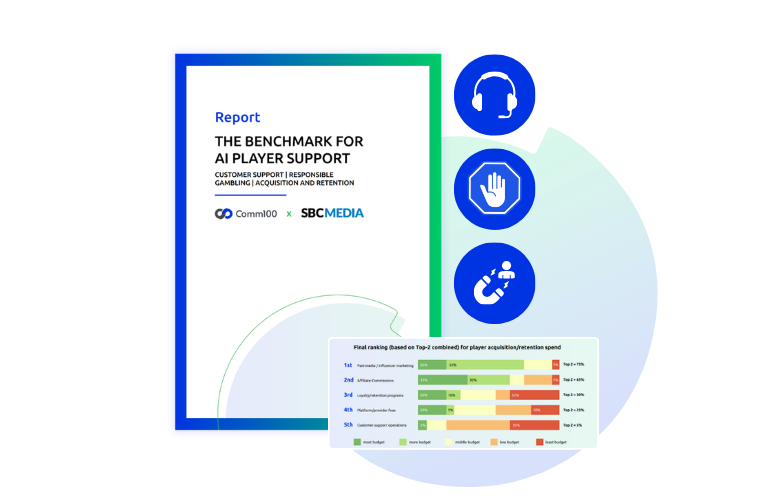
The Benchmark for AI Player Support
Compare operators’ AI adoption, retention priorities, and responsible gambling challenges.
Get the reportReport
Compliance Built Into Every Conversation
In iGaming, support and compliance are inseparable. Any conversation can touch KYC, AML or responsible gambling obligations, and a misstep carries regulatory and reputational risk. A platform built for regulated industries treats compliance as foundational rather than as a feature bolted on later.
Uphold Responsible Gambling Standards
Responsible gambling is where getting support right matters most, and where many operators feel least equipped. Every operator in the SBC Media and Comm100 benchmark trains support agents on responsible gambling behaviors, yet 55.2% cite limited integration with responsible gambling systems as their biggest challenge, and 51.8% still rely on manual supervisor review.
AI can close part of that gap inside the conversation itself. Configured properly, an AI chatbot can watch for at-risk signals in what players write, such as distressed language, mentions of financial stress, or talk of chasing losses. Rather than handling these moments itself, it flags them and escalates immediately to a specialized human agent equipped to respond with care. That design matches operator sentiment, since only 21.7% trust AI with complex responsible gambling queries. Behavioral signals such as session length and deposit patterns sit in the operator’s player account and responsible gambling systems, which is why connecting those systems to the support platform matters so much.
Detecting risk during the conversation and escalating it to a trained human shows regulators a genuine commitment to harm prevention. For a deeper look at how operators are approaching this, watch Comm100’s webinar on player support, AI, retention and compliance in iGaming.
Protect Player Data Across Jurisdictions
iGaming operators handle identity documents, payment details and financial transactions, often across several regulatory jurisdictions at once. Your support platform sits in the middle of all of it, so its security posture becomes your security posture.
Comm100 is certified to SOC 2 Type II, ISO 27001 and PCI DSS, and supports compliance with data protection regulations including GDPR, HIPAA and PIPEDA. SOC 2 Type II and ISO 27001 mean independent auditors have verified the controls behind the platform. PCI DSS compliance means payment card data is protected to the card industry’s security standard.
On the practical side, the platform includes credit card masking and PCI DSS-compliant secure forms, role-based access control, audit logs, two-factor authentication, IP allowlisting, and the option to stop visitors from downloading or printing chat transcripts. Comm100 also runs quarterly vulnerability scans and yearly penetration testing.
For operators with strict data residency requirements, on-premises deployment gives direct control over where player data is stored and processed. You can meet the specific rules of each market you operate in rather than forcing player data into a one-size-fits-all cloud.
How to Choose the Right AI Support Platform for iGaming
Plenty of platforms claim to do AI support. Far fewer are built for the specific pressures of iGaming. General AI support roundups compare features that matter to any SaaS buyer, so evaluate vendors against criteria tuned to your operation instead.
- Deep iGaming expertise: does the platform understand player-specific issues, VIP tiers, bonus mechanics and betting terminology out of the box? A vendor that has never worked with operators will make you teach it the basics.
- Proven scalability: can it absorb sudden volume spikes during a championship final or flagship promotion without slowing down or failing? Test for the peak, not the average.
- Strong compliance and security: does it hold certifications such as SOC 2 Type II and ISO 27001, and offer data residency and on-premises options for jurisdictional rules? Treat this as a gate rather than a nice-to-have.
- True omnichannel integration: can it unify live chat, Telegram, WhatsApp and email in a single agent console so players get continuity and agents get context?
- Player data integrations: can it connect to your CRM, player account management and responsible gambling systems, so the AI and your agents work from the same player context?
- A people-first approach to AI: does it equip your agents with tools like AI Copilot, or simply push every player toward a self-service answer? Ask vendors for resolution rates as well as automation rates, since a handled chat isn’t always a solved one.
Before signing, ask for full cost transparency and a clear implementation plan. Get the complete picture of licensing, AI usage and implementation costs, confirm who will support your team after launch, and find out how long it takes to go live. Plenty of enterprise platforms hide their costs and leave you to figure out implementation alone, and those gaps surface later as budget overruns and delayed launches.
Choosing the Partner That Fits
For iGaming operators, AI-powered support has moved from optional to expected. Resolving routine queries with AI cuts the cost of each one dramatically, frees agents to deliver VIP-level service, and keeps more players from churning. Even at modest scale, retention gains can reach tens of thousands of dollars a year.
The right platform also turns compliance from a burden into a strength. AI that flags at-risk behavior and escalates it to a human, backed by SOC 2 Type II, ISO 27001 and PCI DSS certification and on-premises deployment options, lets you grow without losing control of player data or your regulatory obligations.
With adoption now widespread, the partner you choose matters more than the decision to adopt. Look for genuine iGaming expertise, proven scalability, enterprise-grade security, and a people-first philosophy where AI strengthens your team rather than replacing it. With 15+ years building customer service technology for regulated industries, Comm100 was built for exactly this.
See how Comm100’s AI-powered platform can help your operation improve efficiency and compliance. Request your iGaming-specific demo today.

Comm100 AI Support for iGaming
See AI handle routine queries while agents focus on VIP and responsible gambling cases.
Request a demo todayRequest Demo