
A Complete Guide to Improving Customer Service in Government
with Best Practices & Use Cases
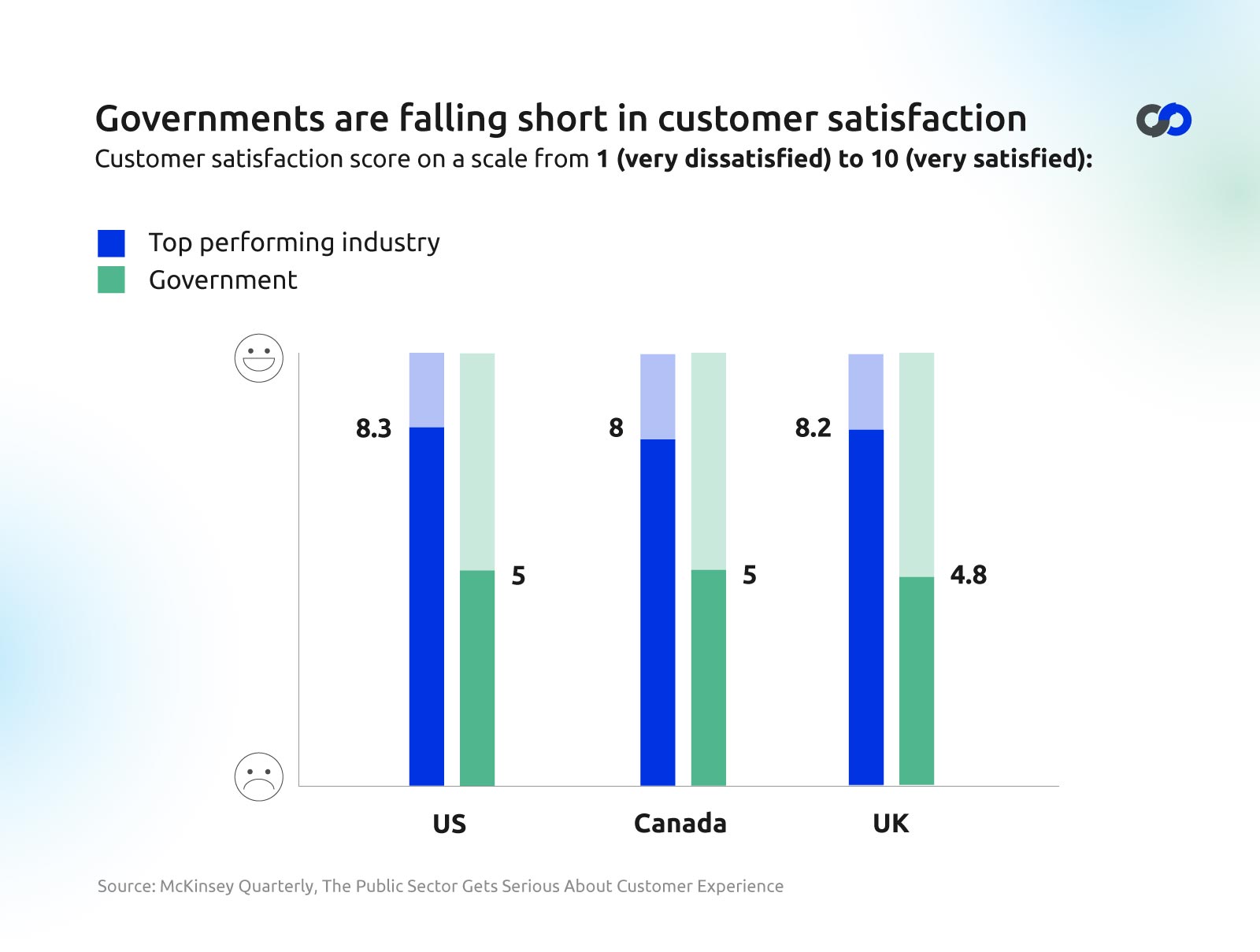
The gap between customer service in the public sector and the private sector is real and well documented. Across a range of countries, McKinsey found that public services score on average 5.5 to 6 out of 10 for customer satisfaction, while the industries that satisfy customers best score around 8 out of 10.
The reasons for this gap are complicated and numerous. With checks and balances built into government systems, as well as necessary regulations, citizens are often forced to interact with many departments and people to accomplish what seems a simple and straightforward task.
Recent data backs this up. Across 220 million live chat interactions analyzed in Comm100’s 2026 AI Live Chat Benchmark Report, government agencies recorded an average wait time of 53.6 seconds, more than double the 22.8-second cross-industry average.
All this makes providing the very best customer service in government no easy feat. Employees are often left frustrated as improving customer service in government is constantly met with roadblocks. However, even within this complex system, there are many ways that customer service in the public sector and in government can be improved to meet citizens’ high service expectations.
With effective digital channels and technologies now available, there are proven strategies to improve customer service in government securely, smoothly, incrementally, and cost-effectively.
“On the one hand, there are rising public expectations and pressure to improve. On the other hand, there is an immense opportunity to adopt new approaches and technologies to accelerate the change.” – McKinsey and Company, The global case for customer experience in government
In this guide, we provide an understanding of government customer service expectations and how citizens want to interact in today’s digital-first world. We will also discuss how government can improve customer service while meeting today’s strict security standards, exploring new approaches and tools with real-world examples and best practices.
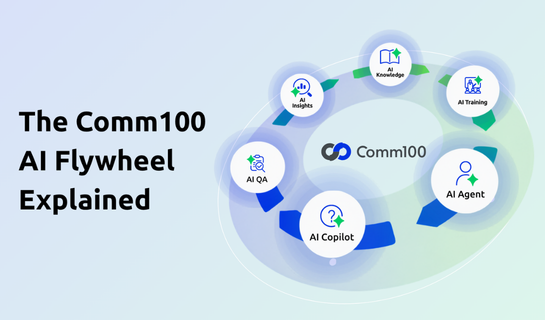
The Comm100 AI Flywheel Explained
In this 6-minute explainer, you’ll see how Comm100 AI Agent, AI Copilot, AI QA, AI Insights, AI Knowledge, and AI Training connect into one continuous cycle, where every customer conversation helps improve the next one.

CHAPTER 1Governments are taking CX seriously
Government agencies have long suffered from a notoriously poor CX image (in many cases from no fault of their own, but the result of complex and difficult systems). For many, the attempt to raise additional resources or divert existing resources to improve this has been met with resistance across the board. However, this is now beginning to change.
Around the world, government CX is being taken more seriously. With improved technology alongside new studies in behavioral science, governments are recognizing three major factors that are driving investment in CX:
- Advanced technology has made it possible for public-sector organizations to improve CX despite their built-in constraints.
- Today’s citizens have high and growing CX expectations, regardless of sector.
- CX can benefit a range of government goals, from customer satisfaction and citizen trust to efficiency and mission success.
Around the world, CX is becoming a core function of government. The United Kingdom’s Government Digital Service, the Canadian Digital Service, and Singapore’s Government Technology Agency are all examples of governments dedicating resources to digital technologies that improve both citizen and government employee experiences. Even back in 2018, the Office of Management and Budget in the US ordered all executive branch agencies to add CX into their ‘strategic decisions, culture, and design of services.’
However, while this all points in the right direction, the quality of customer service in the public sector still has a long way to go, as we will see in the next chapter.
CHAPTER 2The State of Customer Service in Government Today
Technological advancements are benefiting businesses and consumers alike, but it’s also causing challenges for the public sector.
Today’s consumers are surrounded by the very best CX. A wealth of new tools and technologies are available to companies to help them deliver fast, consistent CX and support. As these technologies become more readily accessible and available, consumers are becoming increasingly accustomed to these experiences. This is resulting in exceptionally high CX expectations, heaping pressure on the public sector to improve their often already lagging CX standards/offerings. As Granicus’ Chief Operating Officer Scott Macfee explained,
“Government agencies feel immense pressure to provide a seamless digital experience for citizens. As more people become accustomed to private sector delivery speed, integration of services, easy check outs and attentive customer service, a new normal of heightened expectations is firmly set in place.”
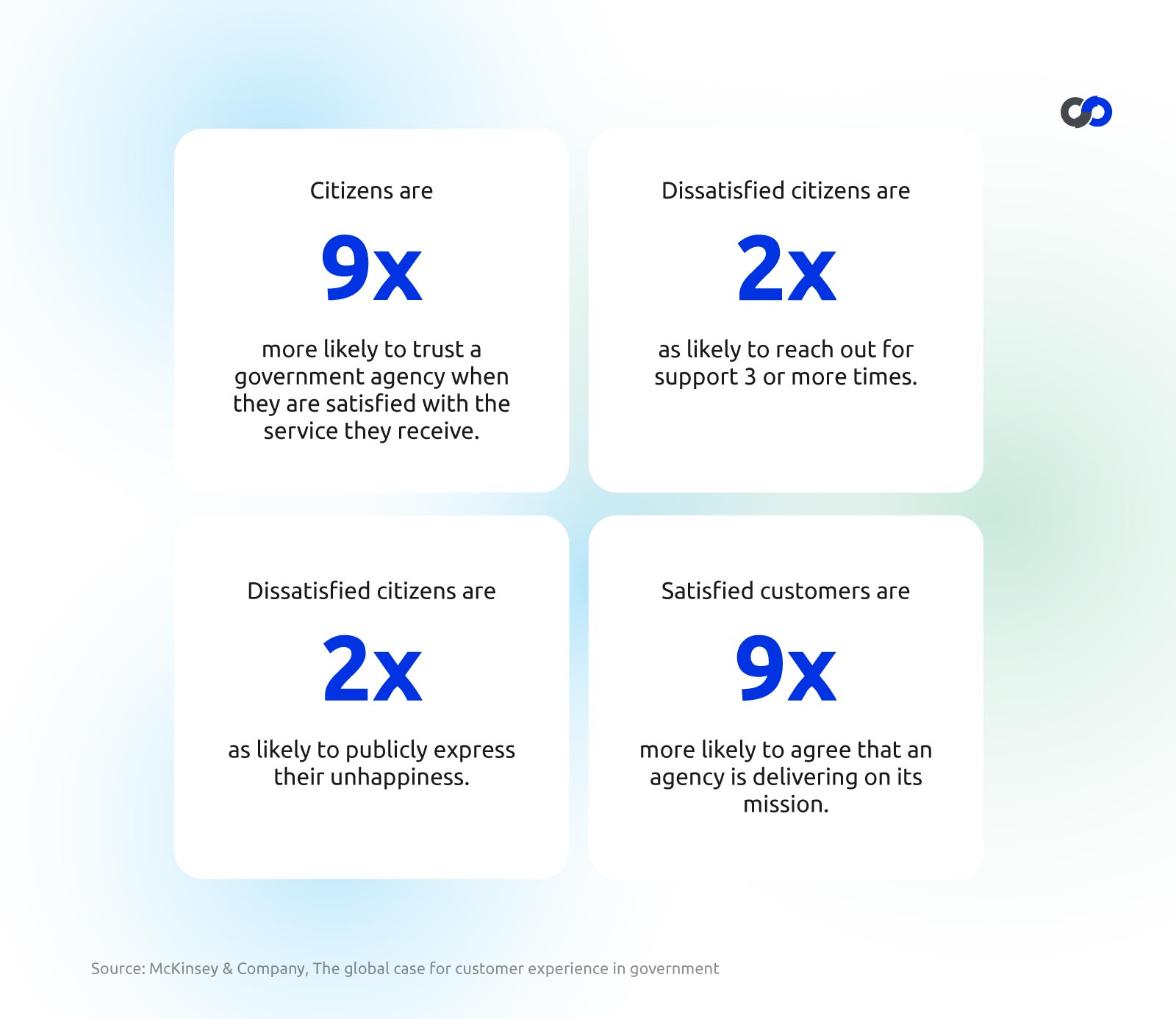
In McKinsey’s public sector benchmark research, government customer satisfaction ranked last across the industries studied. Government services averaged roughly 5.5 to 6 out of 10, while the top-performing industries reached about 8. Reliability and simplicity, not speed, were the strongest drivers of how citizens rated those experiences.
“Government agencies are in a bind. Citizens increasingly demand better digital experiences (DX), especially on mobile devices, but many existing sites are incapable of meeting those demands. With websites prone to crashing and data trapped in silos across agencies and departments, constituents are left underserved, discouraged and with waning trust in the public sector.” – Acquia, Transforming the UK Citizen Experience
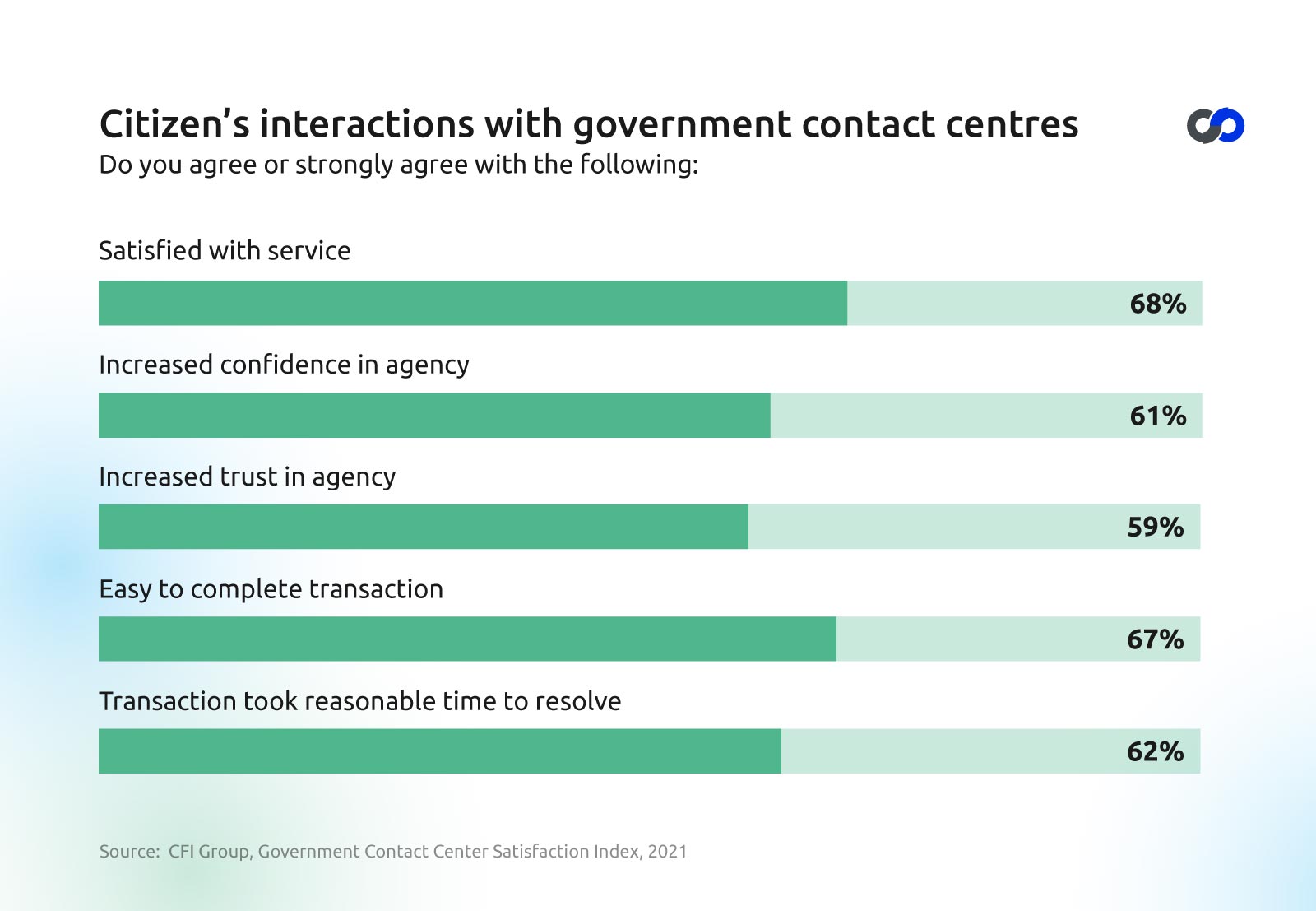
The evidence that government agencies are struggling to meet their citizens’ support expectations is clear. In a survey by CFI Group, a global leader in citizen customer satisfaction measurements, only 68% of citizens said they were satisfied with the service they recently received from government contact centers. When asked if the transaction took a ‘reasonable time to resolve’, just 62% agreed.
More recent data shows the gap persists but is narrower than headline figures suggest. Among government support teams using live chat, customer satisfaction now averages 4.3 out of 5, close to the 4.1 cross-industry benchmark and ahead of sectors like telecommunications at 3.6 and travel at 3.9. The harder problem is speed. Government wait times average 53.6 seconds and response times 56 seconds, both among the slowest of any industry tracked. When government agencies do reach citizens through digital channels, satisfaction holds up. The bottleneck is getting to that conversation quickly.
CHAPTER 34 Fundamental Citizen Customer Service Expectations
A private-sector company can determine their target audience and deliver an experience that they know they expect or need. However, for local government and government agencies it’s not so simple. Their role is to serve everyone within their jurisdiction across every demographic. Because of this, agencies are often forced to resort to a ‘one-size-fits-all’ service in an attempt to cater to their diverse citizen base.
However, while this may be true, there are several fundamental customer service expectations that all consumers want when they communicate with customer service reps. Here are the top 4 customer service expectations that every government agency should be, and can be, providing to improve customer service in the public sector:
1. Digital communication
Across every age demographic there is a move away from traditional support channels, particularly, phone, in favor of digital communication.
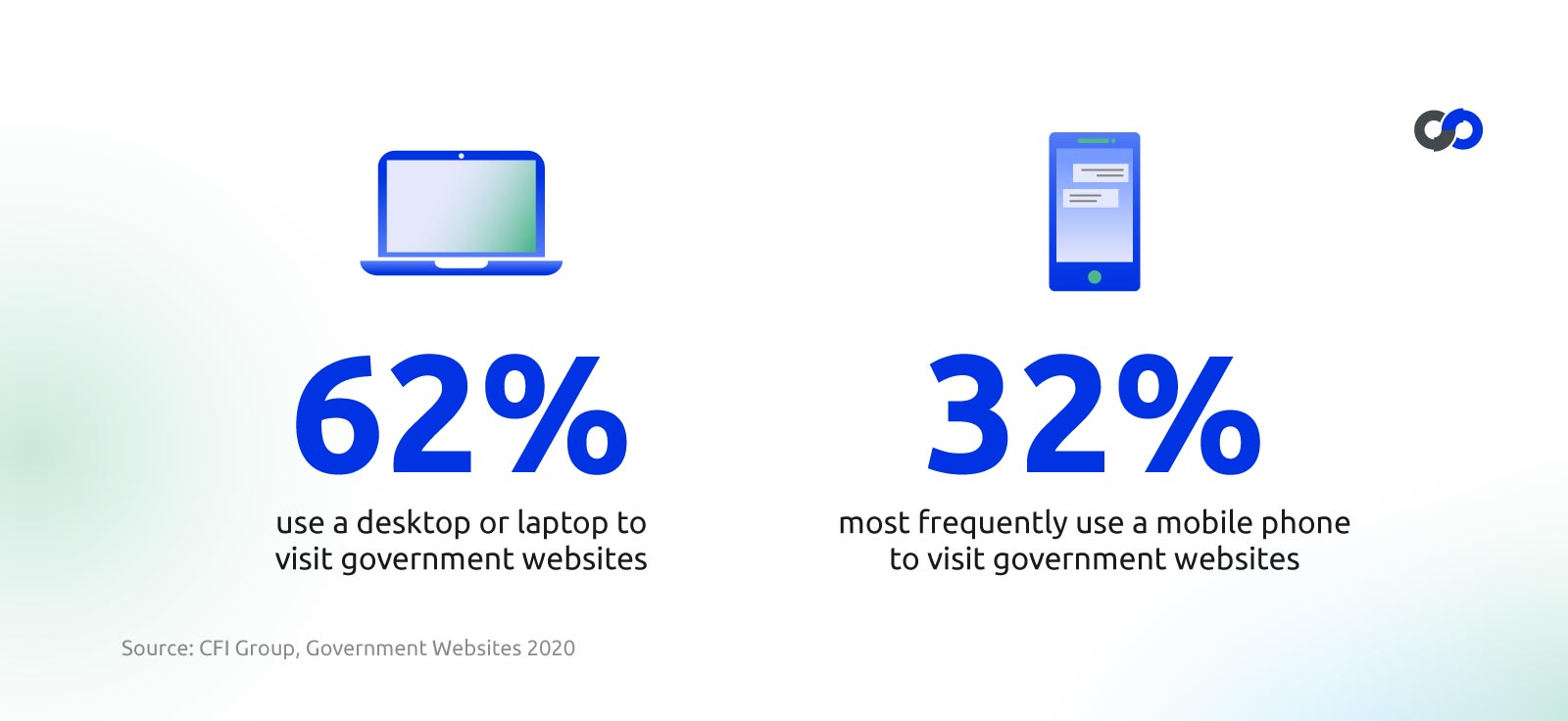
Telephone support has not become redundant by any means – many older and less digitally-able citizens still feel more comfortable with calling in rather than reaching out via live chat or social media. However, this tide is changing, and even faster now due to the Covid-19 pandemic. Across 220 million live chat interactions, 81.2% now take place on mobile devices, up from 77.9% the year before. Citizens expect to reach government from wherever they are, on whatever device they’re holding.
Live chat remains a channel citizens respond well to. The benchmark data puts overall live chat CSAT at 4.1 out of 5 across industries, and 4.3 for government specifically, a strong showing for a channel that resolves issues in real time.
As younger citizens lean heavily towards a digital-first preference and older citizens increasingly use a combination of digital and telephone interactions, it’s vital for government agencies to offer communication channels that meet a wide range of needs.
Learn how WCB Manitoba adopted Comm100 Live Chat to improve customer satisfaction and resolution in the video below:
2. Simplicity
There are many factors that citizens look for in public sector customer service, but none more so across all demographics than simplicity. In McKinsey’s report, ‘The global case for customer experience in government’, they found:
“Across the majority of countries and services, simplicity and reliability are the most critical drivers of service satisfaction. In their interactions with government agencies, customers want experiences to be easy…”
Citizens of all ages and digital literacy want simple and easy customer service above all else. This means simplicity across each stage, from accessing help via their chosen channel, to receiving clear guidance from a customer service rep. As Apple wrote in the headline of their very first marketing brochure – “Simplicity is the ultimate sophistication”.
This desire for simplicity is underpinned by a behavioral psychology known as the Simplicity Theory. This theory explains that people have a bias towards simplicity and ‘are predisposed to choose products and experiences that minimize their cognitive load… In other words, people don’t want to think too hard about your customer experience because thinking is hard work. They’d rather just avoid an experience altogether if it means less thinking is involved.’
3. Accessibility
All government websites and services must be accessible to its citizens. Under some governments, this means removing any barriers that prevent participation by persons with an impairment. These impairments could include impaired vision, deafness or impaired hearing, motor difficulties, and cognitive disabilities.
With these acts now commonplace, customer service in government and the wider public sector must meet these accessibility requirements. Live chat software can support accessibility through WCAG compliance, built-in audio and video chat, automatic translation, and customizable buttons and text.
4. Accuracy
When citizens reach out to customer service in the public sector, they do so primarily because they need information. It’s therefore essential that the information given is up-to-date and accurate so their issue can be resolved – and importantly resolved on first point of contact. First-contact resolution reduces repeat inquiries, improves citizen satisfaction, and maximizes agent productivity.
CHAPTER 45 Key Steps to Improving Customer Service in Government
There are many challenges and roadblocks that make improving customer service in government no easy task. However, we have listed the top five steps that every government agency, local government, and public sector organization can employ to improve citizen support and satisfaction.
1. Meet citizens’ digital expectations
Government response times average 56 seconds per message, slower than banking at 50 seconds, education at 46 seconds, and most other sectors. Citizens used to near-instant replies from private-sector chat feel that lag, and meeting digital expectations starts with closing it.
When it comes to digital support, there are two channels that are now essential for successful customer service in government – email and live chat.
Email has long been an integral channel for customer service in government agencies, often in the form of a webform. It’s an effective medium for citizens who don’t need immediate support or response and are happy to wait a number of days. With sophisticated help desk software, government agencies can track tickets from first call to resolution, ensuring nothing slips through the cracks.
However, for those citizens who want an answer faster than this but are put off from the prospect of long wait times and frustrating IVR that are often associated with telephone support, government live chat software is the answer.
Live chat gives citizens a convenient way to connect with government without navigating a phone menu or waiting for an email response. Typically accessed through a website chat widget, it connects users with a customer service agent in real time. Its popularity largely stems from its convenience and speed. Sitting typically in the bottom right-hand corner of a website, users can easily connect with a customer service agent and receive an immediate answer through real-time messaging.
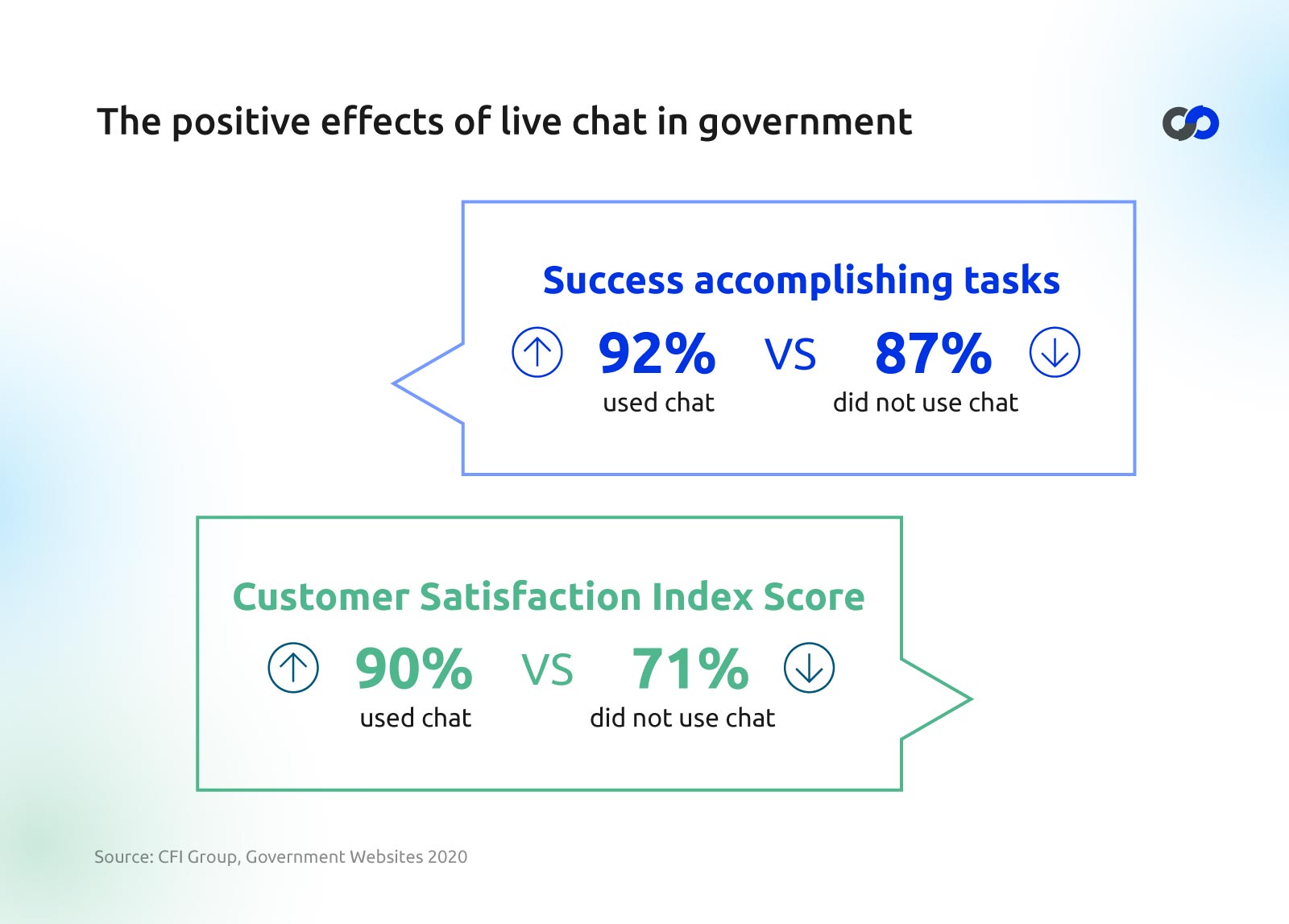
In a survey by CFI Group, they found that visitors who used live chat on government websites scored a 90% customer satisfaction index, compared to a 71% score for visitors who didn’t use live chat. If you want to improve your customer service operations, take a look at this shopping checklist to find the best live chat in government.
Santa Fe County has been using Comm100 Live Chat since 2018. . Its Assessor’s Office handles large volumes of complex information, and the county found that citizens often struggled to find answers and had to rely on already-busy phone lines for additional support. After the county launched live chat, citizens gained faster access to accurate information, while the platform’s routing capabilities helped direct each inquiry to the most appropriate agent or department. Learn the full story in the video below:
If you’re considering implementing live chat, read this government live chat shopping checklist to make sure you pick the best provider for your needs.
2. Offer 24/7 support
It perhaps should not come as a surprise to hear that 49% of citizens in 2020 visited a public sector website outside of regular business hours. For these visitors, most typically searching for information or needing support, there is no access to support past 5pm. This has long been considered an unfortunate but unavoidable circumstance – government agencies and local government simply don’t have the resources to offer 24/7 customer service. However, chatbots in government are now changing this.
There are two major chatbot technologies that governments can use to provide around-the-clock support to their citizens – task bots and AI chatbots:
1) Task bots
A task bot is an interactive bot that resolves common customer service and support questions. Sitting within the live chat window, a task bot guides visitors through a series of questions and answers to help resolve their query. They can also help them complete simple actions like scheduling a meeting or registering for an event. Better still, task bots are incredibly easy to build, requiring no coding or programming – simply choose from a selection of templates or build your own with an intuitive drag-and-drop functionality.
2) AI chatbots
In contrast to task bots, AI chatbots are powered by artificial intelligence. This means that rather than following a pre-set range of questions, AI chatbots can understand intent and complexities of language, allowing them to engage in more natural conversations. This allows them to handle more questions, all without any human interaction, so government agencies can provide 24/7 support without the unattainable cost of night-time agents.
Government agencies are already further down this road than many realize. Among government teams using live chat, AI agents now handle 94.1% of incoming chats, one of the highest rates of any sector, and resolve 67.6% of those without human help. Adoption isn’t the question anymore. The question is how well the bot hands off to a person when a citizen needs one.
That handoff is where automation has historically broken down. The encouraging shift: bot-to-agent satisfaction across all industries climbed to 92.6% last year, up from 86.7%. When the bot passes the agent full context, citizens don’t experience the handoff as a dead end.
‘Chatbot satisfaction rose 9.1% last year to 49.3%, the largest single-metric gain in the report. It’s a sign citizens increasingly accept AI chatbots as a real support channel rather than a barrier to a human.’
For more reasons why you should adopt bots, take a look at the top benefits of local government chatbots and why bots are becoming a key local government customer service strategy.
3. Provide up-to-date, accurate & accessible information
The main reason citizens visit government websites is to find information. Many do so to avoid frustrating IVR systems and long wait times on the phone. This form of self-service, often supported by a knowledge base, benefits public-sector organizations by helping more people resolve their problems without contacting customer service. However, it only works when the information provided is up to date, accurate, and easy to find.
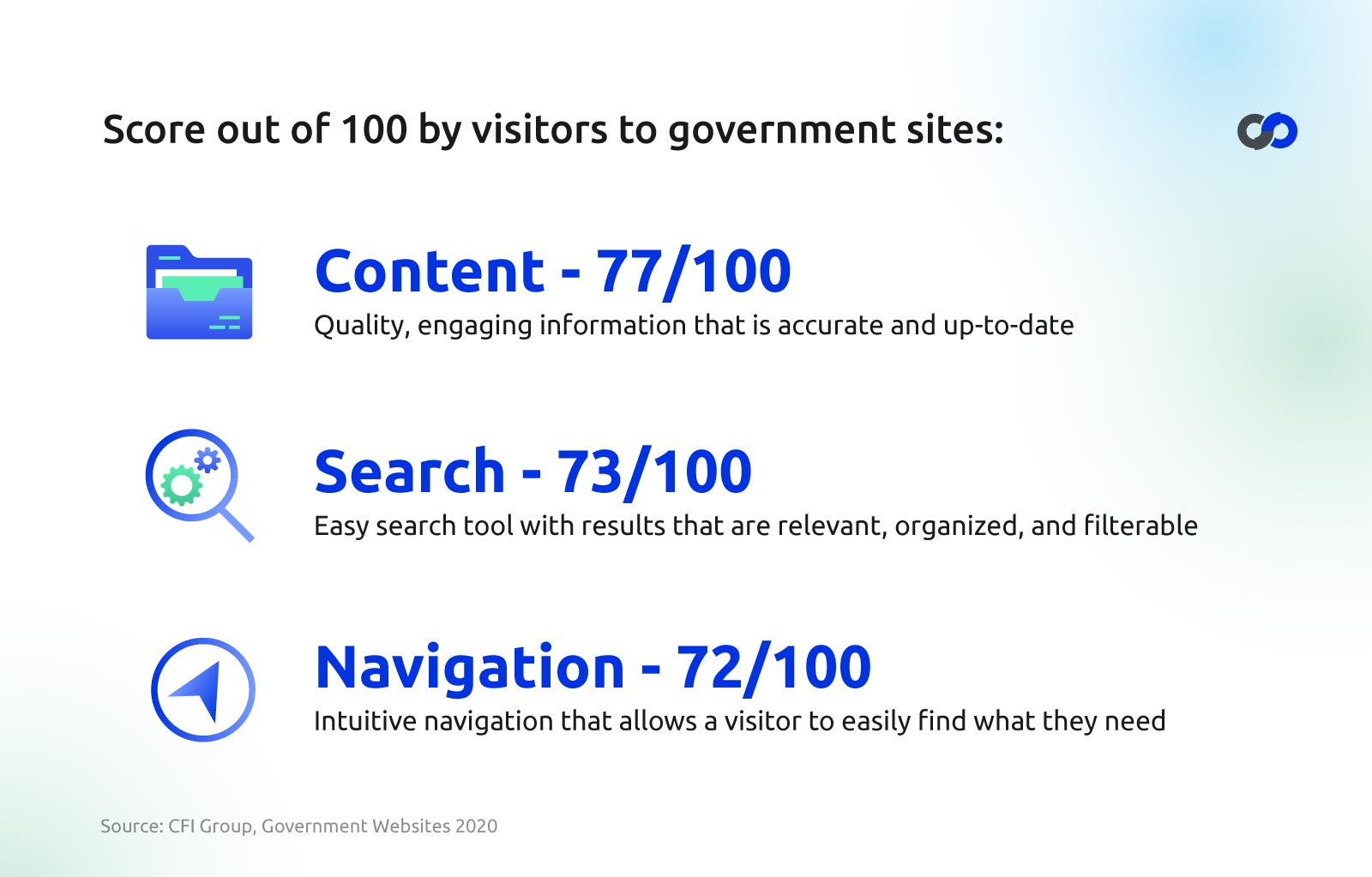
In a study by CFI Group analyzing government websites, visitors gave a score of only 72 out of 100 for the websites’ navigation – ‘intuitive navigation that allows visitors to easily find what they need’. Search was given 73 out of 100, and content only 77.
To improve these figures, a key local government customer service strategy should be to implement knowledge base software. This immediately enables organizations to provide up-to-date and easily searchable information. With a well-structured knowledge management system in place, content can be easily managed, presented and accessed – both externally for citizens, as well as internally for agents.
“Agencies need the ability to update digital content in minutes, providing information that is relevant to the present hour. Editing, removing and replacing content needs to be simple and intuitive. Agencies must be able to orchestrate messages in real time across all communication channels, including email, social, SMS/push and direct mail.” – McKinsey & Company, The global case for customer experience in government
4. Guarantee security and privacy
When it comes to security and privacy, government doesn’t have an easy ride. As Acquia explains in its report, ‘From Customer Experience to Citizen Experience’:
“The demand on IT to deliver trusted, non-intrusive and scalable service is stringent and it’s much easier said than done. Coupled with the fact that most public sector IT groups need to factor in many legacy solutions and technologies, the job may seem impossible at times.”
Pressure for tight security and privacy is also being driven from the public – 99% of customers believe companies need to improve their trustworthiness, and 83% ‘wish there were stronger consumer data privacy laws in my country’.
With this in mind, public sector customer service must ensure that any communication with citizens follows the most stringent compliance standards and certifications. Convenience and speed of government services simply cannot be prioritized over data security.
Live chat helps to alleviate these concerns. Live chat software like Comm100’s complies with all major international security standards and privacy laws that government agencies need including:
- SOC 2 Type II
- ISO 27001
- PCI DSS
- HIPAA
- PIPEDA
- GDPR
For organizations bound by laws regulating where data can be stored, on-premises deployment isn’t a nice-to-have. It’s a precondition for buying at all. Comm100’s on-premises deployment lets agencies host live chat on their own hardware and keep full custody of their data, an option most cloud-only vendors don’t offer. For agencies that can’t move citizen data off government-controlled infrastructure, it’s often the deciding factor.
5. Understand what their citizens need and want
As with any sector or organization, the more insight you can gain about your consumers, the better equipped you are to deliver the customer experience (CX) that they want. While government agencies employ a range of strategies to collect data about their citizens, data that can be collected through customer service interactions is often overlooked.
By using an omnichannel customer service platform, government agencies can connect every communication channel (and the data within) together within one platform. With all this information collated, they have access to a wealth of data about their citizens, providing them with a cohesive and accurate image of what their citizens are searching for, needing help with, and are thinking. As well as a key local government customer service strategy, this information can also be used as part of their efforts to map the customer journey.
When Santa Fe County launched Comm100 Live Chat, they soon recognized the value of the data that they could collect and analyze with the Comm100 platform:
“Getting access to all the data that comes through Comm100’s platform is gold. We present a lot of this data to our administration to show them what our constituents are asking for, what they need, and how they feel… We read through chat transcripts, which is a great training tool too.” – Santa Fe County, Tommy Garcia, Quality Control Program Manager
Learn the full story in the video below:
As we discussed in the previous section, citizen trust in governments around the world is at an all-time low. It’s therefore crucial to carefully balance this need to gather data and insight with an appreciation of citizens’ concern for privacy.
CHAPTER 5Where Government Customer Service Is Heading
The last two years changed what citizens expect from government, and the technology behind public-sector support changed with them. Five shifts are reshaping how agencies serve people: the move from simple chatbots to AI that takes action, the new tension between automation and the human touch, the rise of AI governance, the way search itself is changing, and AI’s growing role in accessibility and equity. Here’s what each means for agencies planning their next step.
From chatbots that answer to AI that acts
For years, a government chatbot meant a box that answered FAQs. That bar is rising fast. The shift defining 2026 is agentic AI: systems that don’t just answer a question but carry out the task behind it. They look up a permit status across systems, guide a resident through a benefits application, book an appointment, then confirm it. Industry analysts describe 2026 as the year agentic AI moves from proof-of-concept to operational deployment in government.
Public-sector technologists are reframing the goal around this. As one government CX architect put it, the agencies that succeed with AI won’t be the ones that deploy the most chatbots, but the ones that build “AI service hubs” that deliver complete, secure, accessible experiences from start to finish. The practical implication for agencies is direct. A bot that only deflects FAQs leaves most of the work on the desk. The value is in resolving the whole request.
An integrated platform that connects AI Agent, Live Chat, Ticketing & Messaging, Knowledge Base, Booking, and Queue Management makes it easier to move a citizen’s request from first question to final resolution without breaking the experience.
The automation-and-trust balance
Automation is climbing, but citizen sentiment is more divided than adoption numbers suggest. In a December 2025 survey of US adults, 79% said they prefer interacting with a human over an AI agent, and 89% believe companies should always offer the option to speak with a person. For government, where trust in institutions already runs low, this matters more than it does for a retailer. A citizen denied a clear path to a human doesn’t just churn. They lose confidence in the agency.
The resolution isn’t choosing between AI and people. It’s sequencing them well. The most effective public-sector deployments let AI handle the high-volume, repetitive inquiries that make up the bulk of contact-center traffic—by some estimates, 50% to 70% of calls are general-information requests, while keeping a fast, visible route to a human for everything else. The benchmark data supports this. Bot-to-agent satisfaction reached 92.6% last year when handoffs passed full context to the agent. Done right, automation and the human touch reinforce each other rather than compete.
Responsible AI moves from optional to expected
As agencies deploy AI faster, oversight is racing to keep up. The clear leadership priority for 2026 is formalizing governance: frameworks that address data security, ethical use, accessibility, and model oversight, because adoption has outpaced policy in many agencies. At the federal level, the groundwork is now in place. FedRAMP 20x launched in 2025 to streamline authorization for AI cloud providers, and shared platforms like USAi lowered the procurement barrier for smaller agencies.
For agencies evaluating vendors, this raises the bar on what “secure” means. It’s no longer enough for a platform to be encrypted. Agencies increasingly need providers who can evidence their compliance posture, including standards like SOC 2 Type II, ISO 27001, PCI DSS, and the authorization programs specific to public-sector buyers, and who can be transparent about how their AI uses data. Responsible AI is what lets innovation scale safely in the public sector rather than becoming a reputational risk.
Comm100 supports this requirement with SOC 2 Type II, ISO 27001, PCI DSS, HIPAA, PIPEDA, and GDPR compliance, together with an on-premises deployment option for agencies that need full control over where citizen data is stored.
Citizens are searching with questions, not keywords
How citizens find government information is changing as fast as how they contact it. Searches are becoming prompts. Instead of typing keywords and scanning a results page, residents increasingly ask a full question like “Where do I apply for Medicaid?” and expect a direct answer. Indiana saw this firsthand after making its “Ask Indiana” assistant the default search on its homepage. Over seven months, simple searches fell by 2.7 million while the assistant fielded 370,000 questions, and residents reached what they needed faster.
This shift has a sharp edge for agencies. An estimated 60% of web searches now end without a click, and Gartner projects organic traffic could fall 25% by the end of 2026 as people get answers straight from AI snippets. When a resident asks an AI tool how to replace a lost benefits card, the model answers from whatever content it judges authoritative. If the agency’s own pages aren’t clear, factual, and machine-readable, the model may surface wrong steps or send the person to a third-party site that omits accessibility options.
The takeaway is straightforward. Government content has to be written to be understood by both citizens and the AI systems now standing between them and the agency. That means plain language, direct answers, and a clear question-and-answer structure.
AI as an accessibility and equity tool
How citizens find government information is changing as fast as how they contact it. Searches are becoming prompts. Instead of typing keywords and scanning a For most sectors, accessibility is good practice. For government, it’s a legal duty. Public-sector sites are held to a minimum of WCAG 2.1 AA, and agencies must serve every citizen equally. AI is starting to help agencies meet and move past that baseline. It can translate notices and council agendas into the languages a community actually speaks, adapt content for different reading levels, and surface answers in plain language for residents who struggle with dense text or traditional navigation.
Channel choice is part of equity too. Virtual service hubs let citizens engage through whatever works for them, whether chat, text, web, or voice, and increasingly in their preferred language, while keeping continuity across those channels. The result isn’t only convenience. It’s consistent service regardless of where a person lives or how they communicate. One caution worth stating plainly: automated accessibility “overlays” that promise instant compliance have repeatedly failed legal scrutiny. AI surfaces issues at scale, but genuine accessibility still needs human review.
Comm100 Live Chat supports WCAG 2.1 AA requirements, helping agencies provide a more accessible digital support experience without separating accessibility from the rest of their service operation.
FAQsFrequently Asked Questions About Government Customer Service
How much of government customer service can AI handle?
Among government support teams using live chat, AI agents now handle 94.1% of incoming chats and resolve roughly two-thirds of those without any human involvement. Automation covers most routine queries, freeing agents for the complex cases.
Will AI replace government customer service staff?
Most agencies aren’t using AI to cut headcount. They’re redistributing effort. AI handles high-volume, repetitive inquiries while staff focus on complex, judgment-heavy cases. Industry surveys consistently show leaders plan to retain human agents rather than replace them, and 89% of consumers say companies should always offer the option to reach a person.
Is live chat secure enough for government data?
It can be, with the right provider. Comm100, for example, holds SOC 2 Type II, ISO 27001, PCI DSS, HIPAA, GDPR, and PIPEDA compliance, and offers on-premises deployment for agencies that can’t store citizen data in the cloud. As AI governance tightens, agencies increasingly expect vendors to evidence their compliance posture, not just claim it.
Why are government wait times so high?
Government wait times average 53.6 seconds, more than double the cross-industry average. The gap reflects staffing for peak demand and seasonal spikes rather than steady throughput, which is exactly where AI-handled intake takes the pressure off.
What is an AI service hub?
It’s the next step beyond a chatbot. An AI-driven system that handles a citizen’s request end to end across multiple channels and back-end systems, rather than just answering a single question. Service hubs aim to deliver complete, secure, accessible experiences from start to finish.
Wrap-up
Ready to modernize customer service at your agency? Book a demo with a Comm100 specialist to see how secure, AI-powered omnichannel support can help your team respond faster, improve accessibility, and give citizens a clear path to human support when needed.
Comm100 brings AI Agent, Live Chat, Ticketing & Messaging, Knowledge Base, and Queue Management together in one secure platform. Organizations including Toronto Public Health, Canadian Blood Services, the Office of the Attorney General of Texas, and Santa Fe County use Comm100 to modernize how they communicate with the people they serve.
There’s a lot more where this came from!
Get our monthly customer service news and best practices update delivered to your inbox.

Article by
Najam Ahmed
Najam is the Content Marketing Manager at Comm100, with extensive experience in digital and content marketing. He specializes in helping SaaS businesses expand their digital footprint and measure content performance across various media platforms.