
Optimizing for deflection often lowers customer satisfaction because the metric only records the fact that a contact did not reach an agent. It + Read More about why optimizing for deflection destroys customer satisfaction

How To Evaluate AI Customer Service Platforms for Enterprise Use
To evaluate AI customer service platforms for enterprise use, assess vendors across three layers and run procurement in parallel with the pilot. The three layers are: the conversational capability of the AI itself (multi-turn context, multi-intent handling, hallucination control, and edge-case behavior), the metrics that prove it works (resolution rate over handling rate, AI CSAT separated from agent CSAT, cost per resolution, and per-tenant reporting), and the operating model behind the platform (compliance certifications with audit scope, deployment flexibility including on-premise, additional solutions like live chat and ticketing, vendor risk artifacts, and multi-tenant architecture).
Enterprise evaluation differs from mid-market evaluation in five ways:
- The buying committee includes 8 to 15 stakeholders across CX, IT, security, compliance, legal, and procurement.
- Procurement and legal review add 90 to 180 days to the timeline.
- Vendor risk management is a separate workstream requiring SOC 2 Type II reports, penetration test summaries, and sub-processor lists.
- Integration discovery with systems of record (CRM, SIS, core banking, PAM) is its own evaluation phase.
- Rollout is phased across multiple regions, brands, and regulatory regimes.
A real enterprise pilot typically runs three to six months, uses real production data instead of curated test sets, includes at least one integration with a system of record, and runs procurement, legal, and InfoSec review in parallel with the technical evaluation. Pilots that succeed technically but stall in procurement are the most common enterprise AI failure mode.
Almost every customer service vendor is now pitching AI. But are these tools really optimized for enterprise use? The demos may look good, and the case studies would appear quite polished. Then six months after deployment, half of the deployments are quietly underperforming.
Here’s the thing: buyers are noticing. If you go to any tech conference right now, almost every booth has a vendor pitching AI. Multiple vendors may even claim to own each use case. The question they came back with was simple: how do you actually evaluate any of this when everything looks good on stage and only reveals itself in production?
Enterprise customers tend to evaluate solutions in greater detail than other types of buyers. The cost of integrating a new solution is substantially higher, making it vitally important for organizations to thoroughly assess a solution before they go ahead with it.
For enterprises looking to onboard a new support vendor, this article provides a practical, three-layer structure on how to evaluate the best AI customer service solutions. From the core capabilities of the AI to the key metrics to look for and the underlying operating model, we take a deep dive on what you should consider.
Why most AI evaluations fail
Before getting to the framework, it helps to name the failure modes most enterprise AI evaluations fall into. There are four, and they tend to compound.
Demos are optimized for best-case scenarios
A vendor controls the data, the prompts, and the conversational flow during a demo. Production controls none of those. A demo will not tell you how the AI behaves when a player asks two questions in one message, when a student types in shorthand at midnight, when the knowledge base has stale articles, or when the customer is hostile from the first turn.
Feature checklists reward parity, not performance
Two vendors can both check the “multilingual support” box and produce wildly different results in production. One handles language switches mid-conversation. The other resets context every time the player flips between English and Spanish. The checkbox is identical. The outcome is not.
Buyers benchmark against the wrong baseline
Comparing AI handle time to a human agent’s handle time misses the point. AI processes thousands of conversations in parallel, so speed is not the differentiator. The meaningful comparison is resolution outcome, agent workload reduction, and customer satisfaction.
The wrong people own the evaluation
When IT runs the evaluation alone, you get a clean security pass and a usability gap. When CX runs it alone, you get conversational quality and a compliance gap. Regulated industries cannot afford either. Both teams must be in the room from the first vendor conversation onward.
These failure modes are why the rest of this guide exists. The three layers below are designed to surface what demos hide.
Step 1: Evaluate the capability of the AI itself
The first layer is the conversational capability test. It is the layer most buyers spend the least time on, because vendors steer demos away from the kinds of questions that expose gaps. The way to push back is to bring your own scenarios into the room.
Eight questions tend to surface the difference between a real AI agent and a chatbot wearing AI branding:
- Can the AI hold context across a multi-turn conversation, or does each turn reset? Ask the same question across three or four turns, with follow-ups that depend on what was said earlier. Watch whether the AI remembers.
- Can it handle multiple intents in a single message? A player asking “Can I withdraw to a different card than I deposited with, and how long does it take?” is asking two questions. A real AI agent answers both. A chatbot picks one.
- Does it answer the question, or does it return a link to a help article? Returning a URL is not resolution. It is deflection dressed up as service.
- Does it produce consistent answers when the same question is phrased five different ways? Inconsistency at this level signals brittle keyword matching rather than semantic understanding.
- Can it gracefully say “I don’t know” and route to a human, or does it hallucinate? Confident wrong answers are worse than no answer. Ask the vendor how they prevent fabrication.
- Can it perform actions, or only answer questions? Ticket creation, account lookups, and policy adjustments are where AI starts moving real work off your team’s plate.
- How does it behave at the edges? Out of scope, hostile users, low-quality inputs, language switches mid-conversation. The edges are where production lives.
For iGaming use cases, the relevant scenarios are transactional and high-velocity. iGaming operators average 25,647 monthly chats per organization according to our 2026 Benchmark Report, with the shortest chat duration of any industry at 6 minutes 1 second. The AI has to be fast and accurate from the first turn, or it falls behind player expectations.
Test it with a VIP-routing scenario, where the player identifies themselves and expects to reach a dedicated team. Test it with a problem-gaming intent, where a player says something like “I think I’m spending too much” and you want to confirm the AI routes appropriately rather than offering a deposit limit increase.
For higher education, the scenarios are deeper and longer. Education chat durations average 13 minutes 1 second, among the longest of any vertical, because student questions span financial aid, registrar, advising, and IT support.
Test the AI with a financial aid question that requires pulling a student’s specific record. Test it with a multi-step admissions follow-up where the second question depends on context from the first. The AI has to sustain context far longer than retail or transactional environments demand.
Whatever your industry, it’s always a wise idea to run a few test scenarios with the AI so that you’re confident that it’s able to handle any scenario.
Step 2: Evaluate the metrics, not the activity
The second layer is where most buyers go wrong without knowing it. The metrics that vendors lead with in sales decks (deflection rate, handle time, first response time) are activity metrics. They tell you something happened. They do not tell you whether the customer’s problem got solved.
The metrics that matter for autonomous AI cluster differently. Resolution rate, not handling rate. This is the single biggest gap between vendor pitches and production reality. In the Benchmark Report, among organizations using Comm100 AI Agent, 75.3% of chats were handled by the bot, but only 44.8% were fully resolved without any human involvement. The 30.5-point gap between “handled” and “resolved” is where most buyers’ ROI assumptions break down. Handling means the bot touched the conversation. Resolving means no agent time was consumed. When a vendor quotes a high handling number, ask them what their resolution number is and how it is measured.
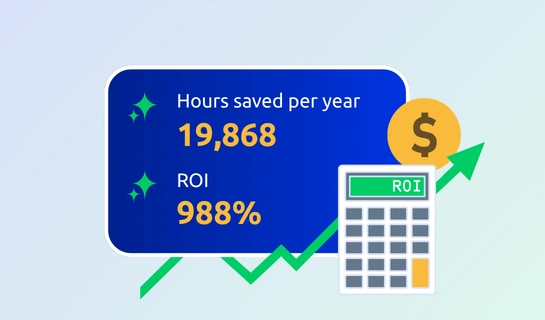
Evaluate AI ROI for Your Platform
Resolution rates matter more than handling rates. Calculate cost per resolution for your environment using our AI Agent ROI Calculator and see how it impacts your support efficiency and operational costs.
Calculator ROIROI Calculator
Resolution by industry, not against a vendor’s headline number. According to our data, Education resolves at 75.9%, banking and finance at 75.2%, iGaming at 38.1%. A lower resolution rate does not mean worse AI. It means more complex query types and more legitimate escalation. iGaming queries, as an example, trend toward urgent, money-related interactions that genuinely need a human in many cases. Education queries are deep but answerable from a knowledge base once the AI grounds them properly. Benchmark against your own industry, not against the highest number on a vendor slide.
First Contact Resolution. For autonomous AI, FCR matters more than handle time. A fast conversation that ends with the customer messaging back the next day is worse than a slower conversation that closes the issue cleanly.
AI CSAT measured separately from agent CSAT. Blending AI and human CSAT into one number obscures what is working and what is not. The Benchmark Report shows chatbot-to-agent handoff CSAT at 92.6%, an all-time high in the dataset. That figure is meaningful precisely because it is measured cleanly: it isolates the moment where the AI hands off and tells you whether the human got enough context to recover the conversation. Insist on AI CSAT, agent CSAT, and handoff CSAT as three separate metrics.
Customer Effort Score. AI can resolve a question and still create friction along the way. Effort score catches what CSAT misses. A customer who got the right answer but had to repeat themselves three times will rate the resolution positively and never come back.
Cost per resolution, not cost per contact. Cost per contact can hide repeat callbacks. Cost per resolution forces the math to account for work that did not stick. iGaming agents handle 1,540 chats per month against the cross-industry average of 1,201, so the per-resolution math looks different vertical by vertical. Run the calculation on your own volume.
Containment vs. resolution. A high containment rate plus a low CSAT score means players or students are getting trapped in automation loops. The 44.8% resolution figure is the right anchor for this discussion, because it tells you what percentage of conversations the AI closed cleanly versus what percentage it merely held onto.
A specific warning on deflection rate. A deflection that ends with a frustrated customer calling back the next day is not a deflection. It is a deferred contact, often a more expensive one because the customer is now annoyed. Treat deflection as a vanity metric unless it is paired with resolution and CSAT data.
For iGaming operators, the broader operational metrics around AI performance fit inside the iGaming operator metrics that matter for player support, which is worth working through alongside the AI-specific evaluation. For higher education, the priority shifts during peak windows. During admissions deadlines and registration weeks, resolution time and First Contact Resolution affect yield directly, because a prospective student who cannot get a question answered in 24 hours starts looking at the school’s competitors.
Step 3: Evaluate the operating model behind the AI
The third layer is the one most evaluation guides skip, and it is the layer that separates platforms that scale from platforms that quietly fail in year two. The operating model is everything around the AI that determines whether you can run it safely, govern it, change it, and trust it with sensitive data.
What is the compliance and security posture?
SOC 2 Type II, HIPAA, PCI DSS, and ISO 27001 are table stakes for regulated industries. For iGaming, ask specifically about data residency, KYC and AML handling, and how the platform recognizes and routes problem-gaming intents. For higher education, ask about FERPA-aligned handling of student records, SSO and 2FA support for SIS and LMS integrations, and whether the platform can be deployed in your data jurisdiction.
How flexible is deployment?
Cloud-only, private cloud, and on-premise are not the same product, and the difference matters more in regulated industries. Ask the question directly: can the platform be deployed in a way that meets our data sovereignty and regulatory requirements? Some vendors will say yes only if you allow their cloud. Others offer a true on-premise option.
How does the AI ground its answers, and how is hallucination controlled?
A weak answer is “we use enterprise-grade LLMs.” A real answer describes where the AI sources its responses, whether it cites sources back to supervisors, whether the buyer can audit what knowledge the AI pulled for a given conversation, and what happens when the knowledge base is silent. What does human-in-the-loop architecture actually look like?
When the AI hands off, does the agent see the full conversation history? Can the agent see the AI’s reasoning and the knowledge it pulled? Can supervisors intervene mid-conversation? Handoff quality is the difference between AI that helps the team and AI that creates double-work.
What does governance, versioning, and rollback look like?
Production AI is not a static system. The buyer should be able to test changes in a sandbox, push to a subset of traffic, monitor the impact, and roll back a misbehaving update. Ask the vendor to walk through their change-management workflow. If they do not have one, that is the answer.
Does the vendor specialize in your vertical?
A generalist vendor optimizing for retail or e-commerce will struggle in regulated environments. A vendor that has shipped product specifically for iGaming compliance, higher education student support, or financial services will move faster on the specific problems your team faces, because those problems are already in their roadmap.
This is the layer where the buyers who succeed pull ahead. The capability layer is visible in demos. The metrics layer becomes visible in the first three months of pilot. The operating model layer is invisible until something goes wrong, and by then the contract is signed.
What a real pilot looks like
Real pilots take months, not weeks. Anything shorter is a sales-engineering exercise.
The shape of a credible pilot has six elements.
- Tie the pilot to a real business metric, not an accuracy claim. Resolution rate, agent hours saved, CSAT, or peak-period response time are real metrics. “Bot accuracy” measured on a curated test set is not.
- Scope narrowly. Two or three high-volume use cases beat ten ambitious ones. Pick the use cases where production volume will stress-test the system.
- Use real production data, not curated test sets. The vendor’s accuracy on their demo data tells you nothing about their accuracy on yours. Insist on running the AI against a recent slice of your own conversations, anonymized as needed.
- Inspect the failure modes specifically. Ask the vendor what the AI does when it is wrong, when it is unsure, and when the customer is hostile. Vague answers here predict vague performance later.
- Run two or three pilots in parallel where you can. Differences between vendors become obvious in comparison, not in isolation.
For iGaming operators, the highest-signal pilot would be a major betting event, where the cost of getting it wrong is directly measurable in player lifetime value. A misrouted VIP is not a customer service failure. It is a retention failure with a dollar figure attached.
For higher education, the highest-signal pilot is a peak admissions or registration window. The volume stress-tests the system the way production will, and the stakes (yield, registration completion, student satisfaction during a critical week) are visible to the executive team in a way that an off-peak pilot will never be.
A buyer’s checklist for AI customer service evaluation
Use the questions below as the working list for vendor conversations. They are organized by the three layers plus pilot, and they are designed to be copy-paste-ready for an internal evaluation document.
Capability of the AI itself
- Can the AI hold context across multi-turn conversations?
- Can it handle multiple intents in one message?
- Does it answer questions or return links?
- Is it consistent across paraphrased versions of the same question?
- Can it gracefully say “I don’t know” and route to a human?
- Can it perform actions, not just answer?
- How does it behave on out-of-scope and hostile inputs?
Metrics that matter
- What is your resolution rate, and how is it measured?
- How do resolution rates break down by industry?
- Do you measure AI CSAT, agent CSAT, and handoff CSAT separately?
- What is your First Contact Resolution rate?
- What is your cost per resolution, not cost per contact?
Operating model behind the AI
- Which compliance certifications do you hold?
- What deployment options do you support (cloud, private cloud, on-premise)?
- How does the AI ground its answers, and how is hallucination controlled?
- What does the agent see at handoff?
- What does versioning and rollback look like?
- What vertical specialization do you offer?
Pilot design
- Will the pilot run against real production data?
- Is it tied to a business metric, not an accuracy claim?
- Are failure modes documented and reviewable?
- What is the post-launch operating cost?
The vendors that survive this evaluation are the ones you want in production for the next three to five years. The vendors that cannot answer the operating-model questions cleanly are the vendors whose deployments quietly underperform a year in.
At Comm100, we built the platform with this evaluation in mind:
- Regulated-industry specialization across iGaming, higher education, banking, healthcare, and government.
- A full compliance stack covering SOC 2 Type II, HIPAA, PCI DSS, and ISO 27001.
- On-premise deployment for buyers whose data sovereignty requirements rule out cloud-only vendors.
- An integrated AI suite anchored by AI Agent for customer-facing automation, AI Copilot for agent assistance, and AI Insights for analytics.
The AI Agent Buyer’s Guide goes through these criteria in more depth.

Download the AI Agent Buyer’s Guide
Learn how to evaluate enterprise AI platforms across performance, compliance, deployment flexibility, and long-term scalability.
Download noweBook