

Your vendor demo ended twenty minutes ago with a promise that you could be live by Friday. Your integration architect hasn’t said a + Read More about how long does it take to deploy an ai chatbot? an enterprise customer service timeline

How Telecom Companies Can Reduce Customer Churn With Technology: 7 Proven Strategies
A subscriber rarely decides to leave during the cancellation call. The decision gets made earlier: on the second call about the same billing line, in the chat that restarts from scratch because the first agent’s notes went nowhere, during the outage where nobody said anything for six hours.
By the time the port-out request lands, you’re negotiating with someone whose mind is already made up.
That’s why pricing alone rarely fixes telecom customer churn. A retention offer made to a subscriber who has felt ignored for three weeks might keep them for one more billing cycle, but it won’t earn their loyalty. The seven strategies below focus on service instead. Each one helps subscribers get a real answer faster, even at the volumes telecom support handles every day.
The Four Service Failures Behind Most Telecom Customer Churn
The Federal Communications Commission defines customer churn as the share of customers who stop paying for a service over a given period, and its 2024 Communications Marketplace Report names service quality as one of the factors that moves the number: subscribers receiving higher quality service are less likely to switch providers. Four service failures account for most avoidable telecom customer churn, and technology can close each of them without adding headcount.
Billing Confusion
A prorated charge after a mid-cycle plan change generates a call. If the first agent can’t see the billing system, it generates a second one. Repeat contacts about the same billing question are one of the clearest early warning signs a carrier has, yet most carriers don’t track them.
Slow First Response
A device activation problem at 9 pm doesn’t wait for business hours. A subscriber left in a queue overnight has hours to compare offers, and signing up with a competitor takes only a few minutes.
Fragmented Channels
Support tools that don’t share history force the subscriber to explain the problem again on every channel. Multi-channel support without a unified record leads to exactly the kind of repetition that pushes subscribers to leave.
Support That Only Reacts
Most customer retention strategies only kick in once someone asks to cancel. At that point, keeping the subscriber usually costs a discount, and many who accept one still leave at the next renewal. It’s worth checking how many of your saved subscribers are still with you a year later.
Strategy 1: Resolve Billing Questions on First Contact
Billing drives more telecom support volume than any other topic, and it escalates faster too. Subscribers are often frustrated about money before the conversation even starts, so every transfer, hold, and callback makes things worse.
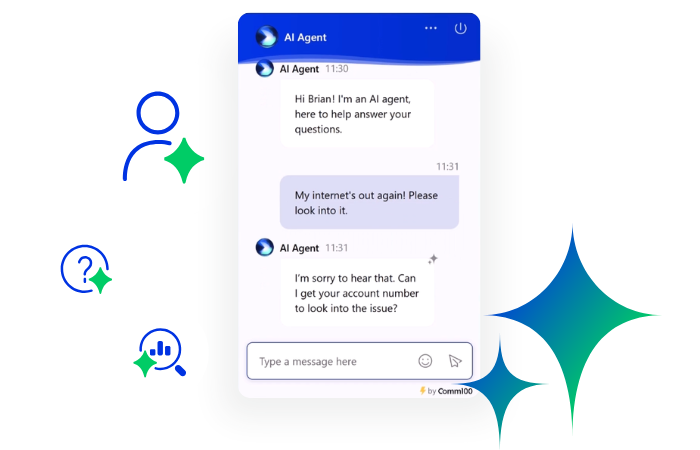
To resolve a billing question on first contact, account details need to be available the moment the subscriber asks. Comm100’s AI Agent connects to billing and account systems to answer prorated charges, plan changes, payment status, and contract end dates directly, without a queue. When a case needs a human agent, the AI Agent hands it over with the full conversation and account history attached, so the agent doesn’t have to start from scratch.
Comm100 AI Agent resolves up to 80% of inquiries automatically. Because so much telecom customer churn starts with billing, it’s also the most cost-effective place to prevent it. That makes billing support a better starting point for churn reduction strategies than a new loyalty program.
Strategy 2: Cover Every Hour With an AI Agent
Telecom demand doesn’t follow a schedule. Outages, device launches, roaming failures, and month-end billing cycles all land outside business hours, and they land in volume.
For carriers looking to reduce customer churn with technology, round-the-clock coverage is a practical place to start. That coverage has to include resolution, though. An automated reply at 2 am that only acknowledges the ticket still leaves the subscriber waiting. The FCC report documents what happens when a carrier closes that gap with technology: after Frontier introduced AI-powered digital self-service tools in 2023, its fiber broadband churn fell from 1.38% to 1.32%. A drop of 0.06 percentage points may look small, but across a subscriber base in the millions, it represents a meaningful number of customers kept every month.
Comm100 has seen similar results with its own telecom customers. Tangerine, an Australian provider selling national broadband coverage and mobile SIM-only plans, went from 500 chat requests in March 2019 to 2,227 two months later. Instead of hiring to keep up, Tangerine deployed Comm100 AI Agent, which resolves 91% of the chats assigned to it. Tangerine says that without the AI Agent, wait times and acceptance rates would have suffered, and it would have risked losing customers to competitors.
Comm100 designs automation to support human agents. The AI Agent handles routine volume so your team can focus on the subscribers most likely to leave: the escalated billing dispute, the enterprise account with a service-level complaint, the long-tenured subscriber who has finally had enough.
Strategy 3: Give Agents Live Context With AI Copilot
A standard billing inquiry can leave an agent switching between the billing system, the CRM, a knowledge article, and the chat console, all while the subscriber waits.
Comm100’s AI Copilot puts suggested responses, account context, and workflow guidance in front of the agent while the conversation is live, then summarizes the interaction at wrap-up. Agents spend less time searching for information, which lowers handle time and keeps answers consistent from one agent to the next.
That consistency matters most in the conversations that decide whether a subscriber stays. It also helps with agent turnover, which runs high in telecom support and means a large share of your team is often new. With real-time guidance, new agents get up to speed faster and give the same answers as colleagues with years of experience.
Strategy 4: Unify Channels Into a Single Subscriber View
A subscriber who starts on chat, follows up by email, and calls the next day shouldn’t have to explain the problem three times. Offering several channels doesn’t help much if they aren’t connected. Without a shared record, every new channel is one more place for context to get lost.
In a true omnichannel setup, every channel feeds into one conversation history that both human agents and AI can access. Comm100’s Live Chat sits alongside email, SMS, social, messaging apps, and voice in a single agent console, with the subscriber’s history continuous across all of them.
A unified view also makes it easier to spot telecom customer churn before it happens. A subscriber who contacts you four times in ten days about the same problem is an obvious retention risk, but you’ll only notice if all four contacts are recorded in the same place. That’s why Comm100 is built as a complete customer service platform for telecom providers, with every channel connected from the start.
Strategy 5: Surface At-Risk Subscribers From Conversation Data
Support conversations often give you the earliest warning that a subscriber might leave, but most of them are never reviewed. The warning signs are usually easy to spot: repeat contacts on one account, sentiment falling across a series of interactions, topics that never reach resolution.
Comm100’s AI Insights analyzes resolutions, sentiment, and agent performance across every conversation rather than a sample. This gives your team insights they can act on, so support data feeds directly into telecom customer retention efforts.
The next step is routing. When a subscriber shows these warning signs, they should go straight into a retention workflow while there’s still time to keep them. Churn reduction strategies work best when they reach the subscriber before a cancellation request, and conversation data is often the first place those signs appear.
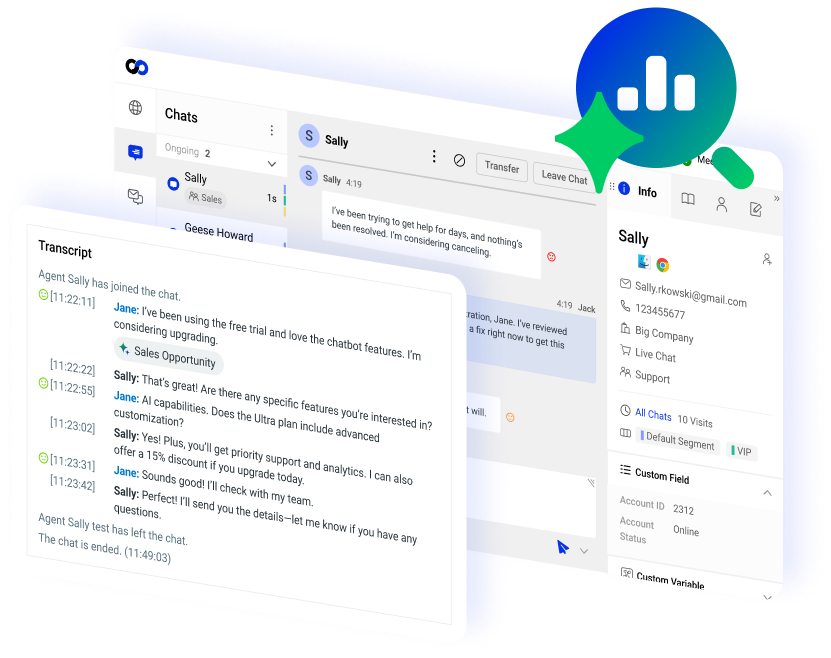
Spot Churn Risks With AI Insights
See how AI Insights flags frustrated customers and unresolved conversations, so your team can act sooner.
Explore AI InsightsAI Insights
Strategy 6: Close the Self-Service Gap With a Living Knowledge Base
Most subscribers try to solve the problem themselves before they contact you. When the help article they need is missing or outdated, that attempt turns into a support contact, and sometimes a second one if the agent’s answer contradicts the article.
Keeping help content current is especially hard in telecom. Plans, devices, promotions, and coverage change constantly, so static articles can fall out of date within weeks of a launch. Comm100 AI Knowledge uses real conversations to find content gaps, update existing articles, and draft new ones based on what subscribers are actually asking.
To keep answers consistent, the same knowledge source should power the help center, the agent console, and the AI Agent. When all three read from one place, a subscriber gets the same answer whether they searched for it, chatted for it, or called about it. That kind of consistency helps reduce customer churn in ways that are easy to overlook.
Strategy 7: Score Every Conversation Instead of a Sample
Manual quality review typically covers only a small, random sample of conversations. As a result, most of the interactions that cost you subscribers are never reviewed.
Comm100’s AI Quality Assurance auto-scores every conversation and turns the findings into one-click coaching moments for supervisors. This makes quality assurance an ongoing feedback loop focused on the interactions that matter most to telecom customer retention.
This is especially useful for teams with high turnover, where coaching needs to be quick and specific. With every conversation scored, supervisors can coach using real examples from each agent’s week instead of general feedback in a monthly one-on-one.
Telecom Churn Questions, Answered
What Is a Typical Telecom Customer Churn Rate?
Churn rates vary widely by segment and are usually measured monthly. The FCC’s 2024 report cites Frontier at 1.47% monthly churn in the first quarter of 2024, up from 1.43% a year earlier, and a survey of 84 rural broadband providers showing 0.68% churn on higher-speed tiers against 1.14% on lower ones. Before benchmarking against an industry average, compare your current rate with your own history and segments.
How Do You Calculate Customer Churn?
Divide the number of subscribers who cancelled during a period by the number of subscribers you had at the start of that period, then multiply by 100. Telecom operators normally calculate this monthly. A 2% monthly churn rate adds up to losing more than a fifth of your subscriber base over a year, so even small monthly changes have a big annual impact.
How Can Telecom Companies Identify At-Risk Subscribers Before They Leave?
The strongest predictors sit in support data: repeat contacts about one unresolved issue, declining sentiment across consecutive interactions, and questions about contract end dates or early termination fees. Conversation analytics surface these patterns automatically and can route the account into a retention workflow before the subscriber initiates a cancellation, giving your customer retention strategies the best chance of success.
Does Customer Service Quality Actually Affect Churn?
Yes. The FCC’s 2024 Communications Marketplace Report identifies service quality as a factor affecting churn rates, noting that subscribers receiving higher quality service are more likely to be satisfied and less likely to switch providers. The same report highlights a carrier that reduced churn after introducing AI-powered self-service tools.
Which Technology Reduces Telecom Customer Churn Fastest?
Among churn reduction strategies, automated resolution of billing and account inquiries usually produces the quickest measurable change, because billing generates the highest contact volume and the highest repeat-contact rate. That automation depends on unified conversation history, since the AI can’t fully resolve an issue without account context.
Turning Support Into Your Retention Engine
All seven strategies depend on one thing: subscriber context that follows the conversation across every channel. Automation can’t resolve issues without that context, and analytics can’t show the full picture without a unified record. Technology reduces telecom customer churn when every tool works from the same data. A simple way to test any plan to reduce customer churn is to ask whether the next agent, human or AI, already knows what the subscriber told the last one.
Use the table below to evaluate how well a platform supports your customer retention strategies:
| Capability | Why It Matters for Churn | Question to Ask a Vendor |
|---|---|---|
| Unified conversation history | Having to repeat themselves is one of the biggest frustrations for subscribers | Does history follow the subscriber across chat, email, voice, and social in one console? |
| Billing and CRM integration | Billing questions can’t be resolved on first contact without account data on screen | Which billing and CRM systems have pre-built connectors, and what requires custom work? |
| Autonomous resolution | An after-hours ticket sitting in a queue doesn’t help the subscriber | What share of inquiries does the AI resolve end to end without a human? |
| Conversation-level analytics | At-risk subscribers are visible in support data before they call to cancel | Can sentiment and repeat-contact signals trigger a retention workflow automatically? |
| Deployment and data residency | Procurement and regulatory requirements vary by market | Are cloud and on-premises both available, and where are the data centers? |
Comm100 has been building customer service technology since 2009 and now handles 223 million conversations a year at a 95% CSAT rate. The platform unifies Live Chat, AI Agent, AI Copilot, Ticketing & Messaging, Voice, and Knowledge Base in one agent console, with cloud and on-premises deployment and data centers in the US, Canada, Germany, and Singapore. Comm100’s certifications and compliance standards include SOC 2 Type II, ISO 27001, PCI DSS, GDPR, and HIPAA.
In the end, telecom customer retention comes down to answering a subscriber’s question the first time they ask. Get that right, and you’ll rely far less on discounts to keep them.

See Comm100 in Action for Telecom
See how organizations like yours are using Comm100 to deliver faster, smarter support.
Request your personalized demoRequest Demo