
Government Customer Service Software for Canada
Citizen Service Your Government Agency Can Be Proud Of
Comm100 unifies every citizen conversation in one console, with Canadian data residency, WCAG accessibility, and AI that resolves the routine questions before anyone waits on hold.
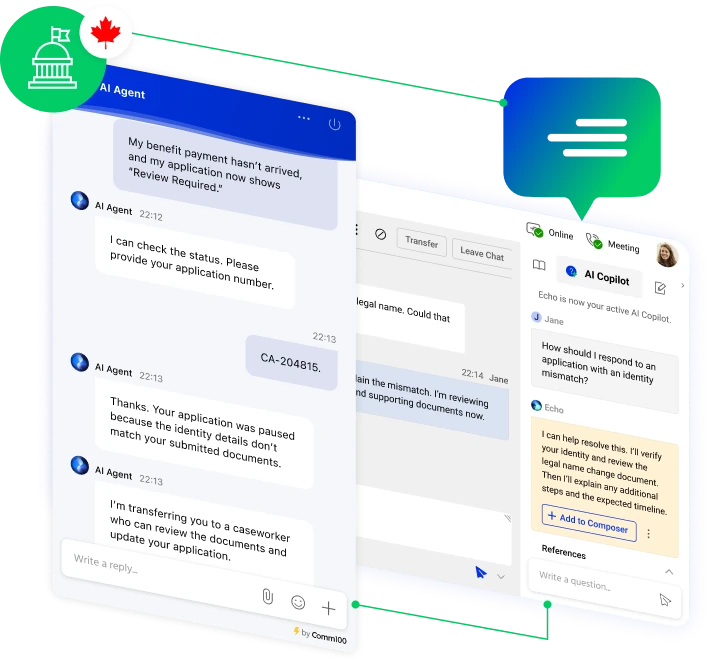









Every Channel, One Citizen View
One Console for Every Citizen Conversation
Government customer service software is an omnichannel platform that unifies live chat, AI Agent, voice, ticketing, and a knowledge base in a single agent console. Comm100 gives public servants one continuous view of every citizen interaction, across departments and across channels. A citizen who chats on Monday and calls on Thursday does not start over, and neither does the person helping them.
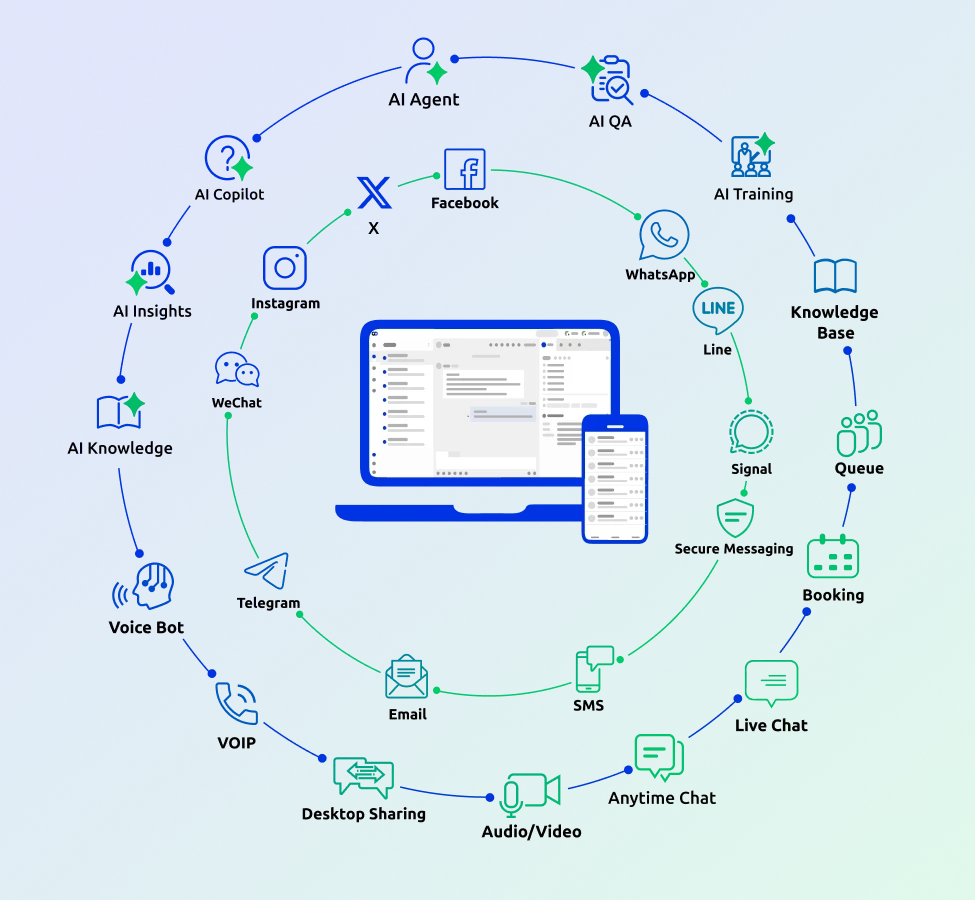
The channels a Canadian agency actually needs
Comm100 brings live chat, AI Agent, voice, ticketing and messaging, knowledge base, and queue management into one platform. Citizens reach you the way they prefer. Your team works in one place.
A true omnichannel experience
Omnichannel customer service software links every channel to one citizen record. Multichannel tools offer the same channels separately and leave the data in silos, which is why a citizen ends up repeating their file number three times. Comm100 applies the same routing rules, history, and context no matter where the conversation starts.
Departmental silos close when the record is shared
Licensing, benefits, and permits often run on separate tools. Comm100 gives every department the same interaction history, so a citizen bounced between two teams is not starting from zero at each handoff. Citizen engagement software is only useful when the context travels with the person.
Proven on a federal level
Global Affairs Canada uses Comm100 across its stakeholder base, and its AI Agent now handles 78% of incoming chats. As their IT team put it, every individual can choose the channel they prefer and still get an accurate answer quickly. Read the Global Affairs Canada story
Security and Compliance Built for Canadian Public Service
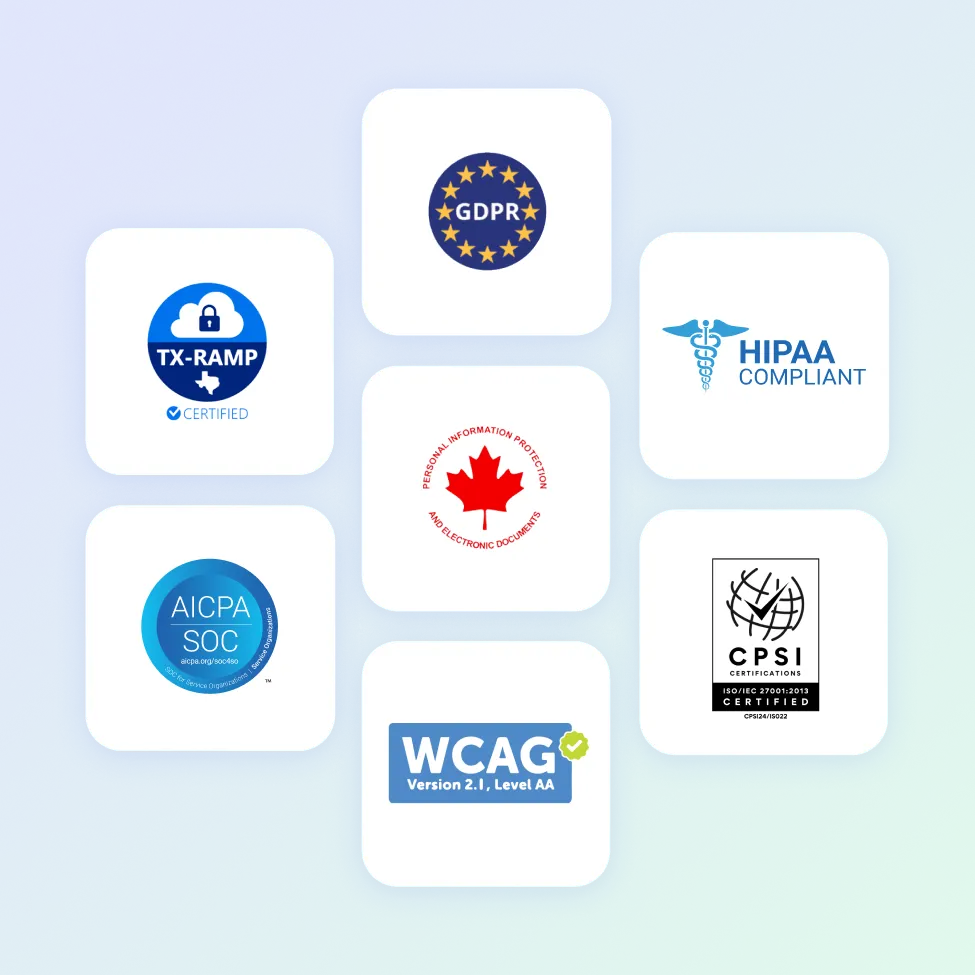
Comm100 is a Vancouver-headquartered Canadian company running on Canadian-hosted cloud infrastructure, which keeps citizen data inside Canadian jurisdiction. The platform carries SOC 2 Type II and ISO 27001 certification and is fully PIPEDA compliant, and every citizen-facing interface is built to WCAG 2.1 AA. These capabilities support the requirements your agency has to meet; they do not take the place of the compliance obligations your agency itself carries.
Certifications that cover the whole platform
The certification list runs past SOC 2 Type II and ISO 27001 to cover PIPEDA, GDPR, PCI DSS, and TX-RAMP obligations. None of it is scoped to one product; the attestations hold across everything Comm100 ships. Ask, and you get the audit reports, the data processing agreement, and the penetration test summary. Browse the complete security and compliance documentation.
Canadian data residency
Canadian cloud customers are hosted on infrastructure located in Canada, so both storage and processing fall under Canadian law. Where sovereignty rules are stricter still, an agency can run the whole platform on-premises, on its own servers, behind its own firewall, with its own IT team in control. Working with a Canadian vendor settles the cross-border transfer question before procurement ever has to ask it.
Built to satisfy FIPPA residency rules
Under Freedom of Information and Protection of Privacy legislation, a public body has to keep personal information stored and accessed inside Canada. Comm100 meets FIPPA requirements through its Canadian-hosted cloud, and agencies that would rather hold everything internally can deploy on-premises within their own environment.
Accessibility is citizen equity
Every citizen-facing interface is built to WCAG 2.1 AA. A person relying on a screen reader or keyboard navigation gets to your service on the same terms as anyone else. An agency answerable for serving the whole public cannot leave accessibility until the end of the build.
Controls sitting under every channel
Encryption protects data on the move and in storage. Access is governed the way an IT team expects: single sign-on over SAML or LDAP, two-factor authentication, permissions tied to role, logins limited by IP, and a full audit trail of what each agent did. A breach costs a public body years of credibility, so these controls sit active beneath every channel from day one.
Resolve Routine Inquiries Without Adding Headcount
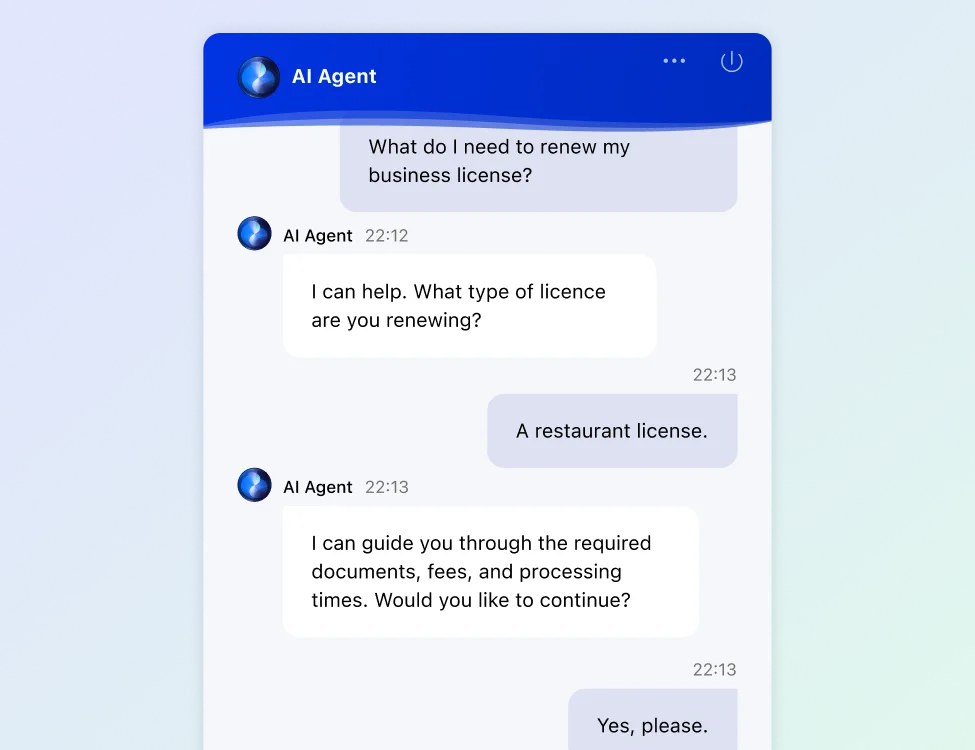
The Comm100 AI Agent resolves up to 80% of routine citizen inquiries automatically, including questions about application status, eligibility, office hours, form requirements, and other common, repetitive topics. Resolution at first touch shortens the wait for everyone else in line and lowers cost per interaction across the agency.
What gets resolved, and what does not
The AI Agent answers from your published content: policy pages, eligibility criteria, service standards, office hours. It resolves the question or transfers to a person on triggers you define. A citizen with a hardship case reaches a human, and that human already has the conversation history.
Accuracy comes from using trusted sources
The Comm100 AI Agent answers from your verified sources rather than from a model’s pre-trained memory. For a public body, a confidently wrong answer about eligibility is worse than no answer at all, which is why grounding matters more here than raw fluency.
The rate climbs as your content improves
Comm100 reports on the questions the AI Agent could not answer and the replies citizens rated poorly. Each gap you close raises the resolution rate. The number you see in month one is a floor.
AI That Supports Public Servants
Comm100 is people-first by design. AI customer service software carries the repetitive volume. Your people carry the cases where judgment, empathy, and discretion decide the outcome. That division is the reason to automate, and the limit on how far automation should go.
AI Copilot works beside your agents
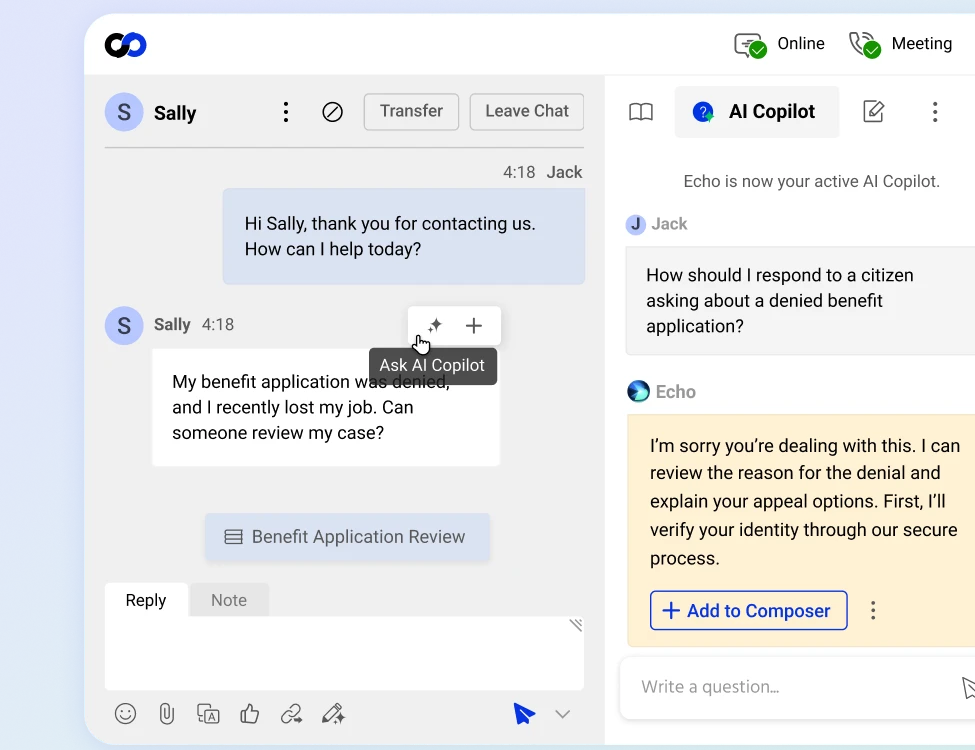
AI Copilot suggests responses, surfaces the right policy article, and drafts conversation summaries while an agent is still typing. A new hire answers closer to the standard of a twenty-year veteran. The public servant still decides what to send.
The hard conversations stay human
A citizen appealing a denied claim needs a person. So does someone navigating a benefit during a hardship, or a caller who needs an accommodation. Comm100 clears the routine volume so those conversations get the time they deserve.
Your team grows more capable
Agencies rarely have the option to add headcount. Comm100 raises what the existing team can handle: more citizens served, shorter waits, and fewer hours spent repeating the same answer. The people stay. The queue shrinks.
What to Weigh When You Shortlist a Vendor
Procurement teams need criteria they can defend to an oversight body. Six dimensions decide whether a citizen service platform fits a Canadian agency. The first one eliminates most of the field, so work through them in order.
Data residency
Ask where citizen data is stored, processed, and backed up, and under whose jurisdiction it falls. A vendor headquartered outside Canada introduces cross-border transfer questions that a Canadian vendor does not. Get the answer in writing before the demo.
Accessibility
Ask for the conformance level, not a general commitment. WCAG 2.1 AA is the working standard for citizen-facing interfaces. Ask which parts of the product were tested and when.
Deployment flexibility
Cloud suits most agencies. Sovereignty rules, legislative mandates, or an air-gapped network make on-premises the only workable answer. Confirm the option exists before a mandate makes it urgent.
Pricing transparency
Use the AI Agent ROI Calculator to get an accurate estimate of how much you’ll be paying for deploying the AI Agent.
Time to launch
Ask how long a comparable agency took to go live, and who did the work. Government call center software that needs a developer every time a routing rule changes will not survive a staffing change. Look for no-code configuration your own team can run.
Government references
Ask for agencies of your size, in your jurisdiction, with outcomes you can verify. A reference from a different sector and a different country tells you very little about your own procurement.
Where Comm100 fits
Comm100 covers all six: Canadian data residency, WCAG 2.1 AA interfaces, a choice of cloud or on-premises deployment, no-code configuration, a dedicated customer success team rather than a self-service portal, and Canadian government references including Global Affairs Canada. It is citizen engagement software built for the constraints a public body actually works under. See the full range of government customer service software capabilities.
Government Customer Service Software: Common Questions
What is government customer service software?
Government customer service software is an omnichannel platform that unifies citizen conversations across live chat, AI agents, voice, email, and ticketing in a single agent console. It gives public servants one complete view of every interaction, across departments, rather than a separate tool per channel. Comm100 delivers that unification alongside Canadian data residency and WCAG 2.1 AA accessibility.
How does AI improve government customer service?
AI customer service software resolves the high-volume, low-judgment inquiries that dominate a public-sector queue, such as application status, eligibility criteria, and office hours. The Comm100 AI Agent resolves up to 80% of routine inquiries automatically and answers from an agency’s own published content rather than from a model’s memory. Global Affairs Canada handles 78% of incoming chats this way.
Does Comm100 support Canadian privacy laws like PIPEDA and FIPPA?
Comm100 is a Canadian company headquartered in Vancouver and is fully PIPEDA compliant, with Canadian-hosted cloud infrastructure that keeps data under Canadian jurisdiction. For public bodies subject to FIPPA, Comm100 supports the in-Canada residency requirement through Canadian hosting or on-premises deployment. The residency obligation sits with the public body; Comm100 provides the deployment options that let it be met.
Can the platform be deployed on-premises for data residency?
Yes. The entire Comm100 platform, including AI Agent, live chat, ticketing, and knowledge base, can run on an agency’s own servers, behind its own firewall. On-premises deployment is designed for organizations with strict data residency, data sovereignty, or air-gapped network requirements, and is used by government agencies today.
Does Comm100 meet WCAG accessibility requirements?
Yes. Comm100 builds its citizen-facing interfaces to WCAG 2.1 AA, so people using screen readers, keyboard navigation, or other assistive technology can reach support on equal terms. For an agency answering to accessibility legislation, the conformance level is the detail that matters in procurement.
How long does implementation take?
It depends on your channels and content rather than on lengthy build work. The AI Agent trains on your existing website content, uploaded documents, and knowledge base instead of hand-built scripts, and routing and workflows are configured through no-code screens. Comm100 assigns a customer success team and can scope a realistic timeline for your agency during a demo.
See Comm100 in Action for Your Agency
Comm100 gives Canadian agencies a people-first, AI-powered omnichannel platform with Canadian data residency, WCAG 2.1 AA accessibility, and a choice of cloud or on-premises deployment. Bring your channels, your compliance checklist, and your busiest queue, and we’ll show you how it fits.