
How to Improve Student Support Services in Higher Ed

Today’s students are CX-indulged.
Thanks to technology, newer generations, especially Gen Z (born between 1997 and 2012) are accustomed to first-class customer experiences, enjoying exceptional levels of convenience, speed, and personalization.
Tools like ChatGPT, Claude, and Perplexity have shifted the baseline. Students now expect answers in seconds, not days. Without student support that meets this bar, schools risk losing prospective applicants at the inquiry stage and current students at every point from registration to graduation.
This guide shows you exactly how to bridge that gap. You’ll learn which digital channels matter most to students, how to implement them without overwhelming your team, and why some schools are able to automate up to 55% of all chats, while keeping service scores high.
The solution isn’t more staff or longer hours. It’s smarter systems that meet students where they already are.

Discover How Comm100 Supports Higher Ed Institutions
Explore how colleges and universities are using Comm100 to deliver fast, personalized, and always-on student support across every stage of the student journey.

CHAPTER 1The Importance of Student Support Services in 2026
Student support services directly impact your institution’s success metrics: retention rates, graduation outcomes, and student satisfaction scores. When students can quickly access the help they need, they stay enrolled and engaged. Here’s where effective support makes the biggest difference:
- Academic Support: Tutoring, writing centers, and study workshops that keep students on track academically.
- Mental Health Services: 76.4% of students report experiencing moderate or high levels of stress within the last 30 days, according to ACHA-NCHA Spring 2024 data. Counseling and mental health services help address this.
- Career Services: Resume help, internships, guidance counseling, and job placement that improve post-graduation employment rates.
- Disability Services: Accommodations and adaptive technology ensuring equal access for all students.
- Cultural Integration: Programs helping international and underrepresented students connect with campus community.
- Financial aid: Services related to financial assistance, including scholarships, bursaries, grants, and other financial support.
The fact is that comprehensive support services create measurable improvements in retention, satisfaction, and graduation rates. Schools that invest in robust support systems see students who are more likely to complete their programs and recommend the institution to others.
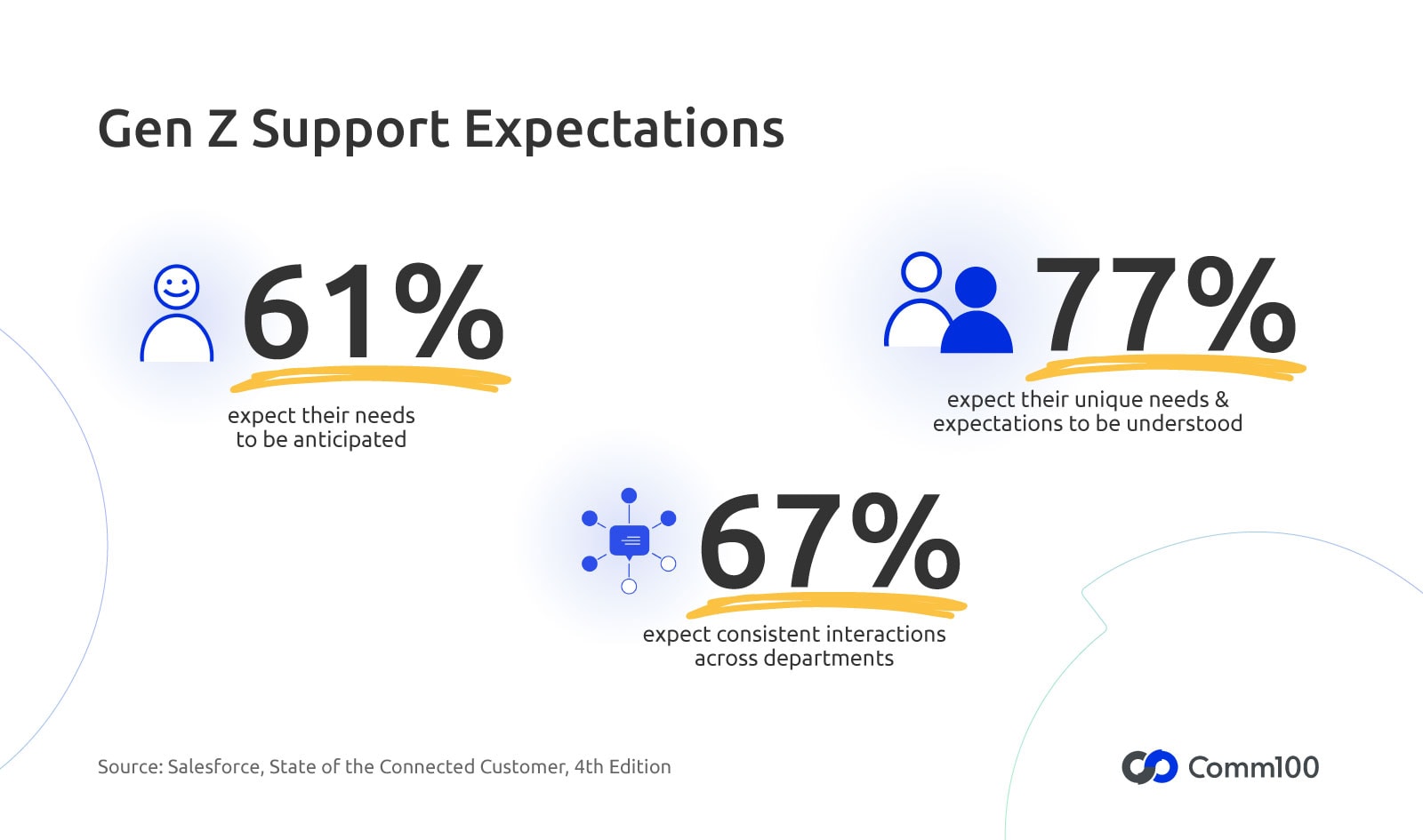
When it comes to support expectations, students hold a high bar. With technology at their fingertips, they have become accustomed to seamless digital experiences and so expect this same experience in customer service and support. Here are the 4 key expectations Gen Z have when it comes to support:
- Speed – 71% believe that CX can be drastically improved by quick responses
- Convenience – 74% of Gen Z say convenience is more important than brand
- Personalization: 61% of Gen Z expect their needs to be anticipated
- Helpfulness: 77% of Gen Z expect their unique needs and expectations to be understood.

Transform Your Student Support with Comm100
Deliver faster, smarter, and more personalized support that today’s students expect—without increasing your workload.
1. Students Expect: Fast & Convenient Support
The solution: Live Chat
71% of 16-24 year-olds believe that CX can be drastically improved by quick responses.
Live chat has become the gold standard for student support because it delivers what students expect most: immediate answers. When a student can’t log into their course portal at 11 PM or needs clarification about financial aid deadlines, they want help now, not tomorrow.
This expectation isn’t unreasonable. Today’s students grew up with instant messaging, real-time notifications, and on-demand everything. They’ve never known a world where getting information meant waiting days for an email response or being put on hold for 20 minutes.
Live chat meets students where they already are. With students spending almost 74% of their free time in messaging apps and online platforms, chat feels natural and familiar. It’s the same interface they use to communicate with friends, making it the lowest-friction way to get help from your institution.
“Our students are mostly 17, 18 or 19 years old, and they naturally find live chat very easy to use. It’s also very quick for them – they can hop on a chat, ask us a question, and have their answer in a minute – all from their mobile device. It’s the perfect channel to help us engage with them and give them the support they need.”
Derek Gaucher, Coordinator of IT Solutions, Dawson College
Read the full story: Dawson College Holds Virtual Open House with Live Chat & Video Engagement
Smart institutions take live chat efficiency even further with an integrated Knowledge Base and AI Agents. Instead of agents juggling multiple windows to find answers, everything they need appears directly in the chat console.
Agents can leverage an AI Copilot to monitor conversations in real-time and instantly surface the right information, suggesting viable answers, and even drafting complete responses for agents to review and send.
The result? Response times drop from minutes to seconds. Students get accurate answers faster, and your support team can handle more conversations without feeling overwhelmed.
2. Students Expect: Immediate, 24/7 Response
The solution: AI Chatbots
99% of students think it’s at least somewhat important for schools to offer 24/7 support.
Your students don’t keep business hours. They’re researching financial aid at midnight, trying to register for classes on Sunday, and panicking about assignment deadlines during spring break. If your support team isn’t available, those students are stuck.
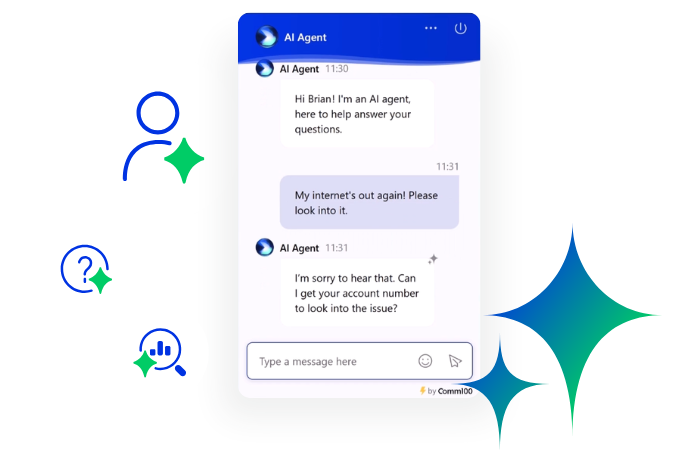
AI chatbots or AI agents solve this problem without doubling your payroll. These aren’t the clunky chatbots of five years ago that could barely handle “What are your hours?” You can now create different types of AI agents that understand complex questions, remember conversation context, and can actually complete tasks for students.
The numbers back this up. In our higher education survey, 95% of students said they’re open to getting help from AI agents. They don’t care if it’s human or AI as long as they get the right answer quickly. Some of the ways AI agents can help students include:
- Course registration troubleshooting: Walk students through error messages, waitlist processes, and prerequisite requirements
- Financial aid calculations: Help students understand their aid packages, payment due dates, and available loan options
- Transcript and grade access: Securely provide academic records and explain GPA calculations
- Appointment booking: Schedule meetings with advisors, counselors, and department staff across multiple calendars
- Application status updates: Check admission, housing, or scholarship application progress in real-time
- Campus logistics: Provide building locations, office hours, parking information, and event details
- Emergency communications: Instantly notify thousands of students about closures, alerts, or urgent policy changes
- Basic IT support: Help with password resets, WiFi connections, and learning management system access
- Payment processing: Assist with tuition payments, payment plan setup, and billing questions
Automate Student Support with AI
Handle up to 80% of incoming student questions instantly and accurately — from course registration to IT help — with Comm100’s powerful AI Agent.
The biggest benefit is that AI agents are available to assist students 24/7. This can be particularly important when you want to engage students international students, as AI chatbots can also send messages at key moments of a student’s journey to assist and nudge them along in the process.
3. Students Expect: Support on the Channels They Use Most
The solution: Live Chat on Social Media
97% of students use social media, with those at university the most active of all students.
It won’t come as a shock to hear that students spend a lot of time on social media platforms. However, despite schools knowing this, student support in higher education is often neglecting this channel. While 98% of schools use social media, the majority use it to improve brand awareness, image, and engagement, while missing out on one of its most important uses; as a support channel.
Your students are already on Instagram, TikTok, WhatsApp, and Discord. They’re messaging friends, following campus accounts, and engaging with content daily. So why are you forcing them to call a phone number or fill out a web form when they need help?
Meeting students on their preferred platforms isn’t just about convenience — it’s also strategic. When a prospective student has a quick question about application deadlines, they’re more likely to send a direct message on Instagram than navigate to your website’s contact page. When current students need help with course registration, they’ll reach out through the platform they’re already using.
The platforms that matter most to students keep evolving, but the principle stays the same: be where your students are. More on this on the next point.
4. Students Expect: Helpful & Personalized Support
The solution: Omnichannel Student Support
77% of students want support staff to remember previous conversations they’ve had.
So far, we’ve outlined what students want: instant answers through live chat, 24/7 AI agent support, and help through the social media platforms they already use. Most administrators hear this and immediately think about the operational nightmare it would create.
Many schools would shudder at the mere thought of offering all of these channels, worrying that some, if not all, of the following are true:
- “We can’t manage Instagram DMs, live chat, email, and WhatsApp without doubling our staff size.”
- “More channels just means more volume we can’t handle with our current team.”
- “Our agents won’t know if a student already contacted us through email when they message us on Facebook.”
- “The technology costs alone would blow our budget.”
These concerns are valid if you’re thinking about managing each channel separately. Imagine this scenario: A student emails your admissions office about transfer credits on Monday, then messages your Instagram account about the same issue on Wednesday because they haven’t heard back.
Meanwhile, they also start a live chat on Friday asking about housing deadlines. Your email team, social media manager, and chat agents are all working in isolation, and none are aware of the full context.
This creates exactly what students hate most: repeating their information multiple times and getting inconsistent answers.
An omnichannel communication platform like Comm100 solves this by connecting everything into one unified system. When that same student contacts you through any channel, your agents immediately see the complete conversation history.
Here’s what this looks like in practice:
- Unified agent workspace: One console shows all conversations from every channel, so agents never miss context
- Complete student profiles: Agents see previous interactions, account status, and relevant student information regardless of how the student contacted you
- Seamless handoffs: A conversation started on Instagram can continue via live chat without the student repeating their question
- Consistent responses: Your knowledge base and response templates work across all channels, ensuring students get accurate information every time
Bridge the Student Support Gap with Omnichannel Service
Connect every channel into one platform to deliver fast, consistent, and personalized support.
The impact on student experience is dramatic. 74% of Gen Z say they prefer personalized products or services, yet only 32% feel like they are being treated as a unique individual. An omnichannel approach bridges this gap by giving agents the context they need to provide truly personalized support.
5. Students Expect: Help Without Long Wait Times in Person
Most live chat and AI conversations don’t require an in-person visit. But some do. Financial aid disputes, registrar questions about transcripts from another country, advising sessions for students on academic probation. These conversations need a person across the desk.
The problem isn’t that students need to come to the office. It’s that the line at the financial aid window during registration week stretches around the building, and students burn an hour or more standing in it. They miss class. They give up. They come back the next day to do it again.
Queue management software lets students join the line from anywhere (their dorm, the library, a coffee shop) and get a real-time notification when their turn is approaching. They use that waiting time however they want instead of standing in a hallway. When the alert comes through, they walk over.
Schools that use queue management report shorter physical lines, lower no-show rates, and higher student satisfaction in the offices that handle the heaviest in-person traffic. The University of British Columbia International, for example, used Comm100 Queue Management to remove the requirement for students to share a phone number to join the line, and to control the language and format of queue notifications. Both were dealbreakers with their previous platform.
Queue management also pairs with Comm100 Booking for advisors and faculty who take appointments. A student can book a 15-minute meeting with their academic advisor through the same system that handles walk-ins, and the advisor sees both queues in one view.
6. Students Expect: Help in a Mental Health Crisis
A student messaging your support team about a missed deadline at 2 AM might also be a student in crisis. The two questions look identical in a chat window until they don’t.
Your support setup needs to route these conversations correctly. That means three things working together: AI agents trained to recognize signals (specific phrases, escalation patterns, mentions of self-harm or suicidal ideation), a clear handoff path to a human counselor or crisis line, and agent training on what to do when AI flags a conversation for human review.
This isn’t about turning your support team into mental health professionals. It’s about making sure that when a student types something concerning into a chat window, whether about an assignment, about housing, or about anything else, your system surfaces it to someone who can help, fast.
For students contacting support outside business hours, AI agents should be configured to recognize crisis indicators and respond with a direct path to your campus crisis line, the 988 Suicide and Crisis Lifeline, or your country’s equivalent. Comm100’s AI Agent supports custom routing rules that trigger handoff to specific teams or external resources based on conversation content.
A note on what not to do: AI should never attempt to provide mental health counseling itself, and your support workflow should not require a student in distress to click through menus or wait in a queue. The fastest path to a human is the only acceptable design here.
7. Students Expect: Support That Works for Every Student
Accessibility isn’t a checkbox at the end of a procurement process. For roughly one in five undergraduates, it’s the difference between getting help and not getting help.
Your support tools need to work for students who use screen readers, students who can’t use a mouse, students with low vision, and students who rely on captions. In practice, this means:
- Live chat interfaces that conform to WCAG 2.1 AA standards, including keyboard navigation, screen reader compatibility, and color contrast that holds up for low-vision users.
- Transcript options for voice-based support, so deaf and hard-of-hearing students aren’t pushed off your phone line and onto a slower channel.
- Multilingual AI agents for international students, with handoff to human agents who speak the same language when needed.
- Alt text on images embedded in knowledge base articles, so visually impaired students can use self-service tools.
Comm100 maintains accessibility standards documented on its accessibility page, and Canadian institutions specifically need to confirm their support vendor meets AODA requirements for the province of Ontario. International students also need multilingual coverage. Comm100’s AI Agent and Live Chat both support multilingual conversations with auto-translation between agent and visitor.
If your current support stack fails an accessibility audit, you have a problem that gets bigger every year as your enrollment becomes more diverse.
8. Students Expect: Answers Without Asking
Most student questions have already been answered. What’s the deadline for course add/drop? Where do I find my financial aid disbursement schedule? How do I appeal a parking ticket?
These are the questions that flood your inbox every September and January. They have correct, stable answers. They don’t need a human to type them.
A self-service knowledge base solves this if, and only if, it’s kept current. A knowledge base full of articles from 2019 referencing deadlines that no longer exist creates more frustration than it removes. Students stop using it. Agents end up answering the same questions anyway.
This is where Comm100 AI Knowledge helps. It runs automated audits on your knowledge base, flags articles that haven’t been updated, analyzes chat conversations to identify questions your existing articles don’t answer, and generates draft articles to fill those gaps. The result is a knowledge base that gets better over time instead of decaying.
When students can find what they need on their own, your support team gets back time to spend on the conversations that actually require a human.
Comm100 Knowledge Base integrates directly with the AI Agent, so the same content powers your chatbot, your help center, and the answers your live agents see in their console.
9. Students Expect: Consistent Quality, Every Time
Your support team handles thousands of conversations a month. Maybe tens of thousands during registration and admissions peaks. How do you know whether the answers your students are getting are actually correct?
In most schools, you don’t. A QA lead might spot-check a handful of chats per week and write up trends in a Friday report. The rest go unreviewed. If an agent is consistently giving incorrect information about a financial aid policy, you find out when a parent calls the dean.
Comm100 AI Quality Assurance reviews conversations against criteria you define (accuracy, tone, policy compliance, escalation handling) and flags the ones that need human review. It also surfaces patterns across your team: if multiple advisors gave the same wrong answer about transfer credits this week, AI QA flags it as a coaching opportunity instead of letting it slide.
This pairs with Comm100 AI Insights, which analyzes conversation content at scale to surface trends in what students are asking about, where they’re getting stuck, and which support topics are growing or shrinking week over week. For higher ed teams that need to report up to a dean or VP, AI Insights gives you a defensible answer to “what’s actually happening on the front lines this semester?”
CHAPTER 2Reconciling the Student Services Expectation Gap
The importance of student support services across the board can’t be stressed enough. The quality of student support can be the decider for admissions to graduation rates and everything in between. However, students’ high expectations have exposed gaps in the student support service capabilities of many universities and colleges.
- Students cannot get support quickly with basic phone or email support
- Students are limited to office hours and/or waiting for long periods for reply
- Students have to use inconvenient channels to get support
- Support staff are overwhelmed with manual processes needed to support student inquiry volume
- Support staff are not trained adequately to manage support tools
- Security is compromised with inadequate support systems in place.
Most leaders of student support in higher ed recognize some, if not all, of the gaps above in their own operations. In a 2012 Academic Impressions survey, only 6 of 79 higher education professionals graded their institution’s customer service with an ‘A.’
The good news is that closing the gap doesn’t require hiring a bigger team. It requires the right combination of tools: live chat for fast answers, AI agents for 24/7 coverage, queue management for in-person traffic, accessible interfaces for every student, a current knowledge base, and AI-driven QA to keep quality consistent at scale. Schools that put these pieces together, including McMaster University’s Faculty of Health Sciences and the University of British Columbia International, see measurable gains in student satisfaction and team capacity.
What Good Looks Like: 2026 Benchmarks for Higher Ed Support
The 2026 Comm100 AI Live Chat Benchmark Report, which analyzed over 220 million live chat interactions across 18 industries, offers the following benchmarks for higher education:
- AI Agent chat handling rate (all industries): 75.3% of chats handled by AI Agents.
- AI Chatbot-to-agent handoff CSAT: 92.6%.
- Wait time reduction (large teams): 37.5%.
- AI Chatbot satisfaction lift: +9.1%.
These aren’t aspirational targets. They are what’s already being delivered by support teams using a properly configured AI and live chat stack today. Higher ed teams looking to benchmark their own performance against industry-specific data should download the full report, which breaks out figures by sector.
4 Ways Live Chat Can Make Education More Inclusive
Live chat has a lot of different functionality that dyslexic students can utilize, making it one of the most versatile assistive learning technologies. Here are some ways those in education can use the software to make education more inclusive.
1. Live chat tools can be used to proofread
One of the biggest things dyslexic students struggle with is spelling. AI-powered chatbots can help with this, as students will be able to copy and paste a written passage and get it proofread in real-time. This allows them to improve their spelling and grammar at any time, enabling those with dyslexia to self-monitor and quality-check their work.
In addition to proofreading entire passages, live chat can also be used to help improve vocabulary by suggesting better words and synonyms. This can allow dyslexic students to express themselves better, communicate clearly, and create more engaging written content.
Besides live chat, dyslexic students can use other advanced technology like speech recognition software, text-to-speech apps, touch typing hardware, and more to help with their writing.
2. It offers 24/7 support
Often in education, a dyslexic student only has access to support from staff and lecturers during school or college hours, making completing homework or after-school study much more challenging. This is no longer the case with live chat.
With the technology, dyslexic students can access support anytime, either by getting help through AI or by contacting a live agent who can help with queries. With 24/7 access, dyslexic students can build study routines that work around their lives and obtain support whenever needed.
As well as this, live chat can also be used to connect struggling dyslexic students with mental health support and college counseling, making it a great feature of the application.
3. It allows easy access to information
When searching for specific information, such as statistics, to help with an essay, a dyslexic individual may become overwhelmed if there’s a lot of content to shift through on a website or module. This can be demotivating, cause stress, and make finding this information much harder.
With live chat functionality built into a website or learning application, a student can instead ask for the information they’re looking for within the chatbox, which will search the website to provide reliable information. This helps boost the accessibility of the content and allows students to engage with topics and subjects that interest them.
4. It builds confidence
Although getting support from teaching assistants and other professionals can help those with dyslexia, being tended to as someone that requires this support can impact self-esteem and confidence. Often, those with dyslexia don’t want to feel different or show that they’re struggling, so they may also not want to ask for support.
Live chat can fix this, as it’s a lot more discreet and independent. With this technology, students are empowered to request and find support whenever needed, giving them the agency to engage with their studies.
For example, a student can better keep up with a class or module by dipping into the live chat feature to help them out instead of asking for help in person. This prevents them from feeling isolated, aiding with their confidence.
Next steps
To improve your student support services and match what students expect in 2026, book a demo with Comm100’s specialists.
Comm100 brings live chat, AI Agent, AI Copilot, AI Knowledge, AI Quality Assurance, ticketing, queue management, knowledge base, voice, and booking into one platform. It is SOC 2, HIPAA, PCI DSS, and ISO 27001 certified, and offers on-premise deployment for institutions that need full control over student data residency. Schools using Comm100 include McMaster University’s Faculty of Health Sciences, the University of British Columbia International, California Southern University, and Stanford.
Explore Live Chat & AI Solutions
Book a 30-minute, obligation-free demo with our specialists to discover how Live Chat, AI Agent, AI Copilot and AI Insights can benefit your business.
There’s a lot more where this came from!
Get our monthly customer service news and best practices update delivered to your inbox.

Article by
Kate Rogerson
Kate is the Content Marketing Specialist at Comm100. She has extensive experience in content creation for technology companies across the world, including the UK, Australia and Canada. She specializes in B2B messaging, branding and soccer trivia.